Leaves on a StreamEmotional Fitness · ~3 min
About this template · Updated September 2026
If you typed stress quiz into a search bar, you probably want an answer to one question: how stressed am I? Most online stress tests reply with a number, a band and a color. The number looks tidy, but it rarely tells you what to do differently on Tuesday.
This page asks a narrower question that turns out to be more useful: where is the stress showing up? For most people it does not stay in one place. It tightens your stomach one week and shortens your nights the next, and it can seep into how you eat and how you answer the people you love.
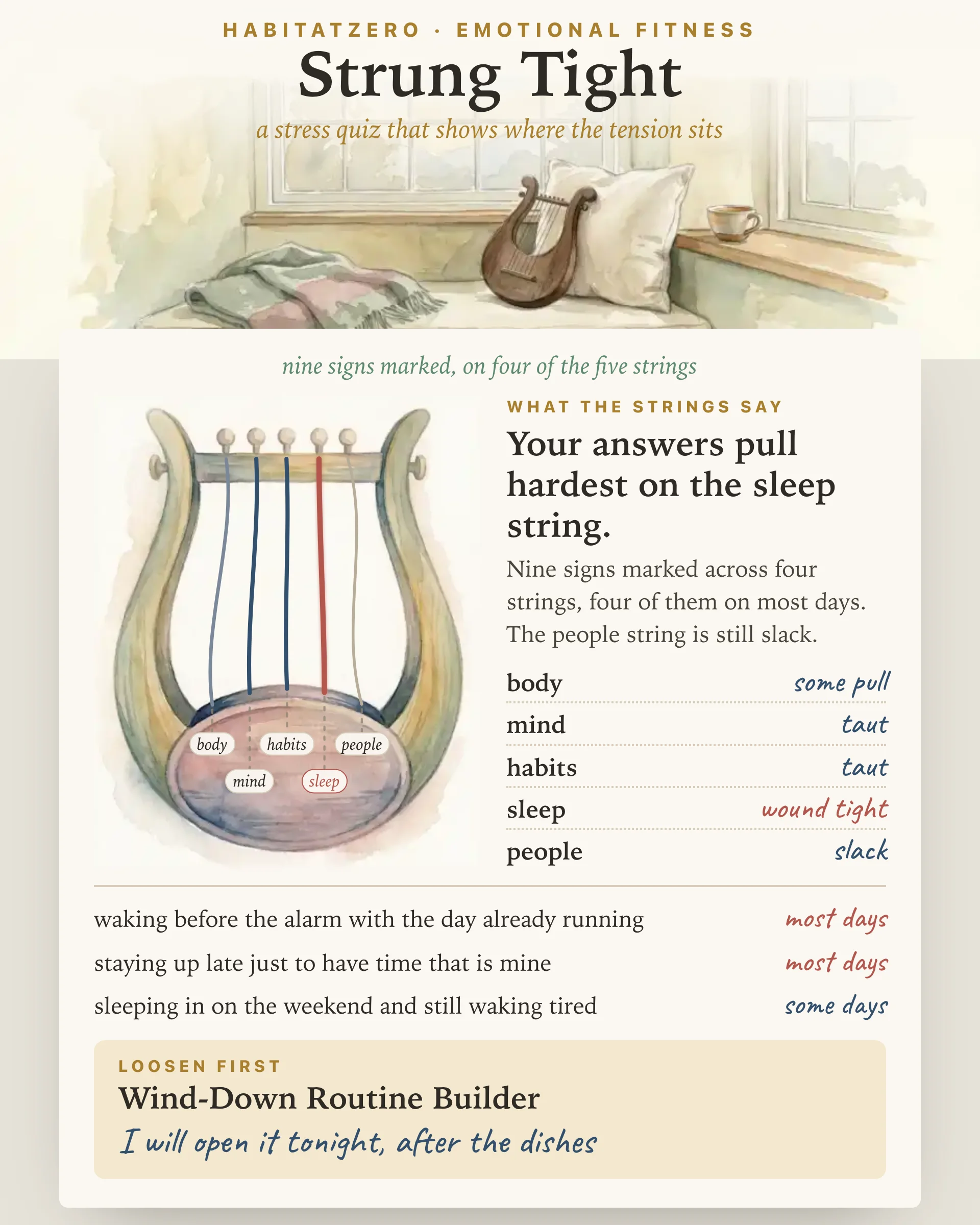
The quiz is drawn as a small lyre with five strings, one for each place stress tends to land: body, mind, habits, sleep and people. Under each string sit four everyday signs, picked because they are things you actually catch yourself doing rather than entries from a symptom checklist. A heart that jumps when the phone buzzes. Walking into a room and forgetting why. Eating standing up. Waking before the alarm with the day already running. Someone close asking whether you are okay.
Think back over the last two weeks or so. Tap a sign once if it happened on some days and twice if it happened on most days. If the list misses something that is true for you, write it on the line and tap the string it belongs on; each string takes two signs of your own.
Every mark tightens its string. A string with nothing marked hangs slack, and as the marks add up it moves through some pull and taut to wound tight, redrawn on the lyre as you tap. Below the signs, a plain-words reading names the string pulled hardest, counts what you marked and how much of it lands on most days, and notes which strings are still slack.
Then it points you to one tool, matched to the tightest string. Body leads to guided progressive muscle relaxation, mind to a timed brain dump, sleep to a wind-down routine, people to a boundaries worksheet, and habits to Letters From a Calm Day, a plan of buffers you write on a quiet day. When four or five strings pull at once, the reading stops singling one out and sends you upstream to the Stress Relief Worksheet, where you list the pressures themselves. You finish by writing down when you will open the tool, because a named time holds up better than a good intention.
It is not the Perceived Stress Scale, the questionnaire Sheldon Cohen and colleagues published in 1983 to measure how stressful people judge their own lives to be. That scale has been used in research for decades and produces a score. This page has not been validated as a test, keeps no score, and cannot tell you how your stress compares with anyone else's. It gives no verdict either. The same pattern of marks can mean a hard month for one person and an ordinary Monday for another, and only you know which one you are living.
Stress is not only a feeling in your head, and the research bears that out. In a well-known experiment, healthy volunteers answered questions about stress and were then given one of several cold viruses, and their odds of coming down with a cold climbed step by step with their stress. Sleep is another common landing place. A review of the evidence found stress closely tied to shorter, more broken sleep, noted that anticipating a demanding next day seems to be an important part of it, and described short sleep in turn pushing stress markers such as cortisol higher. That two-way loop is why the reading adds a note when your mind and sleep strings pull together: easing either one often gives the other some slack.
These are findings about groups of people, not a diagnosis of you. The lyre is a way to practice noticing, which is the first move in nearly every approach to handling stress, and noticing is easier when the signs are ordinary enough to recognize on a busy Wednesday.
Take the quiz when you feel wound up but cannot say where it is landing, and again two weeks later to see whether the same string is still the tight one. A string that loosens after a week of wind-down evenings is worth knowing about; so is one that stays taut no matter what you try. If the strain is mostly about work and has lasted for months, The Three-Wick Candle looks at burnout instead.
A quiz is practice, not treatment. The National Institute of Mental Health suggests talking to a professional if you are struggling to cope or your symptoms will not go away. If stress has gone on for weeks, gets in the way of sleep or work, or simply feels like too much, a doctor or counselor is a better next step than another quiz.
Stress rarely announces itself by name. It tends to show up sideways, as a headache by late afternoon, an email read three times, dinner eaten over the sink, or a morning that starts before the alarm. Noticing where those signs cluster tells you more than a single number, and it shows where a small change will help first.
Not in any exact way. Most online stress tests turn your answers into a number, and that number depends on the questions asked while saying little about why you feel the way you do. This quiz leaves the number out. It shows where your answers pull hardest across body, mind, habits, sleep and people, and suggests one tool for that place.
No. The Perceived Stress Scale is a research questionnaire by Sheldon Cohen and colleagues that scores how stressful your life has felt over the past month. This page is not that scale, has not been validated as a test, and diagnoses nothing. It is a practice in noticing, built from everyday signs of its own.
When four or five strings pull together, the reading stops pointing at one place and suggests working upstream instead, by listing the pressures themselves and sorting out which ones are in your hands. If stress that widespread has lasted for weeks, or feels like more than you can manage, talk it over with a doctor or counselor too.
You can look through the filled-in example on this page first. To mark your own signs, add the ones the list misses and keep your reading for next time, open the quiz in HabitatZero, which costs nothing.
By the team behind Fabulous, the science-based self-care app used by over 30 million people.