Leaves on a StreamEmotional Fitness · ~3 min
About this template · Updated September 2026
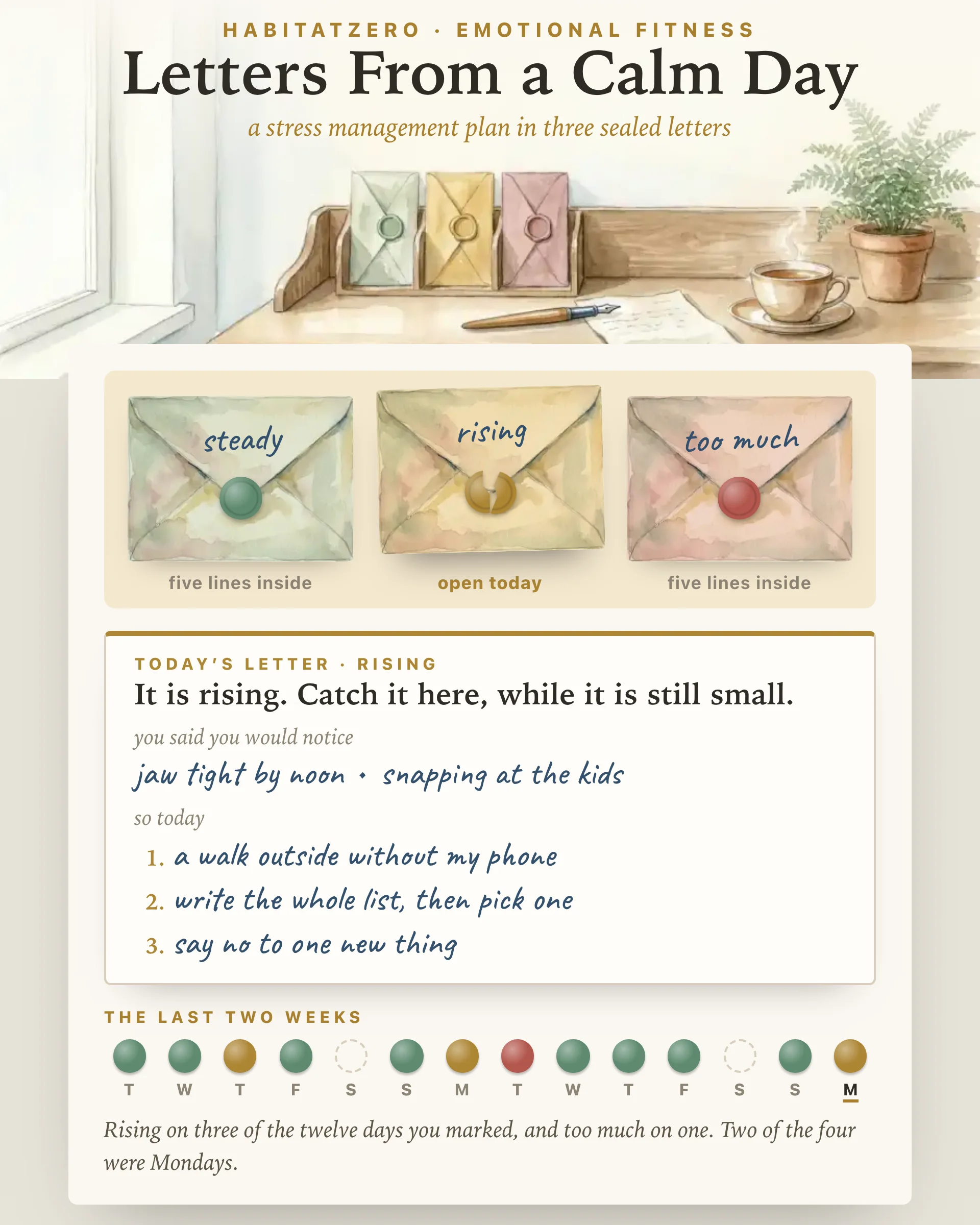
Nobody writes a good plan in the middle of a bad week. Under pressure, attention narrows to whatever is loudest, and what would actually help gets its worst answers: more coffee, one more hour at the desk, one more scroll. A stress management plan fixes the timing. You decide what helps on an ordinary, unhurried day, and on the hard day you only read.
This page keeps that plan in three sealed letters and hands you the one a day needs.
The three stages come from a tool with a long clinical record. People with asthma are often given a written action plan in zones: what to do on a normal day, what to change when symptoms start, and what to do when things turn serious. Reviewing 26 randomised trials, Gibson and Powell found that personal written plans which spelled out when and how to step up treatment, using two to four action points, consistently improved asthma outcomes. Stress is not asthma, and this page has not been tested the way those plans were. What carries over is the shape: personal, written ahead of time, a few clear stages, and a specific action for each.
Each letter opens with suggestions to tap, and anything you write yourself lands in handwriting. The letters stay short on purpose. A buffer holds two lines, the rising letter takes five signs and five moves, and the too-much letter takes four first moves and three names. A full list tells you so and asks you to let a line go, because a plan you can take in at a glance is the only kind anyone reads on a bad day.
Above the letters sit three envelopes. Tap the one that matches today and its seal breaks: the page hands back that stage of your plan and nothing else, so a rising day shows your early signs and your moves rather than a wall of advice. Change your mind later the same day and the mark moves instead of doubling.
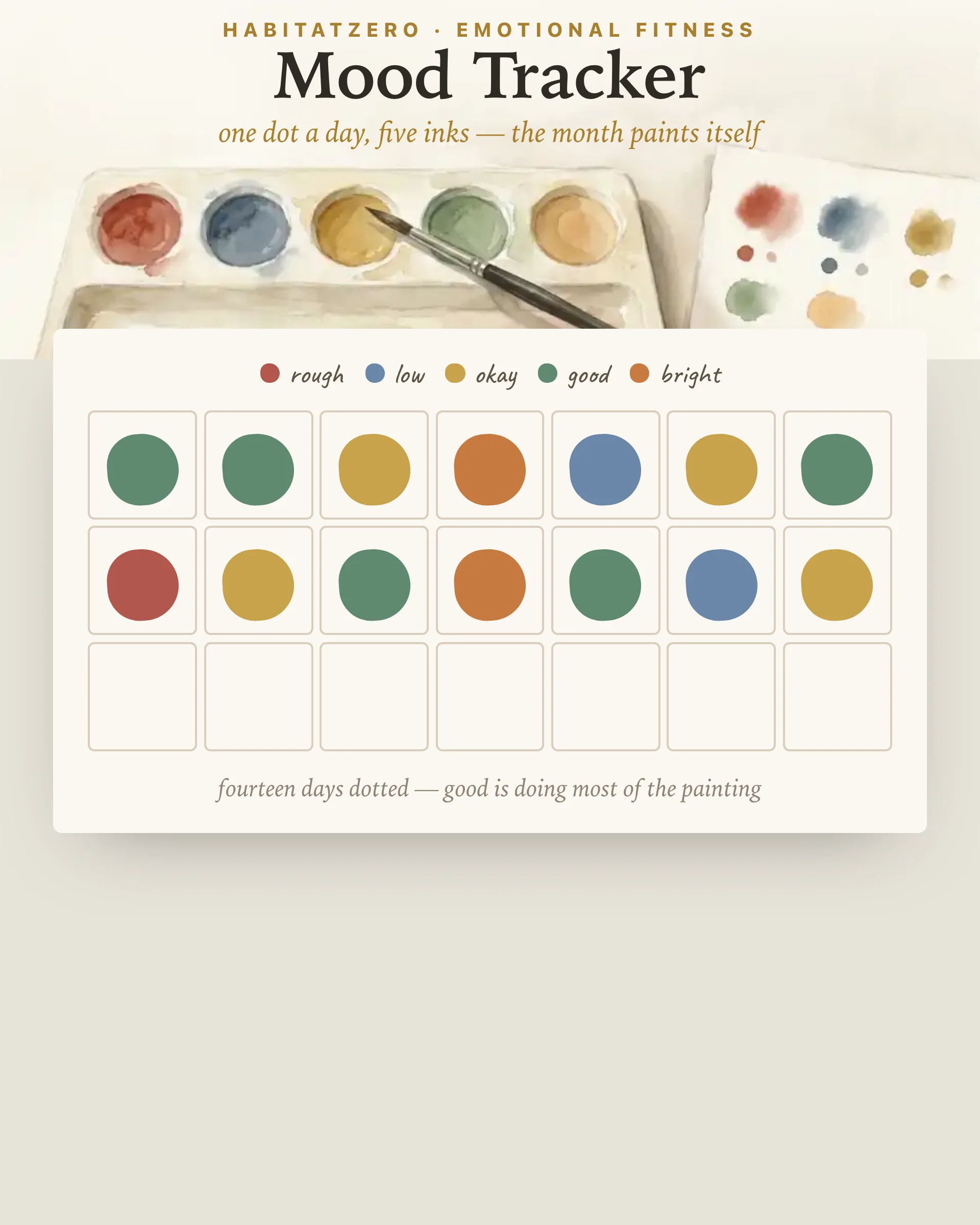
Each day you open a letter goes into a two-week strip. Once a few days are marked, the page reads the strip back to you: how often you were rising, how often it was too much, and which weekdays keep returning. If two of your three hard days were Mondays, that is worth knowing on a Sunday evening. And when too-much days arrive with no rising day before them, the page suggests another look at your early signs.
Handling stress deliberately does measurably help. When Katherine Richardson and Hannah Rothstein pooled 36 experimental studies of workplace stress management programs, covering 55 interventions, they found a medium to large overall effect, with programs built on cognitive-behavioral skills producing larger effects than the other kinds. Those were structured programs run over weeks, not a page on your phone, and the effects they measured were mostly psychological.
The rising letter leans on a second finding. Peter Gollwitzer and Paschal Sheeran reviewed 94 tests of if-then plans, where you decide in advance that when one thing happens you will do another, and found a medium to large effect on reaching goals. An early sign paired with a move is exactly that kind of plan: when my jaw is tight by noon, I take the walk without my phone.
None of this makes the page a treatment. It is a practice for everyday stress. If most of your days land on too much, or stress has been costing you sleep for weeks, take your letters to a doctor or a therapist; they make a practical opening for that conversation.
The too-much letter also carries one line you do not have to write, because a plan for hard days should say plainly where its job ends. If you are in crisis or thinking about hurting yourself, call or text 988 (US) right now, or reach your local emergency number.
Write the letters on a calm day, ideally soon after a hard week, while you still remember what helped and what only looked like it would. Open one each morning, or the moment you catch an early sign. Reread all three once a month and strike out anything you have skipped every time.
If the week is one tangle of pressures, untangle it first with the Stress Relief Worksheet. If the rising letter is short of moves, The Coping Skills Toolbox is a good place to stock up, and The Physiological Sigh is a quick first move worth trying for the too-much letter.
It is a short personal plan, written while life is calm, that says what you will do at each stage of a stressful stretch. Some people call it a stress action plan, after the asthma action plans whose green, yellow and red zones it borrows.
Four things, in the order this template asks for them: the everyday buffers that keep stress low, the triggers and early signs that tell you it is climbing, the moves that bring it down at that point, and the first steps and phone numbers for a day that is too much.
Mostly, yes. A stress reduction plan usually leans on the steady stage, cutting sources of strain and adding recovery, while a management plan also covers what to do once stress is already rising. This page holds both in one set of letters.
The filled example on this page belongs to someone whose rising days tend to fall on Mondays. Their rising letter names a jaw tight by noon and snapping at the kids as the early signs, then a walk outside without the phone and saying no to one new thing as the moves. Yours should be just as specific.
Reading the example needs nothing. Writing your own three letters and keeping the two-week log that spots your hard weekdays happens in HabitatZero, which is free to use.
By the team behind Fabulous, the science-based self-care app used by over 30 million people.