Leaves on a StreamEmotional Fitness · ~3 min
About this template · Updated September 2026
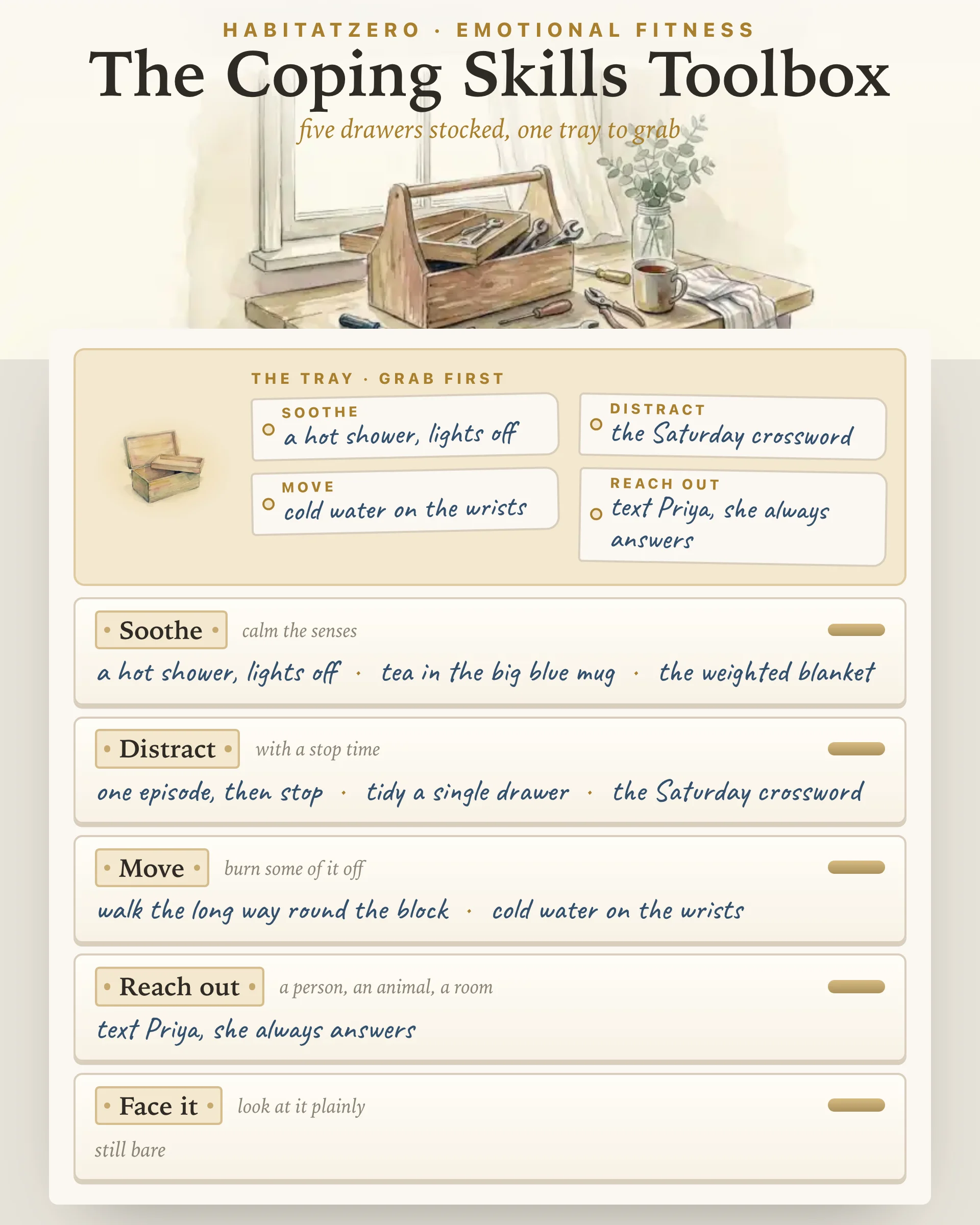
The coping skills toolbox began as a school handout. The version most people meet is the one Purdue Extension's 4-H program still circulates: a box stocked with objects sorted into self-soothing, distraction, opposite action, emotional awareness and mindfulness, so that a student in a bad moment reaches for a stress ball instead of a habit they will regret. It is a good idea with a paper problem. A printed list of categories is still blank, and a blank list is exactly what nobody fills in at nine on a Tuesday night.
This page rebuilds the box as a chest of five drawers you stock by tapping, with one addition the handout cannot make: a tray on top that holds the tool you would grab first from each drawer.
The drawers are named for what they do, because that is the question a hard moment actually asks.
Each drawer opens with a handful of suggestions to tap. Anything you write yourself lands in handwriting. A drawer holds six tools and then asks you to let one go, and a tool can live in only one drawer: try to add the walk to Soothe when it already sits in Move and the sheet tells you where it lives.
It is tempting to fill the drawer you like and leave the rest. The research argues against that. Reviewing the coping literature, George Bonanno and Charles Burton concluded that no single strategy is the healthy one; what predicts doing well is having a range of them and switching to fit the situation. They call it regulatory flexibility. A chest with five stocked drawers is that flexibility made physical.
The drawers also earn their keep at different intensities. In a series of experiments, Gal Sheppes and colleagues found that people choose distraction when a feeling is very strong and reappraisal when it is milder, and they read the pattern as sensible rather than lazy: at full heat, looking straight at the thing is too much, and a crossword is the right tool. Later, when the heat drops, Face it becomes usable. So Distract is not the lesser drawer. It is the drawer for a particular temperature.
There is one caution, and the sheet's reading is built around it. Pooling more than a hundred studies, Amelia Aldao and colleagues found that habitual avoidance and suppression go with more anxiety and low mood, while problem solving and acceptance go with less. A toolbox that is all Distract, opened every time, slides toward avoidance. That is why the line under the title counts your tools, says where the toolbox leans, and names the drawers still bare. It is not a verdict. It is a stock check.
On the day the toolbox is for, you will not read the toolbox. Thirty tools in five drawers is a menu, and a menu asks for a decision you may not have in you. So the tray holds one tool per drawer, pinned while you were calm. Tap to the tray beside a tool and a tag hangs on the tray with the drawer's name and your handwriting. Pin a second tool from the same drawer and the tag swaps; tap a pinned tool again and it lifts off. Five tags at most.
When the moment comes, start at the tray. The only question left is which drawer the moment is asking for, and the tag has already answered the rest.
It is a practice for ordinary hard evenings, not a treatment, and it gives no diagnosis, only a stock count. If the moments you reach for it come daily, land heavily, or frighten you, that is a conversation for a professional, and the stocked toolbox is worth bringing along to it.
Stock it on a steady evening, one drawer at a time, and revisit it when a tool has gone stale. If you would rather keep a plainer list of what steadies you, with a note on when each one works, Coping Skills Worksheets is that page, and the two pair well. For the Face it drawer, 5-4-3-2-1 Grounding is a ready-made tool to pin, and Steadying Practices walks a single hot moment through naming it, pausing, and choosing the opposite move.
A coping skills toolbox is a small, organized collection of the things that settle you, sorted by the kind of help each one gives. The paper versions handed out in schools sort by self-soothing, distraction, opposite action, emotional awareness and mindfulness. This page keeps the drawer idea and turns it into five plain verbs: soothe, distract, move, reach out, face it.
Only tools with a track record on you. A drawer holds six at most, so the warm shower you take every bad week outranks a technique you admired once. Aim for at least one tool in every drawer rather than a full drawer of one kind: the moment that needs company is not the moment that needs a crossword.
Yes. Once the drawers are stocked, print the page and the tray tags plus the five drawers come out on paper with the chips and buttons stripped away. What prints is your toolbox rather than a blank template, which is the difference between this page and most coping skills toolbox PDFs.
Because on the day you need the toolbox you will not read the toolbox. The tray holds one tool per drawer, chosen while you were calm, so the hard moment asks a single question: which drawer. Tap a tool to hang it on the tray, tap it again to lift it off, and pinning another from the same drawer swaps the tag.
The public page shows a stocked example you can read but not change. Signing in to HabitatZero, which costs nothing, unlocks the drawers so your own tools, your pins and the reading under the title are kept between visits.
By the team behind Fabulous, the science-based self-care app used by over 30 million people.