Leaves on a StreamEmotional Fitness · ~3 min
About this template · Updated September 2026
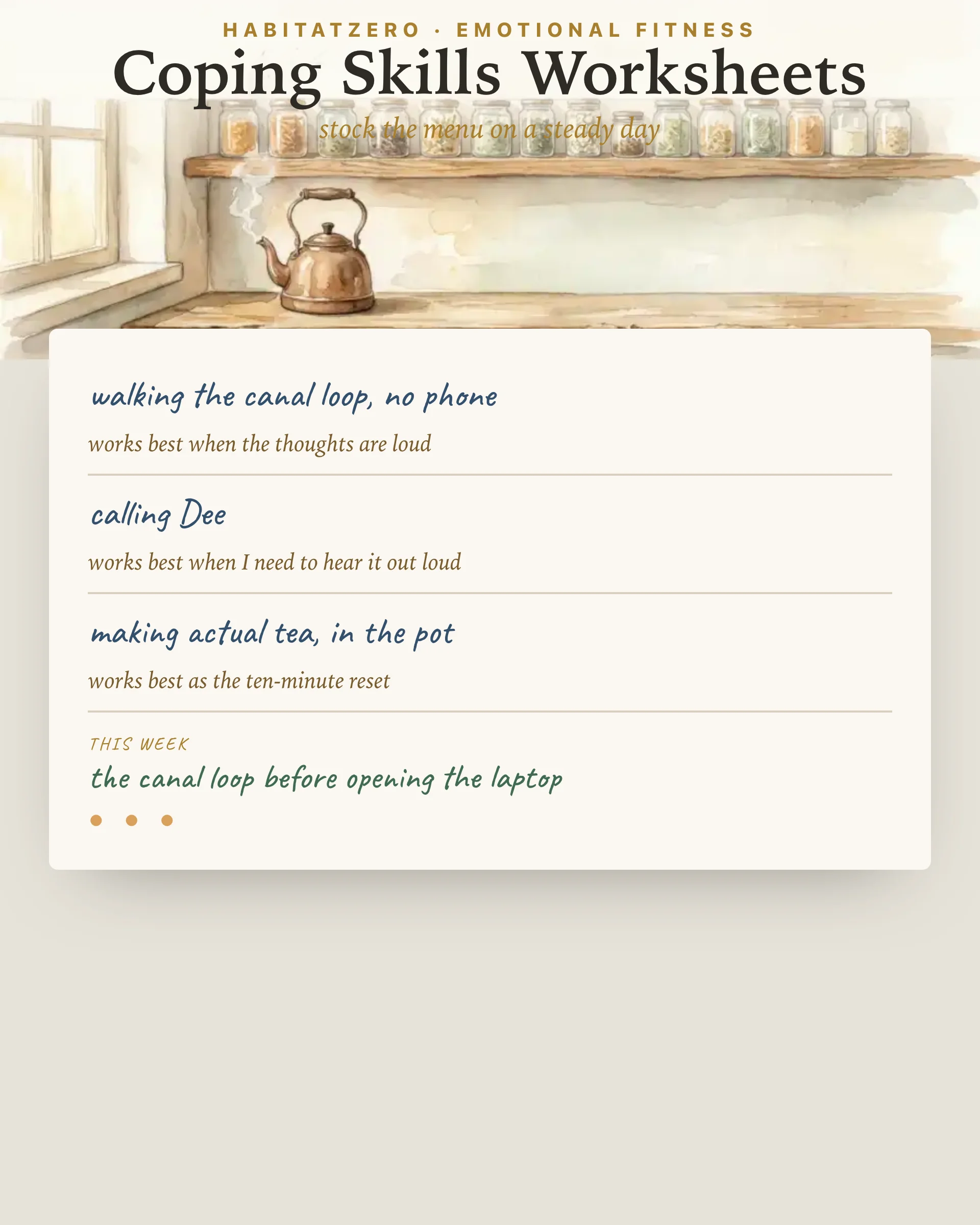
Search for coping skills worksheets and you'll mostly find curricula — laminated lists of techniques someone else validated, waiting to be learned. This page runs the other direction. Psychology's working definition of coping is simply the set of strategies a person uses to manage stressful demands (APA Dictionary of Psychology: coping) — a person's strategies. You already own a set. The worksheet's job is to get it out of your head, onto a page, and within reach before the day it's needed.
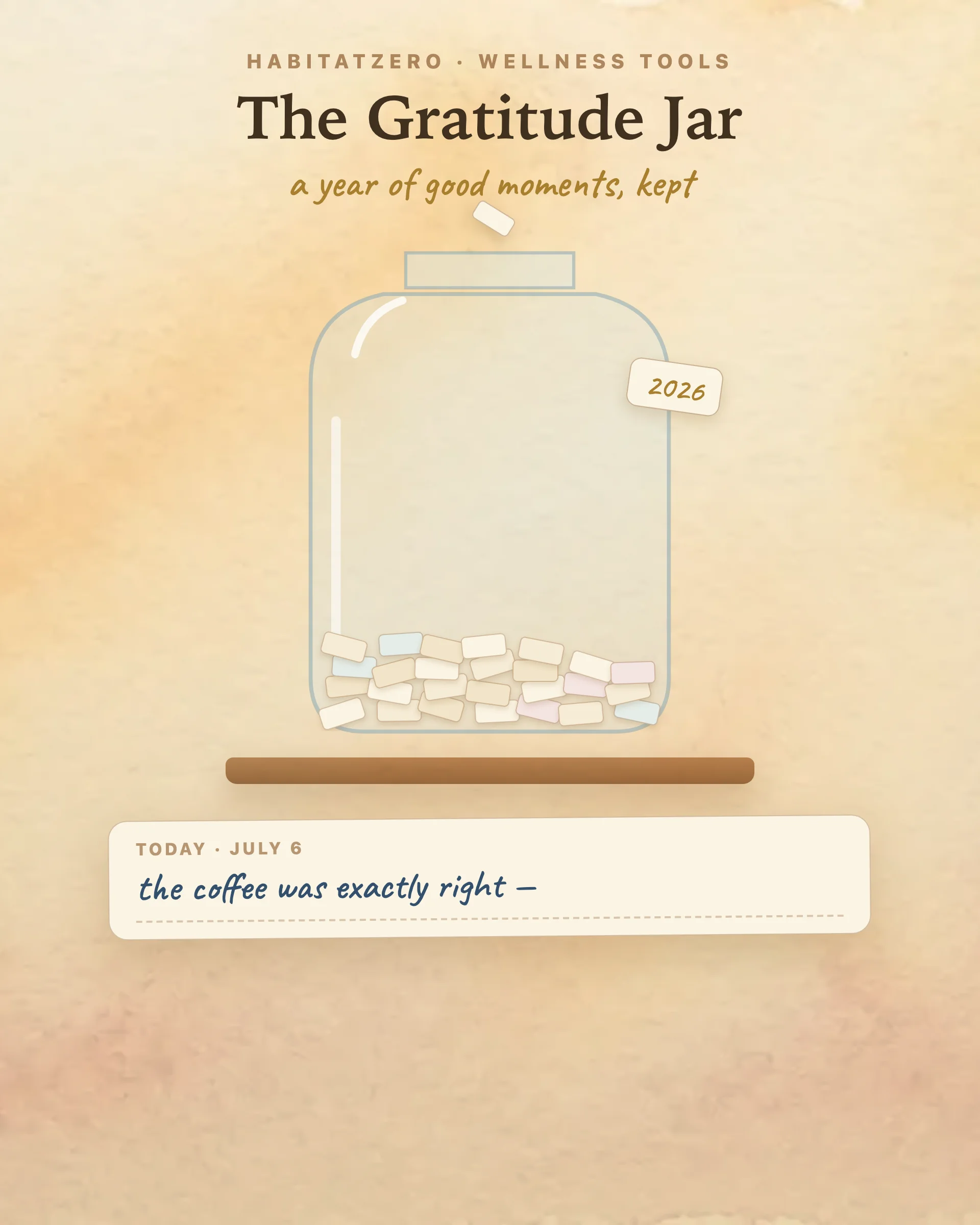
The first section holds up to twelve jars — things that verifiably steady you, written in your words. The long shower with the music on. Walking the canal loop, no phone. Calling Dee. The admission standard is a track record, not impressiveness: if it reliably takes the edge off, it earns a jar.
This matters because the graveyard of coping advice is full of excellent techniques that didn't fit the person holding them. The breathing protocol read about once loses, every time, to the walk actually taken. New tools are welcome — a course or a professional can genuinely expand the pantry — but the menu records what has survived contact with your real weeks, which is the only inventory that answers when the week turns.
Each jar takes a when-note: after people-heavy days; when the thoughts are loud. Matching the steadier to the moment is half the craft, and it's precisely the judgment that isn't available mid-storm. Written on a steady day, it's just pattern recognition; needed on a rough one, it's a label on the right jar.
The second section holds one line — the jar you're practicing this week — and a counter that ticks each time you actually reach for it.
This is the part most coping lists skip, and it's why they fail quietly. Under real stress, people don't lose their strategies; they lose access to them — the remedy sits fully stocked while the evening goes sideways without it. Access is trainable, though, the same way any reflex is: by deliberate, unnecessary repetition. Take the canal walk this week when you only half-need it. Tap the counter. What you're practicing isn't the walk — it's the reaching, so that on the day it matters the decision is already made and the hand knows the way.
A stocked pantry plus a practiced reach: that's the entire method, and it fits on one page in your own handwriting.
A menu you wrote has honest limits, and this page states them rather than blurring them. If the rough moments come often, land heavy, or take real effort to ride out, that's a conversation for a mental-health professional — the menu then becomes a useful supplement to real support instead of a substitute for it. And a moment that feels unsafe is an emergency before it is anything else; no worksheet has a jar for that, and pretending otherwise is the one thing this page won't do.
For the ordinary weather, though — the loud-thought evenings, the people-heavy Tuesdays — stock the jars while you're steady. Note when each works. Practice one reach a week. The rough days don't get easier to predict, but what happens next can stop being improvised.
In this version: a personal menu, not a lesson. You write down what already steadies you and when each works best, then practice reaching for one deliberately. Psychology defines coping broadly as the strategies people use to manage stressful demands — this page simply gets yours out of your head and onto a page, before the day they are needed.
Because the strongest predictor that a strategy gets used under stress is that it already fits your life. The canal walk you actually take beats the breathing protocol you read about once. Courses and professionals can absolutely add new tools — this page is where the tools that survive contact with your real weeks get recorded and kept reachable.
Anything with a track record on you: movement, a person, a place, a small ritual like making tea in the pot. The bar is verifiable, not impressive — if it reliably takes the edge off, it earns a jar, and the when-note beside it tells you which moment it belongs to.
Because owning a menu and using one are different skills. Under stress, most people forget their own remedies — the counter turns reaching into a practiced move, so that on the genuinely rough day the decision is already made and the hand already knows the way.
Yes — the framing, examples, and voice are written for adults managing ordinary heavy weeks: work pressure, family logistics, loud-thought evenings. Nothing here is clinical material, which also means nothing here is age-gated wisdom; it is a grown-up pantry for grown-up weather.
Then the menu is a supplement, not the plan. Frequent, heavy, or hard-to-ride-out moments belong in a conversation with a mental-health professional — and a moment that feels unsafe is an emergency first, a worksheet never. Stock the jars for the ordinary days; bring in people for the rest.
By the team behind Fabulous, the science-based self-care app used by over 30 million people.