Leaves on a StreamEmotional Fitness · ~3 min
About this template · Updated September 2026
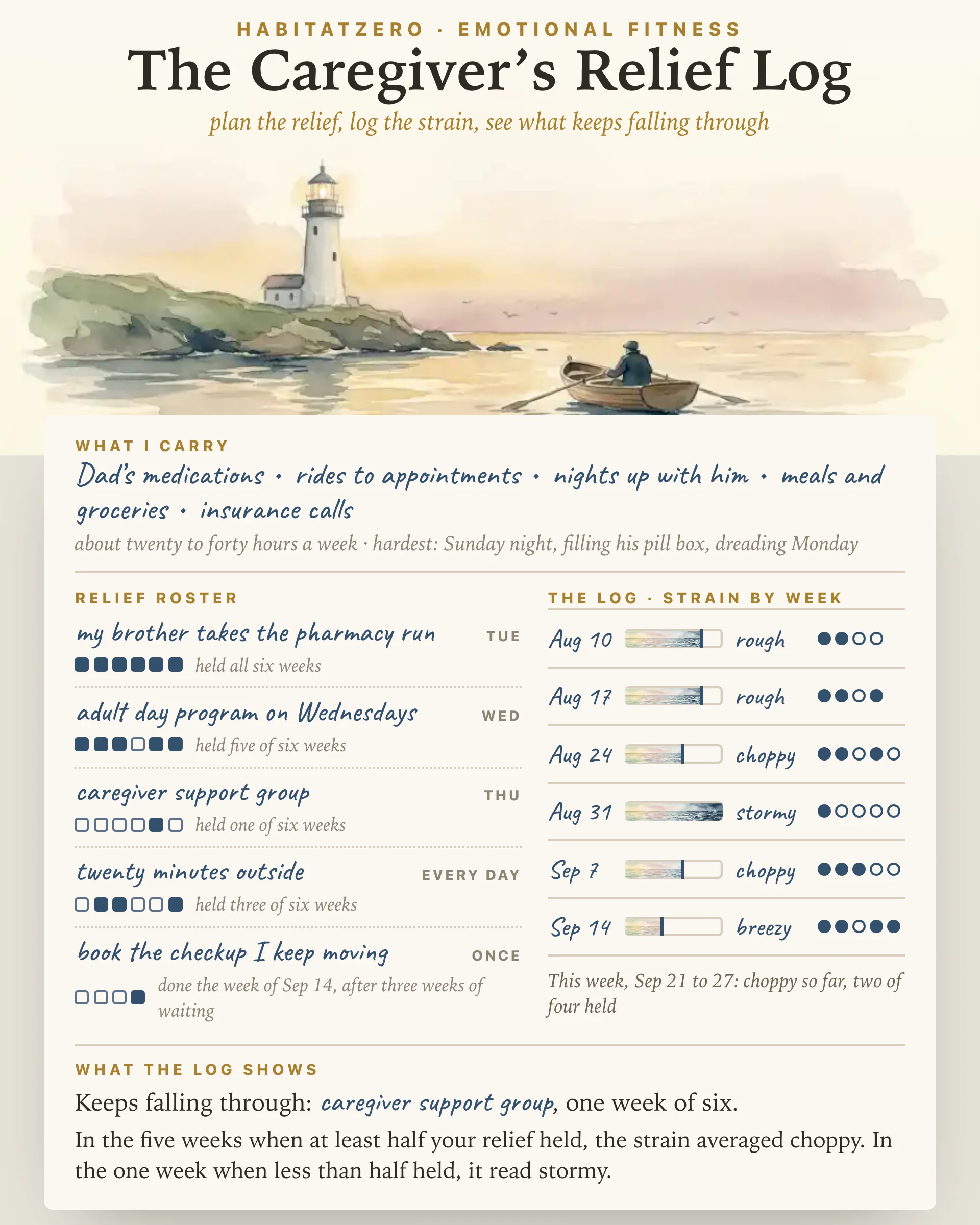
Most advice for a stressed caregiver arrives as a list: ask for help, take breaks, see your own doctor, sleep, find a support group, keep a little time for yourself. The trouble is what happens to it by Thursday. The pharmacy run you meant to hand off lands back on you, the group meets on the evening Dad has a bad spell, and the checkup slides into next month again. You don't need a longer list. You need to see which items keep failing, and what that costs you.
This page turns the familiar stress management techniques for caregivers into a roster you can keep, with an honest log of which relief came.
Someone keeps the light on through the night, and nobody can do that for long without being relieved. The log is kept like a keeper's logbook, one line a week with the weather in it: calm, breezy, choppy, rough or stormy, instead of a score.
What you carry. Tap the tasks that fill your week, pick roughly how many hours they take, and write the hardest hour in a few words. Nothing here is scored; it keeps the plan honest about the week you really have.
The relief roster. Choose up to six reliefs across six kinds, each drawn from the National Institute on Aging's advice for caregivers:
Give each relief a day, every day, or once. Six is the ceiling on purpose: a short roster you keep teaches more than a long one you abandon.
This week. Tap each relief as it holds, and the stretch of painted sea that matches how heavy the week felt. Anything unmarked when Sunday ends counts as fell through, and on Monday the week closes into the log.
What the log shows. After two closed weeks, the page names the relief that keeps falling through and the one that holds best, and compares the strain in weeks when at least half your relief held with the weeks when less did. A relief that keeps dropping usually needs a smaller shape, a different day or a different pair of hands, not more willpower.
The strongest evidence comes from structured programs, not from any single tip. In the REACH II trial, 642 family caregivers of people with dementia received twelve home and phone sessions over six months aimed at their depression and burden, their self-care and social support, and the care recipient's problem behaviors. Hispanic and white caregivers in the program, and Black caregivers looking after a spouse, gained more in quality of life than those who got two brief check-in calls, and clinical depression was less common in the program group at six months, 12.6 percent against 22.7 percent (Belle and colleagues, 2006). It made no significant difference to institutional placement, and it followed families for only six months.
Across 78 caregiver intervention studies, a meta-analysis found real but modest average gains, smaller for burden and depression than for caregivers' knowledge and skills, and smaller for dementia caregivers than for other groups (Sörensen, Pinquart and Duberstein, 2002).
Be clear about what this page is. It has not been tested in a trial, and a worksheet alone is not what those studies delivered. It can make the plan concrete and the follow-through visible. Its readings describe your own weeks, and they show what moved together, not what caused what.
Tell your own doctor that you are a caregiver, and book the checkup you keep postponing; NIA notes that caregivers are less likely than others to get preventive care. If the log reads rough or stormy week after week, if sleep has gone, or if you feel hopeless or have lost interest in things you used to enjoy, take it to a doctor or counselor, not to another plan. If hopelessness starts to include thoughts of harming yourself or not wanting to go on, call or text 988 in the US, or your local emergency number elsewhere, today.
Set up the roster on a quieter evening; it takes about eight minutes. To see which load weighs most right now, take the Caregiver Burnout Quiz first and build the roster around it. If sleep is the relief that keeps failing, a Sleep Log shows what the nights really look like, and if you keep saying yes to more than one person can carry, the Boundaries Worksheet helps you find the words for a no.
November is National Family Caregivers Month in the US, a fitting time to start. So is any Monday.
It is the strain that builds when looking after someone else crowds out your own sleep, health and time. The National Institute on Aging lists signs such as exhaustion, a short fuse, loneliness, poor sleep and letting your own care slide. It is common, and it is a cue to plan relief rather than a verdict on how well you are coping.
The ones with the most support tend to work in combination: asking for specific help, regular breaks while someone else is on duty, keeping your own medical appointments, protecting sleep, a support group, and a little time that belongs to you. Structured programs that bundle several of these, such as the REACH II trial, improved caregivers’ quality of life.
Caregiver strain is the physical, emotional and practical load of caring for another person. This page does not score or diagnose it. Each week you describe it as sea weather, from calm to stormy, so you can compare your weeks with one another and see how the strain moved alongside the relief you kept.
Tell your doctor you are a caregiver at your next visit, and book the checkup you keep putting off. Go sooner if the strain reads rough or stormy for weeks, if your sleep or appetite has changed, or if you feel low most days. A doctor can also point you to respite and support services near you.
The sample on this page shows how a filled log reads. Keeping your own roster and logging real weeks happens when you personalize it in HabitatZero, which costs nothing.
By the team behind Fabulous, the science-based self-care app used by over 30 million people.