
Leaves on a StreamEmotional Fitness · ~3 min
About this template · Updated September 2026
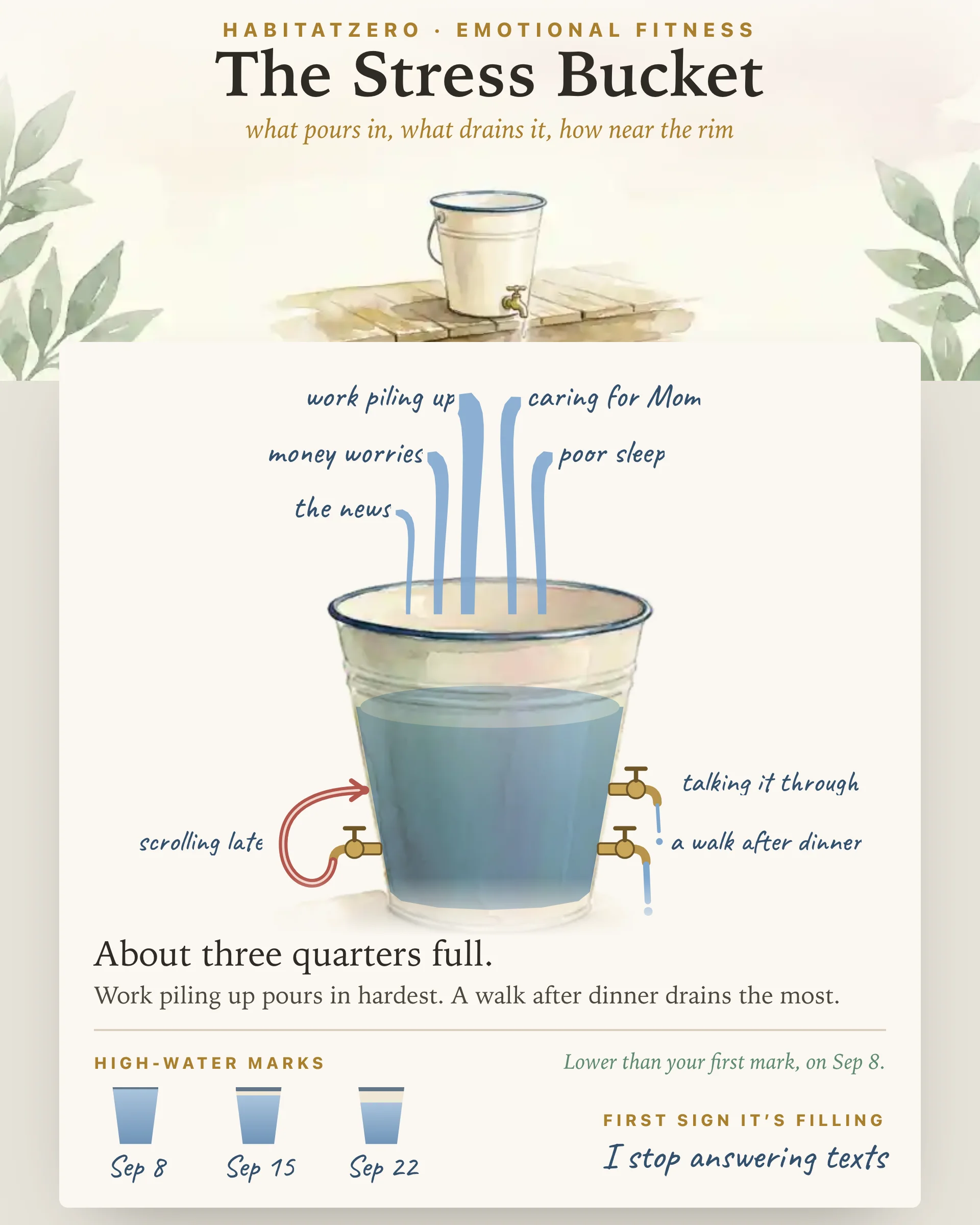
The stress bucket is usually credited to the clinicians Alison Brabban and Douglas Turkington, from their 2002 chapter in A Casebook of Cognitive Therapy for Psychosis. It draws an older idea, the stress-vulnerability model that Joseph Zubin and Bonnie Spring set out in 1977. This worksheet is our own take on their picture. Brabban, Turkington, their publisher and the charities that print bucket sheets of their own have no part in it and have not endorsed it.
Picture a bucket. Its size is how much stress you can carry before things start to spill: sleep slips, patience wears thin, and small jobs feel enormous. Buckets come in different sizes, and nobody picks their own. Genes, a rough start in life, an ongoing illness, or a year that has already asked a lot of you can all make yours smaller.
Stress pours in from above: work, money, family, the news. Some of it arrives as a trickle and some as a flood. Near the bottom sit the taps, the things that let stress back out, such as a walk, a decent night's sleep, or an honest conversation. When more pours in than your taps let out, the level climbs. At the rim it spills over, and that overflow is where everyday stress starts turning into something harder to shake.
The sharpest part of the model is about a second kind of tap. A drink to unwind, an hour of scrolling in bed, or pushing the hard email to tomorrow can each feel like relief. In the bucket they behave like a hose that curls from the tap back over the rim. Some water leaves, then it pours straight back in, often with more behind it.
Start by tapping what is filling your bucket, or write your own, and say whether each one arrives as a trickle, a stream or a flood. Each appears as a named stream pouring into the painted pail, and the water rises to match. Six streams is the limit, because a bucket with twenty labels tells you less, not more.
Then open your taps. The ones that drain the bucket sit on the right. The ones that only feel like relief hang on the left, their hoses curling back in. For each, say how far it is open: a crack, halfway or wide. If something makes your bucket smaller right now, tap it, and the pail shrinks a notch.
The reading underneath does the math you would otherwise do in your head. It tells you how close to the rim you run, which stream pours in hardest, and which tap drains the most, so you can see whether your best tap is really doing the work. Write down your own first sign that the bucket is filling, then mark the level about once a week. The dated marks show whether it is settling or staying high.
Zubin and Spring wrote their model to explain why the same pressure leaves one person unwell and another untouched: each of us has a threshold, and trouble starts when stress climbs past it. The bucket turns that threshold into something you can see. It has traveled well beyond the psychosis care it came from, and Mental Health UK, which hands out a printable bucket of its own, describes it as widely used across mental health services, schools and workplaces.
The hose has some evidence behind it too. In a ten-year study of 1,211 late-middle-aged adults, people who coped by avoiding things at the start had more chronic and more acute stressors four years later, and those extra stressors linked their early avoidance to more depressive symptoms at the ten-year mark. That is a pattern across a group of people, not proof that avoidance caused each new problem, but it fits the picture of a hose feeding the bucket.
What the research does not hand you is a validated bucket. The stress bucket is a teaching picture, not a test, and the level on this page comes from your own ratings rather than any measurement. Use it to see the shape of your weeks, not to grade them.
A full bucket now and then is part of an ordinary life. A bucket that sits at the rim for weeks, whatever taps you open, is worth taking to someone trained to help, such as a therapist, a counselor or your doctor. They can help you turn down what pours in and find taps you have not tried yet. If the overflow ever brings thoughts of hurting yourself or ending your life, don't wait for the level to fall on its own: call or text 988 in the US, or your local emergency number.
Fill it in on an ordinary evening, when you can look at the week without being in the thick of it, and come back when you notice your first sign. If you are not sure where stress is showing up, Strung Tight helps you spot the signs. When you want more taps to choose from, stock them in The Coping Skills Toolbox, and Letters From a Calm Day turns what you learn here into a plan for the harder weeks.
It is a picture of how stress builds up. The bucket stands for how much you can hold before stress spills over into problems, the water is whatever pours in from your life, and the taps are the ways you let it back out. A bucket that fills faster than it drains ends up overflowing.
The bucket is a drawing of that model. Joseph Zubin and Bonnie Spring argued in 1977 that each person has their own threshold for stress, shaped by things like genes and early experience, and that trouble starts when pressure climbs past it. In the drawing, that threshold becomes the size of the bucket.
Helpful taps, like a walk, an early night or talking it through, let stress out. Unhelpful ones, like a drink to unwind or putting a hard task off, feel like relief in the moment but act like a hose that runs back over the rim, so the level stays put or rises.
No. The bucket is usually credited to Alison Brabban and Douglas Turkington, and this page is an independent worksheet built around their picture. It has no tie to them, their publisher or the charities that print their own bucket sheets, and none of them has reviewed or endorsed it.
You can explore a filled-in bucket right here. To pour in your own streams, keep your taps and dated marks, and pick them up again next week, open it in HabitatZero, where it costs nothing.
By the team behind Fabulous, the science-based self-care app used by over 30 million people.


