
The Overwhelm Recovery ProtocolWellness & Routines · ~5 min
About this template · Updated November 2026
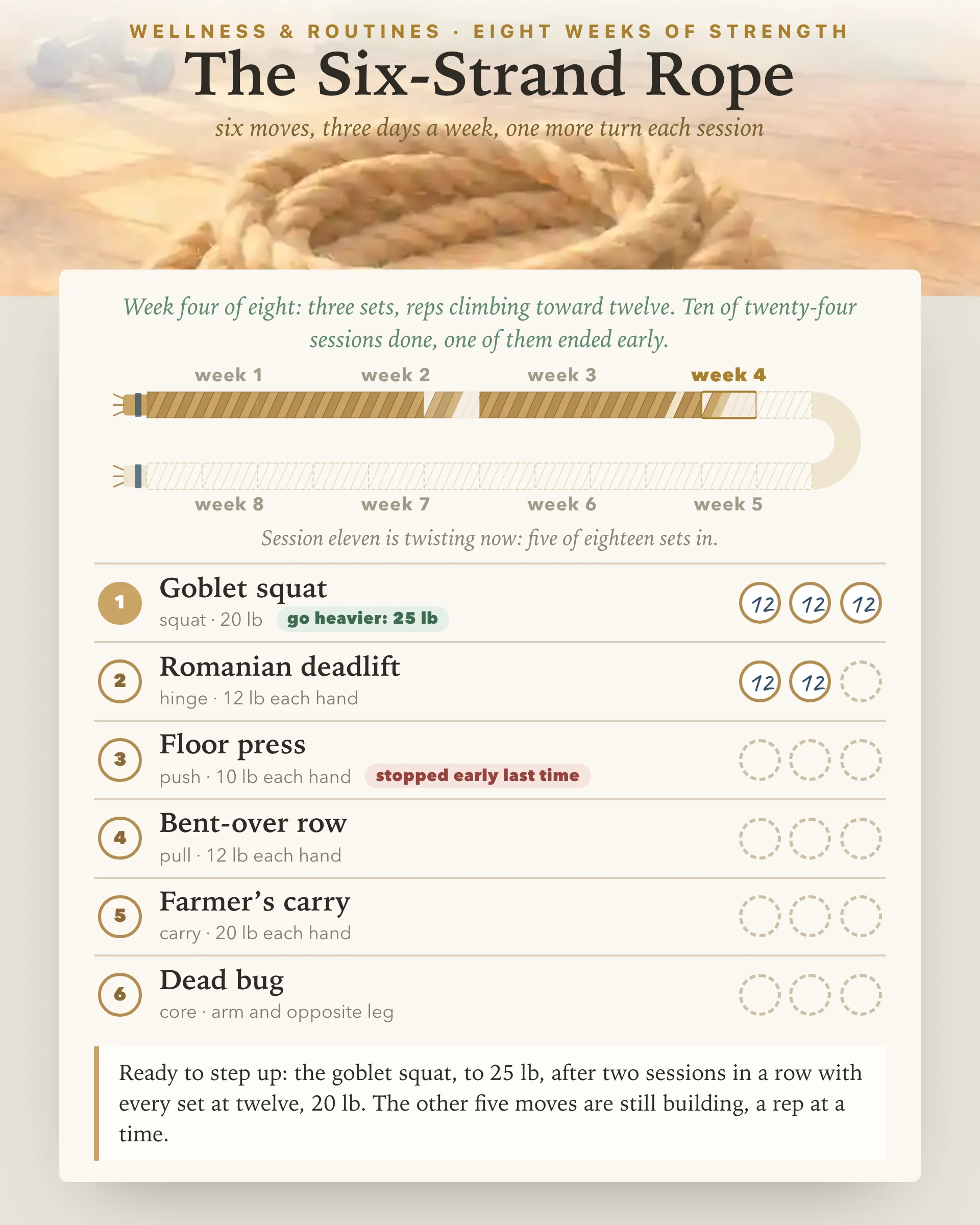
Strength training for weight loss deserves a straight answer before any plan. Lifting will not melt fat from a chosen spot, reshape your body to order, or move the scale much by itself. What it does well is help you keep, and often build, the muscle that dieting tends to strip away. What you eat and how much you move through the whole day decide where your weight goes. This page is built on that split, and it logs the one thing lifting reliably changes: how much you can do.
STRRIDE AT/RT, a randomized trial run by researchers at a US university medical center, placed 119 sedentary adults with overweight or obesity in eight months of aerobic training, resistance training, or both. The aerobic and combined groups lost more body mass and fat mass than the lifting-only group, while both groups that lifted gained more lean mass, which is mostly muscle.
In a 2017 trial of 160 older adults with obesity, every exercise group followed one weight-management program and lost a similar share of weight. Those who lifted, alone or with aerobic work, lost less lean mass and less hip bone density than those who only did aerobic exercise, and their strength rose by close to a fifth.
A 2022 review by researchers in Australia and Brazil pooled 114 trials with more than four thousand people. Resistance training paired with eating less brought the largest drops in body fat, and lean mass held steady in those programs instead of falling. Lifting alone trimmed a little fat and added a little muscle. These are averages across many trials: read them as what steady practice allows, not a forecast.
None of them measured toning or fat leaving one spot first, and this page promises neither. It keeps no scale, calorie or tape fields.
Every session works six patterns: a squat, a hip hinge, a push, a pull, a loaded carry, and the dead bug for your core. You choose where you train, and the moves follow.
Weeks one and two ask for two sets of each move, eight to twelve reps, or twenty to forty seconds for the carry. That makes a thirty-minute session: six minutes of warm-up, then twelve sets of about two minutes each, rest included. From week three a third set joins every move, and the same arithmetic gives forty-two minutes. Leave a day between sessions.
The set clock gives you a short get-set, then counts each rep at about three seconds. Or keep your own pace and log the reps as you counted them. Either way, the load goes in with the set. A set you stop partway keeps only the reps you finished, marked stopped early, and it never counts toward going heavier. A ninety-second rest timer starts after every set and runs from clock time, so a locked phone still shows the right rest.
Once two sessions in a row bring every set of a move to the top of its range at the same load, the sheet offers the next step. A session between that falls short, skips the move or uses another load breaks the run. A set under the range suggests easing off. At home, the steps are harder versions first, then more weight in the backpack.
Each finished session twists one turn of the rope, six strands for six moves. A session you end early leaves gaps where a move was never done.
The Strength Doorframe is a twelve-week beginner plan for women that uses a lunge instead of a core move and marks each new best as a pencil line. The Training Consistency Planner is about showing up at all, with session stamps and no sets or loads. The Yoga Block Tower builds timed yoga flows for days you want to move without weights. Use this one when lifting is the strength side of an effort your eating and daily movement already carry.
The American College of Sports Medicine’s screening advice rests on three questions: how active you are now, whether you have heart, metabolic or kidney disease or symptoms such as chest discomfort, and how hard you plan to work. If you are inactive and live with one of those conditions, or have symptoms at all, see a doctor before week one. Ask first, too, if you take medicine for diabetes or blood pressure, are pregnant, have had a fall, dizzy spells, a joint replaced or recent surgery, or live with pain.
Stop a set if anything hurts, and stop the session for chest pain, faintness or a racing heart that does not settle. Have a sturdy chair or a kitchen counter close enough to grab during anything you do standing.
It helps with the part of weight loss people tend to forget: keeping muscle. In trials, lifting on its own moves the scale only a little, while eating less and moving more through the day drive most of the change. Pair lifting with those, and the weight you lose comes with less muscle loss and more strength.
They do different jobs. In an eight-month randomized trial of adults with overweight, aerobic training lowered body mass and fat more than resistance training, and resistance training added more lean mass. Many people do both: brisk walking or cycling on most days, and two or three lifting sessions a week.
Two or three full-body sessions a week with a rest day between suits most beginners. This plan uses three, thirty minutes at first and forty-two from week three, and it leaves the other days for walking and recovery.
Yes. The home version uses a squat to a chair, a hip bridge, an incline push-up that moves from the wall toward the floor, and a row and a carry with a loaded backpack or grocery bags. Harder versions come first, then more weight in the backpack.
Anyone who is not active now and has a heart, metabolic or kidney condition, and anyone with chest discomfort, unusual breathlessness or dizziness during effort. Also ask first if you take medicine for diabetes or blood pressure, are pregnant, have had a joint replaced or recent surgery, or live with pain.
By the team behind Fabulous, the science-based self-care app used by over 30 million people.


