
The Overwhelm Recovery ProtocolWellness & Routines · ~5 min
About this template · Updated November 2026
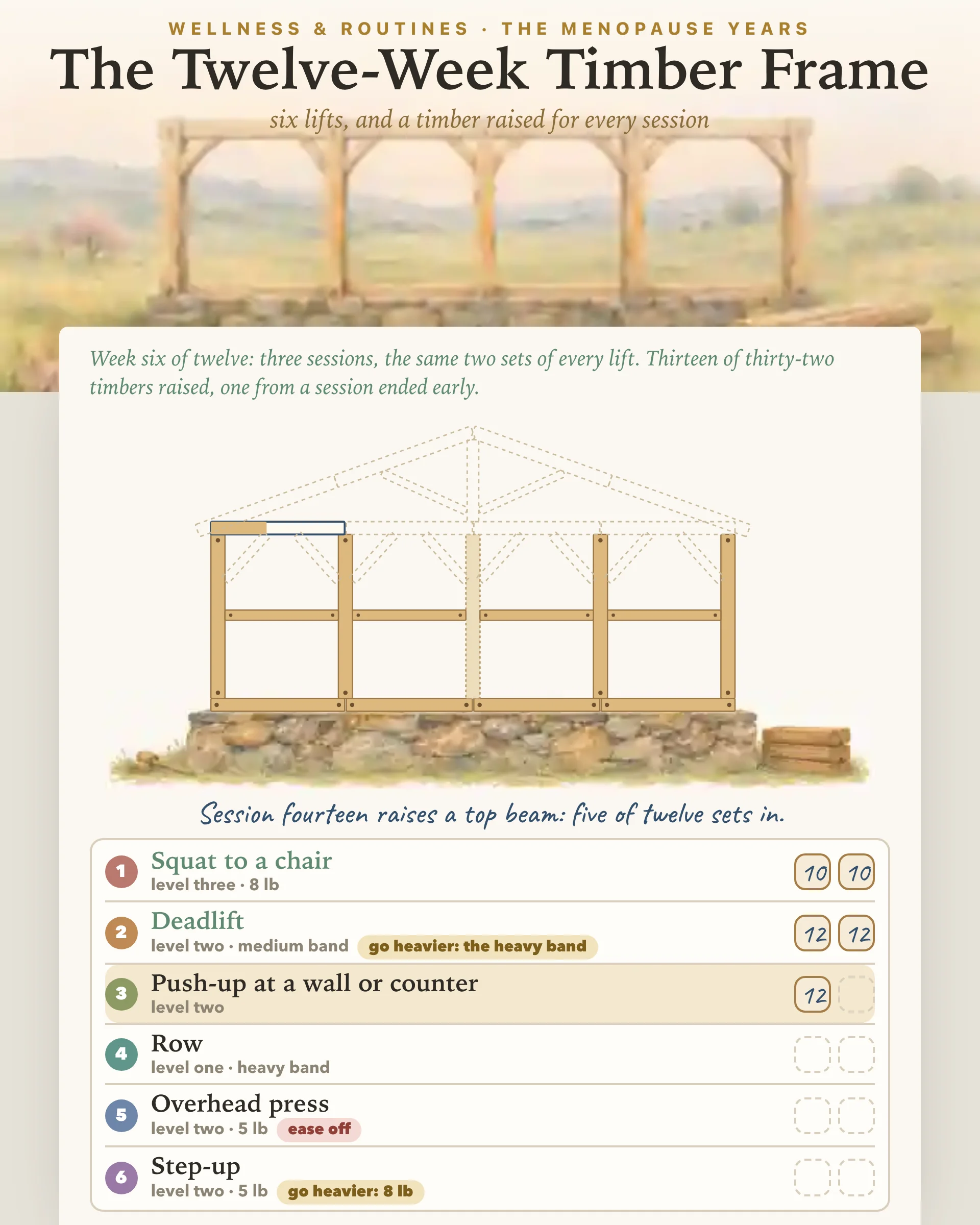
The years around your final period are when bone thins fastest in midlife, and they are a sensible time to start lifting. This page is a twelve-week plan for that stretch of life: six lifts two or three times a week, a counter that paces every rep, a rest timer, a log of each set with its weight, and a timber frame that gains one beam for every session you finish.
The Study of Women's Health Across the Nation tracked the bone density of African American, white, Chinese and Japanese women through menopause for ten years. In that study, loss began about a year before the final period and ran fastest until two years after it. Over the ten years the lower spine lost about a tenth of its density, most of it inside those three years. Afterward the loss slowed, though it never stopped. This plan is built around that window.
The trial most often cited on lifting after menopause is LIFTMOR. It enrolled 101 women past menopause, average age 65, all with low bone density and screened for conditions and medicines that affect bone. About half trained twice a week for eight months in supervised thirty-minute sessions of heavy lifting and impact work, five sets of five reps at more than 85 percent of the most they could lift once. The others followed a light program at home. The lifters' spine density rose slightly and their hip density held, while the home group lost some at both, and the lifters did better on every test of strength and function. One woman had a minor back spasm.
The trial was small and short, its women were otherwise healthy, and it was not built to show whether fractures become rarer. It says nothing about menopause symptoms. Its loads were far heavier than this page asks of you, and they were lifted under close supervision, so home lifting at moderate weights cannot promise the same change on a scan. What it does show is that progressively heavier lifting is not off limits after menopause, even with low bone density, when the build is careful.
Before week one, talk with your doctor or a physical therapist if you have osteoporosis or have broken a bone in a minor fall, if you have had a fall or dizzy spells, a joint replacement, a heart or blood pressure condition, or pain that does not settle. Stop any lift that hurts. Keep a sturdy chair or counter within reach for every standing lift.
With osteoporosis, keep weight out of any move that rounds your back forward or twists it. The UK consensus statement on exercise for osteoporosis recommends strength work two or three days a week, building toward the most you can lift eight to twelve times, and advises changing exercises that curve the back far, especially with a load added. It calls the hip hinge a safe way to bend, and a deadlift is that hinge: your hips fold back while your back stays long. Still, ask your clinician before you hold a weight for it, and until they agree, tap the stand-in, a hip bridge done lying down. Nothing on this page twists.
Weeks one to four hold two sessions each; from week five there are three, with a rest day between. Every session runs all six lifts for two sets: a squat to a chair, the deadlift or its stand-in, a push-up at a wall or counter, a band row, an overhead press and a step-up on the stairs. Each lift has three levels, from the gentlest version to one with a dumbbell, a stronger band or a higher stair. Plan on about thirty minutes, counting ninety seconds of rest after each set.
Choose a level and a weight, set your reps and tap start. The counter gives you three seconds to get set, then paces each rep with words for each part. Stop partway and only whole reps go in, as a set marked stopped early; a stop before the first whole rep logs nothing. The rest timer keeps true time even if your phone locks, and a rest never goes in the log. Rather count for yourself? Log the set by hand.
A lift goes heavier after its two latest sessions, in order, each had both sets whole at the top of its range, at the same level and weight. The page then names the next dumbbell, band or level. One set under the range says ease off. Finish all twelve sets and a timber is pegged into the frame; by session thirty-two it stands from sill to rafters.
Strength Training for Women Over 50 splits six moves across two workout cards and has you tap how far you got. Strength Training for Women Over 40 rotates three workouts a week for eight weeks, at home or at a gym. This one is shaped by the bone research and the years around menopause, runs every lift in every session at a counted pace, and keeps building for twelve weeks. If pushing is your weakest link, The Wall Push-Up Ladder gives that one move four weeks of its own.
The clearest evidence is about bone. In the LIFTMOR trial, 101 women past menopause with low bone density lifted heavy weights under supervision twice a week for eight months; their spine density rose slightly and their hip density held, while a light home program lost some at both. Strength and everyday function improved too. It was not designed to show fewer fractures, and it says nothing about menopause symptoms.
Ask your doctor or a physical therapist first. A UK consensus on exercise for osteoporosis supports regular strength work and advises changing any exercise that rounds the back far, especially while holding a load. On this page nothing twists, and the deadlift has a lying-down stand-in, the hip bridge, to use until your clinician agrees to loaded hinging.
Choose a weight you can lift eight to twelve times with steady form, where the last two or three reps feel hard. Move to the next dumbbell, band or level only after two sessions in a row in which both sets of that lift reached the top of the range, whole, at the same level and weight.
Two or three, with a rest day between sessions. This plan begins with two sessions a week for four weeks while you learn the lifts, then adds a third for the remaining eight weeks. Each session takes about thirty minutes.
Those plans are built around an age and a set of workout cards or rotating workouts. This one is built around the years near your final period, when bone thins fastest, and runs all six lifts in every session, counted at a steady pace, over twelve weeks.
By the team behind Fabulous, the science-based self-care app used by over 30 million people.


