
The Overwhelm Recovery ProtocolWellness & Routines · ~5 min
About this template · Updated November 2026
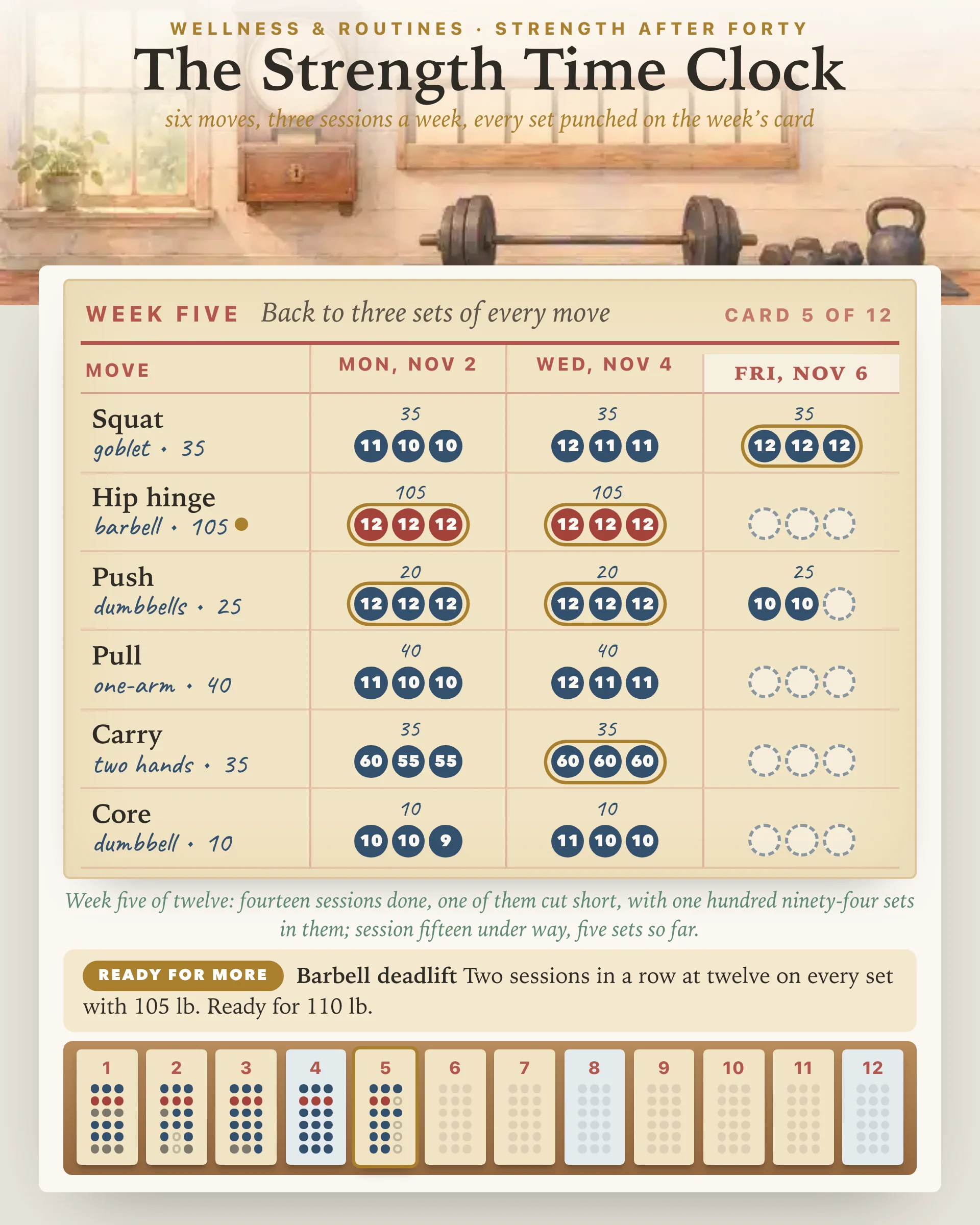
Past forty, the hard part of getting stronger is rarely the lifting. It is showing up three times a week, adding weight slowly enough that your knees and shoulders keep pace, and backing off before a small ache becomes a month off. This page is built for that kind of patience: a twelve-week plan of six full-body moves, with every set you finish punched onto a weekly time card, the way a shift used to be.
Each session covers the same six patterns: a squat, a hip hinge, a push, a pull, a carry and a core move. Every pattern has three levels. Level one uses your bodyweight (a box squat, a hip bridge, an incline push-up), level two uses dumbbells or a kettlebell, and level three uses a barbell. The whole plan works at home with a pair of adjustable dumbbells, or at a gym with a rack and a bar.
Weeks one and two keep every move to two sets while you find working weights. From week three each session grows to three sets. Weeks four, eight and twelve are lighter: two sets, stopping a couple of reps short of your best. A session runs about thirty-four minutes in a two-set week and forty-six in a three-set week, warm-up and cool-down included, on three days with a rest day between.
Tap a row on the card to pick a move, then choose its level and weight. After each set, tap the reps you did, or the steps you walked on the carry, and punch it. The hole fills in the ink of the level: gray for bodyweight, blue for dumbbells, red for a barbell. A set you put down early is hatched and never counts toward going heavier.
The rest starts on its own after every set and reads the real time, so a phone that locks between sets still ends the rest when it should. A rest is never logged.
Each move carries one plain rule. Two sessions in a row with every planned set at the top of the range (twelve reps, or sixty steps on the carry), nothing stopped early and outside a lighter week, earn five pounds more, or the next level if you are still at bodyweight. Two sessions in a row with a set stopped early or under eight reps suggest easing off. The warm-up line works out a light first set of the squat and the hinge at about half of today's weight.
The World Health Organization's 2020 guidelines, written by an international panel of physical activity researchers, ask adults for muscle-strengthening work at moderate or greater intensity, reaching all the major muscle groups, on two or more days a week. Three sessions here clears that with a day to spare.
A Finnish study of middle-aged and older adults followed ten men averaging forty-two through six months of heavy resistance training with some explosive work. Their maximal leg-extension strength rose by about a fifth on a dynamic test and about a third on an isometric one, while the thigh muscle itself grew only about five percent. The group was small, and the authors credit most of the gain to the nervous system learning to use the muscle. A meta-analysis by rehabilitation researchers at a US university pooled forty-nine studies of 1,328 adults over fifty and found an average gain of about 1.1 kilograms of lean mass, more with higher training volume and a little less in older participants. Neither tells you what your own body will do, and neither makes any promise about how you will look.
The lighter weeks rest on coaching practice more than proof. The one controlled trial of a deload we could find, run by exercise scientists in New York, gave thirty-nine young, trained lifters a full week off in the middle of a nine-week program. The week off did not change muscle growth and slightly reduced the lower-body strength gain. A week of two easier sets is a different thing, and the trial says nothing about joints after forty. Treat the lighter weeks as cheap insurance for joints and old injuries, not as a way to add muscle.
An old knee usually does best squatting to a box at a pain-free height, lowered an inch at a time. A grumpy lower back can stay with the goblet squat, hip bridge and one-arm row while it settles. A cranky shoulder tends to prefer dumbbells pressed with the elbows angled in. A move that hurts during the set, or aches more the next morning, means drop a level and see a physical therapist, not push through.
Check with a doctor before week one if you have a heart condition, high blood pressure, chest pain or dizziness during effort, a hernia, or a recent injury or surgery.
The Twelve-Week Honeycomb alternates two dumbbell workouts for men over fifty. The Eight-Week Container Yard lets you choose a split and your training days. The Rice Terrace Planner applies a progression rule to moves you already do. This one keeps a single full-body session, runs from bodyweight to a barbell, and builds the lighter weeks in from the start.
Three days a week with a rest day between is the rhythm on this page. The World Health Organization asks adults for muscle-strengthening work that reaches every major muscle group on two or more days each week, so two good sessions still count when a week gets crowded.
No. In a Finnish study, men averaging 42 years old raised their leg strength by about a fifth to a third over six months of heavy training, and a review of studies in adults past 50 found muscle gains too. Start lighter than your pride suggests and let the weeks do the work.
Resistance training means any work your muscles do against a load, including your own bodyweight and bands. Weight training is the part done with dumbbells, kettlebells or a barbell. Level one of each move here is bodyweight resistance, and levels two and three add weights.
Heavy enough that eight reps take real effort but leave two or three in reserve. When every set reaches twelve for two sessions in a row, the page offers five pounds more. Small jumps keep joints and tendons on the same schedule as the muscles.
Weeks four, eight and twelve drop to two sets with reps in hand, so sleep, joints and an old injury get room to catch up. It is common coaching practice rather than a proven way to add muscle, and the article explains what the one trial on it found.
By the team behind Fabulous, the science-based self-care app used by over 30 million people.


