
The Overwhelm Recovery ProtocolWellness & Routines · ~5 min
About this template · Updated November 2026
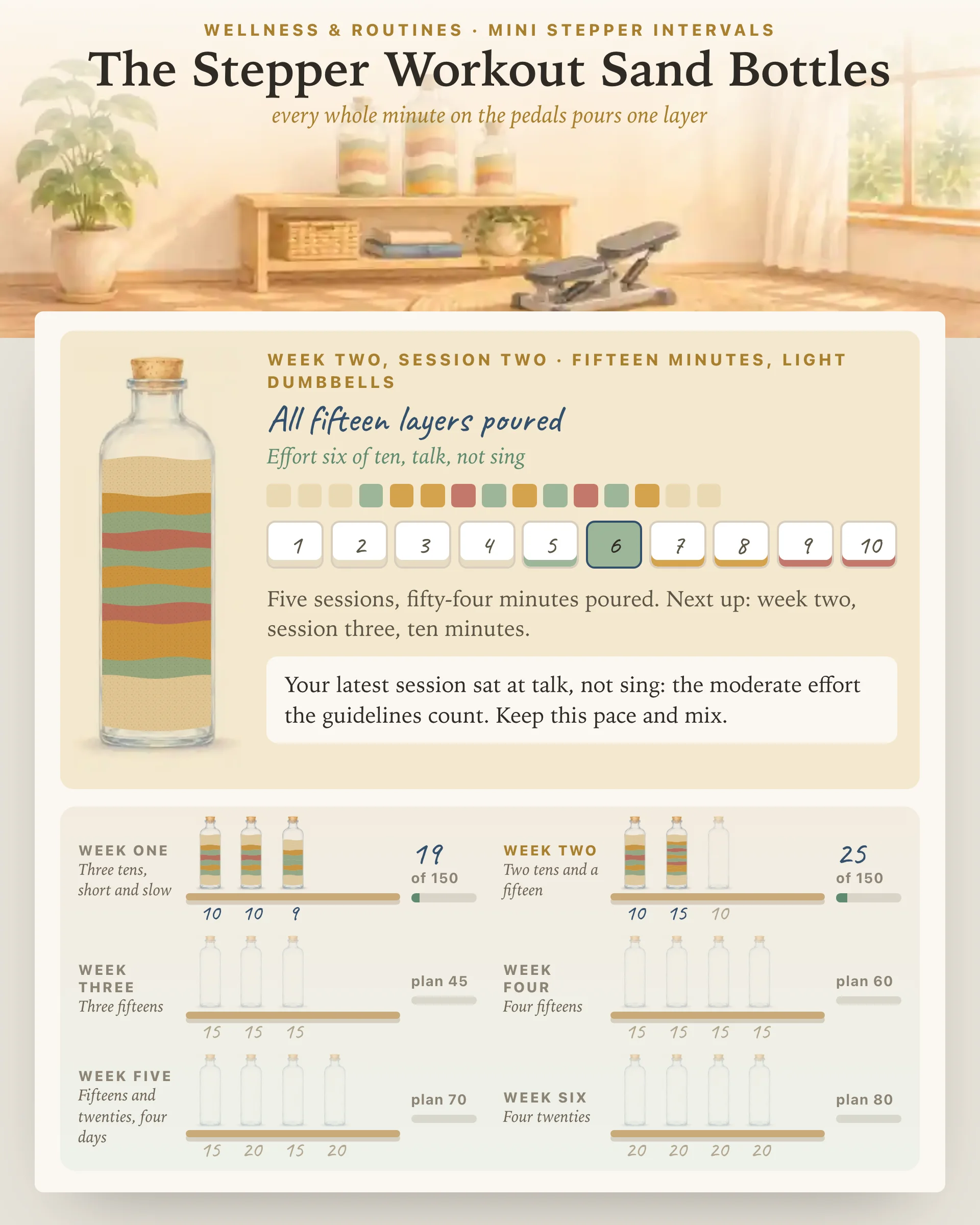
A mini stepper is the small machine with two pedals that sink and rise under your feet as you step in place. It fits under a desk and ignores the weather, yet many end up in a closet after a week of aimless stepping. This page gives every session a shape: easy minutes at each end, a middle you mix yourself, and a glass bottle that takes a layer of sand for each minute you actually finish.
This page is for the mini stepper only, not the stair-climbing machines at a gym, with their moving steps and side rails, nor the low platform of a step aerobics class.
Pick ten, fifteen or twenty minutes. Each length opens with two or three minutes of short, slow steps and closes with two or three more, easing down. The middle is yours to mix from three kinds of minute:
The plain mix alternates steady stepping with arm work, with every fourth minute overhead. Tap a tile to change any middle minute; two overhead minutes never sit side by side, so your shoulders get a rest between them.
If your balance is shaky, choose holding on: one hand stays on a counter or a handle, and the other arm does the arm minutes, switching halfway.
The clock runs on real time, so a phone that locks partway through still knows where you are. When a minute ends, its layer settles in the bottle. A minute you skip pours nothing, and neither does the minute you stop in. The bottle shows what you really did, and only those whole minutes go in the log.
After each session, rate it from one to ten. The 2020 World Health Organization guidelines, written by an international expert panel, describe moderate effort as about a five or six on a zero to ten scale set against your own capacity, and vigorous effort as a seven or eight. For adults they set a weekly aim of 150 to 300 minutes of moderate activity, or half as much vigorous activity.
The talk test is the other half of the rating. A review by two researchers at a Canadian heart institute's prevention center found that comfortable speech usually means you are working below the point where breathing turns labored, and that the test held up across walking, jogging, cycling, elliptical trainers and stair steppers. It drew on studies of athletes, healthy adults and people with heart disease, not on mini steppers specifically.
On this page, minutes rated five or six count once toward the weekly 150 and minutes rated seven or more count twice, as the guidelines allow. Two whole sessions in a row rated four or lower point you up: quicker or deeper steps, or one more arm minute. A single session rated nine or ten, finished or not, points you down.
| Week | Sessions | Minutes |
|---|---|---|
| 1 | three tens | 30 |
| 2 | two tens and a fifteen | 35 |
| 3 | three fifteens | 45 |
| 4 | four fifteens | 60 |
| 5 | two fifteens and two twenties | 70 |
| 6 | four twenties | 80 |
Even week six stops at eighty minutes, so at a moderate effort the stepper covers part of the 150, and walks, yard work and other moderate movement can make up the rest. Each week stands on its own shelf, with empty glass for sessions still to come.
Research on mini steppers as training is thin. The closest is a study by a University College London cohort team in which 518 adults, about seventy-one years old on average, did a six-minute self-paced test on a mini stepper with support rails fixed to the wall in front of them. Their step rate was strongly linked to how much oxygen they used, they rated the effort a little above five out of ten on average, and every one of them chose to hold the rails. It was a single fitness test, so it says nothing about what six weeks of sessions will change. More than a hundred people were screened out for reasons such as blood pressure that was not under control, severe arthritis or a recent heart problem or stroke.
Start with short, slow steps, keep your whole foot on each pedal and stand tall rather than leaning into your hands. Stop if a knee or hip hurts. Check with your doctor before you begin if you have had a fall or dizzy spells, a joint replacement, a heart or blood pressure condition, or pain when you exercise.
If a real step suits you better, The Step-Up Hill builds a six-week plan on the bottom stair. For a seated machine, The Stationary Bike Console lays out rides by resistance level, and with no equipment at all, The Living Room Mile turns walking in place into laps of the room. Here the pedals set the rhythm, your arms add the work and the bottle keeps the count.
It is a session on the small home machine whose two pedals sink and rise under your feet as you step in place, usually ten to twenty minutes long. This one mixes steady stepping with minutes of arm work and short bouts of arms overhead, with easy minutes at each end.
No. The stair climbers at a gym are big machines with moving steps or long pedals and rails on both sides. A mini stepper sits low on the floor with short pedals and often no handles, which is why this plan sets it next to a counter.
Ten minutes is plenty to start: two easy, six in the middle and two easing down. The six-week plan keeps to ten-minute sessions in week one and works up to twenty minutes by week six, on three or four days a week.
Most middle minutes should sit around five or six out of ten, where you can talk in sentences but could not sing. Down to a few words means slow the steps; able to sing through two whole sessions in a row means the next one can go a little quicker.
Anyone who has had a fall or dizzy spells, a hip or knee replacement, a heart or blood pressure condition, or joint pain that comes on with exercise. Whoever you are, stop if a knee or hip hurts while you step.
By the team behind Fabulous, the science-based self-care app used by over 30 million people.


