
The Overwhelm Recovery ProtocolWellness & Routines · ~5 min
About this template · Updated November 2026
Joseph Pilates, the German-born trainer who later taught in New York, built the method these moves come from and called it Contrology. Penelope Latey tells that story in The Pilates method: history and philosophy. The lawn on this page is our own arrangement of standing moves. It stands apart from his estate and from every Pilates studio and teacher training body, and none of them has reviewed or endorsed it.
Standing pilates keeps what the mat work is known for, a slow breath and a steady middle, and puts all of it on your feet. A kitchen counter steadies the leg work and the one-leg balance, and a patch of wall carries the roll-down, the push-ups and the closing breath. That makes it a practical way into standing pilates for seniors, and for anyone whose knees or back have made the floor a chore.
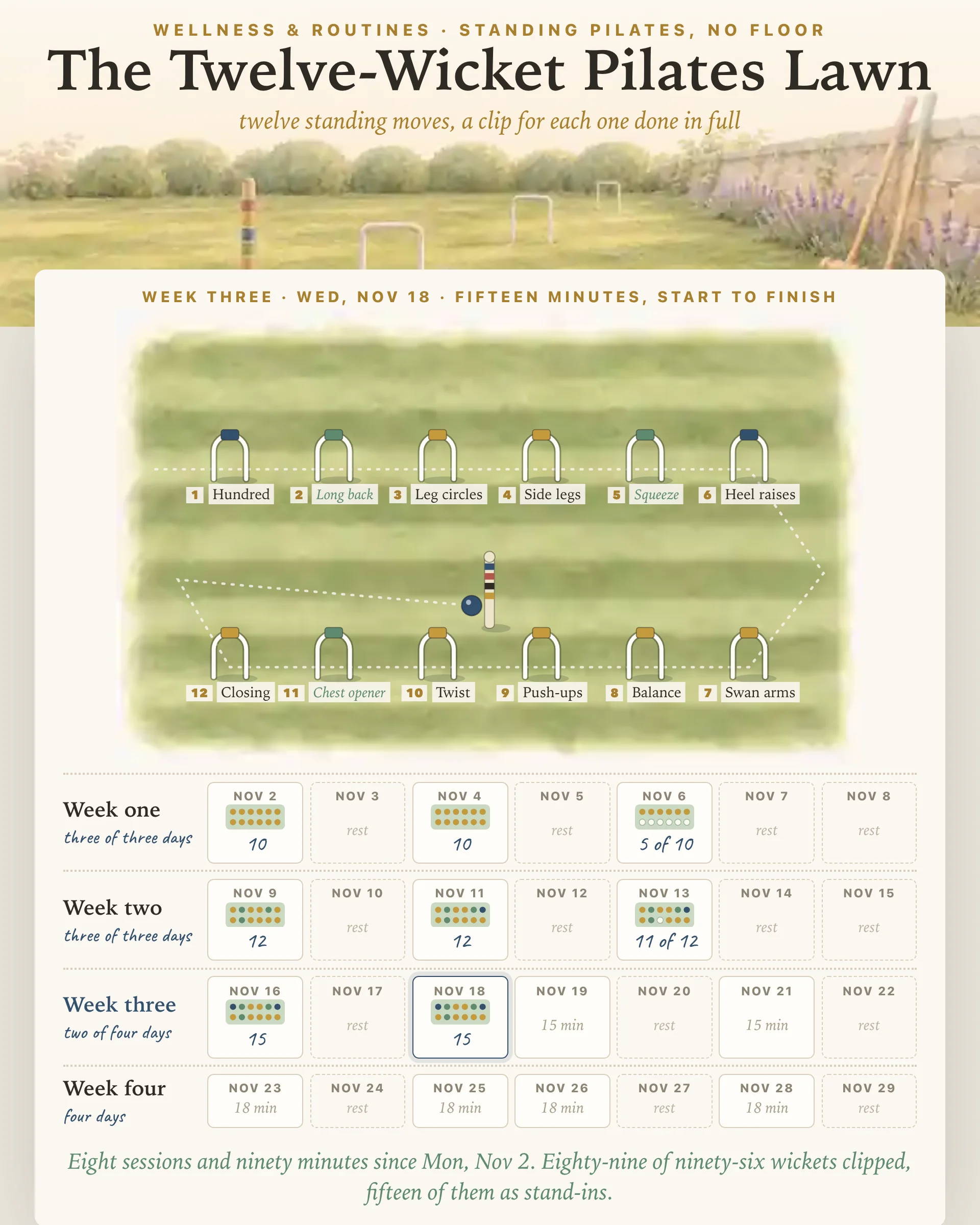
The twelve moves are the twelve wickets of a croquet course: out along the top row, back along the bottom, then the stake. Press begin and a real clock runs the session. The ball rolls toward the next wicket as a move's time passes, and the move gets its clip only if that time runs out in full. Skip a move, or stop partway, and its wicket stays bare. A pause stops the clock, and a phone that locks mid-session still keeps true time.
A session you end early keeps its whole minutes and nothing more, so a minute and a half counts as one and fifty seconds counts as none. Afterward you tap how steady you felt on your feet. An unsteady last session, even a short one, brings a nudge toward both hands on the counter. Only two whole, steady sessions in a row suggest taking one move a step fuller.
Every session runs all twelve moves in order, and only the time on each one grows:
Your first session sets day one, and each session shows on the four weeks as a small lawn, one dot per move.
Every move starts supported: both hands on the counter for the heel raises and the one-leg balance, your back against the wall for the hundred. The fuller version takes some support away once a move feels calm.
Three moves bend the spine forward: the wall roll-down, the standing saw and the standing cat stretch. The UK consensus statement Strong, steady and straight, agreed by specialists who reviewed meta-analyses and used expert opinion where trials were missing, advises people with osteoporosis to avoid postures with a lot of spinal flexion, names the Pilates roll-down among the exercises that need an alternative, and encourages back extension work. So each of the three has an upright stand-in in the same time slot: a long back against the wall, a shoulder blade squeeze and a chest opener. One tap on "no forward bends" swaps in all three. The same statement calls twisting safe when it is smooth and comfortable, so the spine twist stays, done tall and slow. It is guidance by agreement, not a trial, and it does not grade every Pilates move.
A 2024 review by de Campos Júnior and colleagues pooled 39 studies of Pilates in older adults, 1,770 people in all. Pilates groups did better on balance tests than groups who did no exercise, with certainty rated very low to moderate, and only 14 of the studies met the reviewers' quality bar. The review found no drop in the number of falls or in the fear of falling, and Pilates did about as well as other kinds of exercise. We could not find a trial of a routine done only on your feet.
The firmer evidence covers balance and functional exercise in general. A Cochrane review of exercise for preventing falls in older people looked at 108 trials with 23,407 people living at home, average age 76, three in four of them women. That kind of training cut the rate of falls by about a quarter, with high certainty. The review did not test Pilates or this page, so the lawn promises nothing about falls, posture or bone density.
Talk to a doctor or physical therapist before you start if you have had a fall or dizzy spells, a joint replacement, osteoporosis, a heart or blood pressure condition, or pain that keeps coming back. Stop any move that hurts, and keep the counter within reach for everything that tips your balance.
If you would rather sit for every move, a wooden abacus of seated moves keeps the whole routine in a chair. The Pilates Ring travels from the chair to standing, then the wall, and then the bed, with three levels per move. This lawn starts and ends on your feet. When the floor feels comfortable again, The Pilates Sampler lays out six weeks of classic mat work.
It is Pilates done entirely on your feet, with a counter, a wall or the back of a chair taking the place of the mat. The slow breathing and the steady middle stay the same, and nobody has to get down to the floor and back up.
For many older adults it is a gentle way in, since it skips the trip to the floor and lets you keep a hand on the counter through the balance moves. Reviews of Pilates in older adults find better balance than doing no exercise, though the certainty is low and fewer falls have not been shown. If you have had a fall or dizzy spells, ask your doctor or a physical therapist first.
Most of these moves keep your spine upright. The roll-down, the saw and the cat stretch bend it forward, which a UK consensus on exercise for osteoporosis advises against, so each has an upright stand-in that keeps its time slot. Your doctor or a physical therapist can tell you which moves suit your bones.
This plan opens with ten minutes on three days a week and builds to eighteen minutes on four days by week four. Every session runs all twelve moves, and only the time on each one grows, from fifty seconds to a minute and a half.
No. The method traces back to Joseph Pilates, but this lawn of twelve standing moves was arranged independently, and no studio, teacher training body or estate tied to his name has reviewed or approved it.
By the team behind Fabulous, the science-based self-care app used by over 30 million people.


