
The Overwhelm Recovery ProtocolWellness & Routines · ~5 min
About this template · Updated November 2026
A stability ball workout asks one big, slightly wobbly ball to be a seat, a wall pad and a bench for your heels. Because the ball can roll, every move carries a second task: keeping it where you want it. That steadying work, done slowly, is what this page is built around.
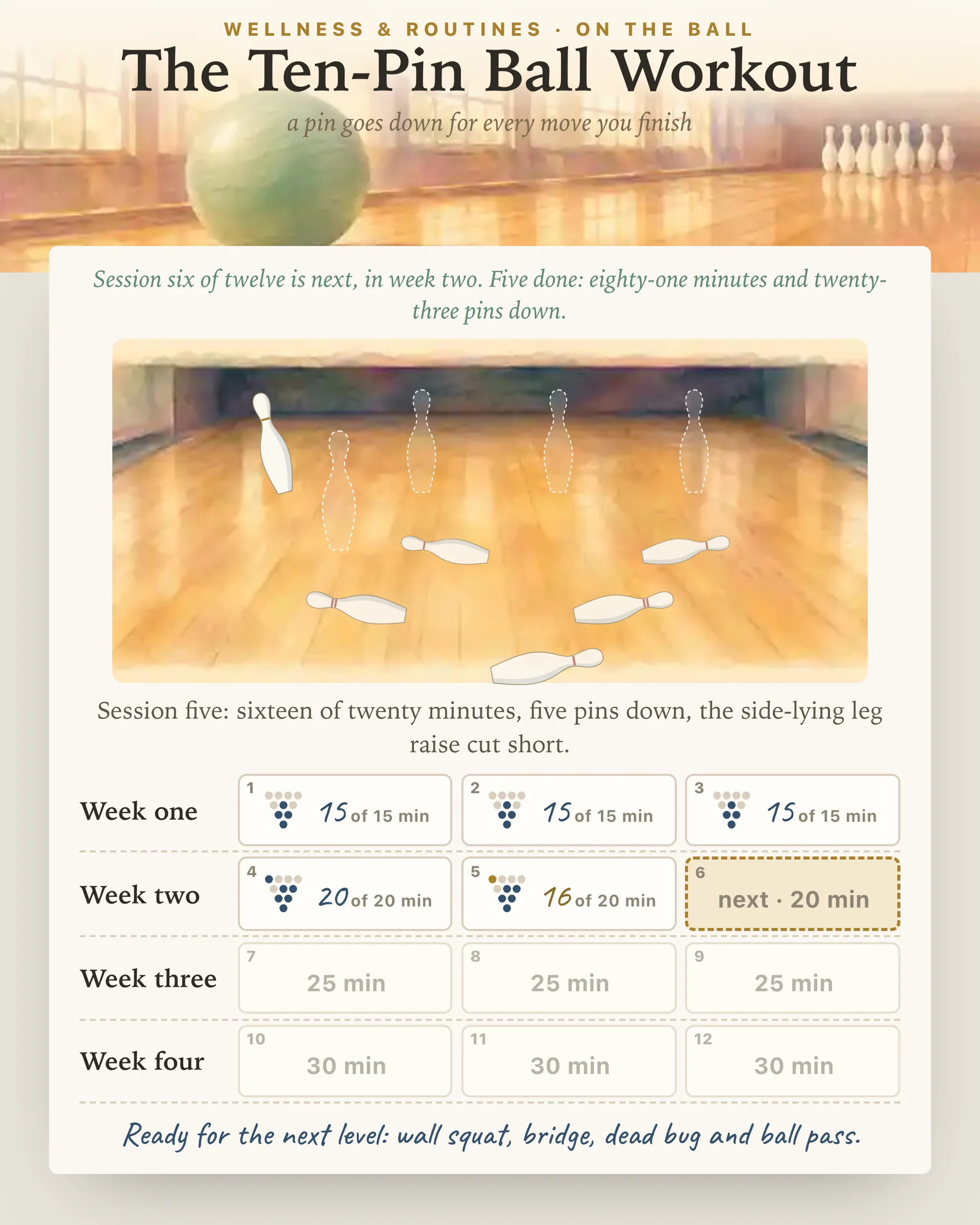
This sheet sets ten moves out like bowling pins, one pin per exercise. You stand up the pins you will do today, the clock walks you through them, and a pin goes down only when both of its sets have run whole. Over four weeks, the lane sheet fills with small triangles showing which moves you finished, which you cut short and which sat out.
The front pin is the gentlest and the back row asks the most. Each move has three levels, shown as bands on the pin's neck.
Every move has a breathing cue. Breathe out on the hard half of each rep and keep breathing through the timed ones; never hold your breath under effort.
Pick a length and the deck fills itself: fifteen minutes stands four pins, twenty stands six, twenty-five stands eight, thirty stands all ten. Tap a pin to read its move, choose its level or swap it.
Every session has the same shape: two and a half minutes of warm-up, two and a half minutes per move, and two and a half minutes of cool-down. Inside each move you get ten seconds to set up, a paced set, half a minute of rest, a second set, then rest until the next move.
The clock reads the real time, so a phone that locks mid-set still knows where you are. End early and only whole minutes are kept, and a set you stopped partway keeps only the reps you finished, marked as stopped early. When a move's last two sessions in a row ran both sets whole at one level, its pin gets a gold arrow: a hint, never an order, that the next level may be ready.
A common guide: a 45 cm ball if you are under 5 ft 1 in, 55 cm up to 5 ft 7 in, 65 cm up to 6 ft 1 in, and 75 cm above that. Charts disagree by an inch or two, so the real test is sitting on it: with your feet on the floor, your hips should rest level with your knees or a little higher. Choose a ball labeled anti-burst or burst-resistant, which deflates slowly instead of popping if punctured, and keep it pumped firm.
A position stand from the Canadian Society for Exercise Physiology weighed the studies on training with unstable surfaces. Trunk and limb muscles tend to work harder when a similar move is done on something unstable, but instability also cuts how much force and speed you can produce. Its conclusion was modest: not the best main tool for athletes, yet a real option for people who would rather not use free weights.
In a twelve-week study of Swiss ball core training, twenty-one sedentary women with an average age of about thirty-four trained for forty-five minutes, three days a week, and their trunk and leg strength, endurance, flexibility and reach balance improved. It was a small study of younger women, and it cannot tell you whether the same moves on a steady floor would have done as well, or how older adults would fare.
The CDC's guidance for adults asks for muscle-strengthening activity on at least two days a week, covering the legs, hips, back, abdomen, chest, shoulders and arms. Three ball days a week sits comfortably inside that. None of this research promises a smaller waist or a new shape, and neither does this page.
Clear a space a little bigger than a yoga mat, away from sharp corners, with a wall or sturdy chair within reach. Check with a doctor or physical therapist first if you have had a recent fall or dizzy spells, a joint replacement, a heart or blood pressure condition, bone thinning, back pain, or you are pregnant. Stop any move that hurts.
If the floor is not right for you yet, The Core Rings keeps trunk work at a chair and a counter. For steadiness on your feet, The Balance Ladder climbs from supported holds to one leg. And if the plank becomes your favorite pin, The Plank Tree House has ten more ways to build it.
It is a strength routine built around a large inflatable ball, which you sit on, lean against, lie over or hold. Because the ball can roll, your trunk and hips work to keep you steady while the main move happens. Stability ball, exercise ball, Swiss ball and yoga ball are all names for the same piece of equipment.
A common guide is a 45 cm ball if you are under 5 ft 1 in, 55 cm from 5 ft 1 in to 5 ft 7 in, 65 cm from 5 ft 8 in to 6 ft 1 in, and 75 cm if you are taller. Sizing charts disagree by an inch or two, so test it by sitting: with your feet on the floor, your hips should be level with your knees or slightly above them.
Many of them can be, if you start at the easiest level, keep a wall or chair within reach and use an anti-burst ball. Talk to a doctor or physical therapist first if you have fallen recently, get dizzy, have had a joint replaced, live with a heart or blood pressure condition, bone thinning or back pain, or are pregnant.
US activity guidelines ask adults for muscle strengthening work on at least two days a week. This plan uses three ball days with a rest day after each, growing from fifteen minutes in week one to thirty in week four.
No workout can choose where your body loses or gains, and this page makes no promise about your shape. What steady practice on the ball can build is strength and control in your legs, hips and trunk, and that is what the lane sheet tracks.
By the team behind Fabulous, the science-based self-care app used by over 30 million people.


