
The Overwhelm Recovery ProtocolWellness & Routines · ~5 min
About this template · Updated November 2026
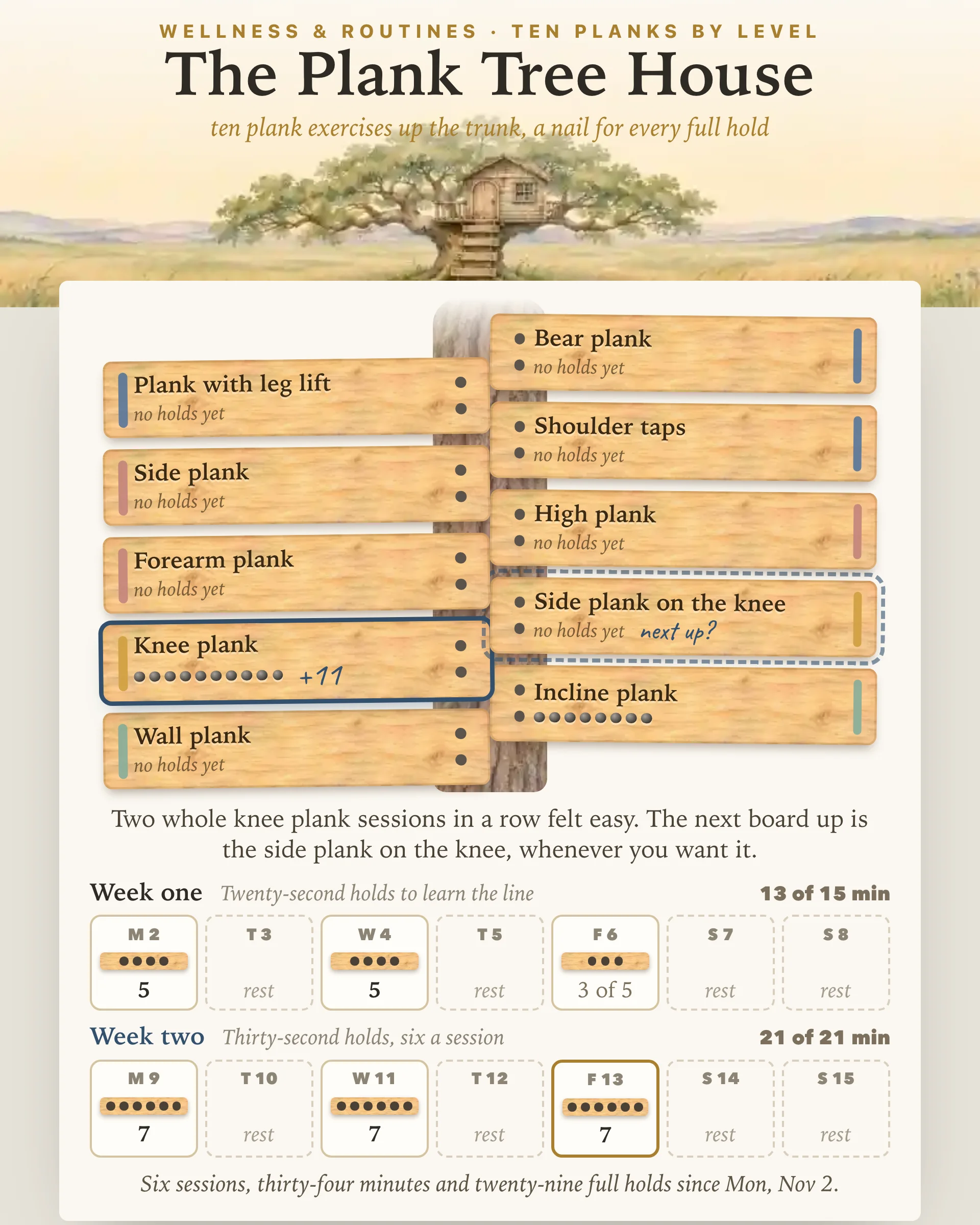
A plank asks your body to be a board: one straight line from your head to your heels or knees, held still while you breathe. The shape comes in many versions, and the version matters more than the seconds. A plank with your hands on a kitchen counter and one up on your toes train the same skill at very different loads, so the useful question is which plank to do today.
This page nails ten plank exercises up a tree trunk as boards, the gentlest at the foot of the tree and the hardest by the tree house door. You pick a board, follow its card, and let a hold timer run a short session three days a week for four weeks.
Each card says how to set up, how to breathe and what keeps the line, such as moving to your forearms when your wrists complain.
Press begin and the timer gives you a minute to warm up, then runs the week's holds with a rest after each. It keeps real time: if your phone locks, the clock still knows where the session is when you look again, and a pause stops it outright.
A hold counts only when it runs its full time, and each full hold drives a nail into your board. Stop a session partway and the page keeps only the whole minutes you finished and the holds that ran to the end.
The four weeks rise gently. Week one asks for four holds of twenty seconds on three days, five minutes a session. Week two moves to six holds of thirty seconds, week three to forty, and week four to forty-five, in sessions of seven to ten minutes.
After each session you tap how it felt. When your two latest sessions on a plank both ran whole and both felt easy, the next board up is marked for you. A hard session, even one you ended early, points one board down, and a tap on something hurt sends you to rest and to a doctor or physical therapist rather than to any board.
Climbing by taking away support has a basis. In a 2024 study of ten plank exercises, researchers measured shoulder and upper back muscles in 21 healthy young men and found that moving from forearms to hands, and from four points of contact to three or two, changed how hard those muscles worked. It was one lab session in young men, so it says nothing about results over weeks, or about women or older adults.
For older adults, a small randomized pilot study gave 24 healthy people aged 65 to 85 either a home core strengthening program, three times a week for six weeks, or no program. The exercise group improved more on two balance reaching tests. It was tiny and short, did not measure falls, and its program was not this ladder. A 2013 systematic review of 20 studies found that trunk strength goes along with better balance and everyday function in older adults, but most of the training studies were of modest quality, and the authors asked for better ones.
Planks cover only part of strength training. The World Health Organization's 2020 guidelines ask adults for muscle strengthening of all the major muscle groups on two or more days a week, and older adults for varied balance and strength work on three or more days. Planks train your trunk and shoulders, so pair them with work for your legs.
No hold burns fat from your middle in particular, and this page makes no promise about how your body will look after four weeks. Judge the month by a steadier line, a quieter breath and nails on a board higher up the trunk.
Talk with a doctor or physical therapist before starting if you have had surgery on your belly, back or chest in recent months, if you are pregnant or had a baby recently, or if you have shoulder, wrist or back pain. Keep breathing through every hold, since many people hold their breath without noticing, and stop any hold that hurts.
If you want a fixed calendar instead of a ladder, The 30-Day Plank Challenge runs forearm, high and side planks on a set thirty-day schedule with its own stopwatch, while this page lets you choose among ten planks and climb at your own pace. If getting down to the floor is not right for you yet, The Standing Cairn works your middle on your feet, and The Core Rings adds gentle seated and standing core work for later life.
The ones where you can keep a straight line and keep breathing. A wall plank or an incline plank with your hands on a sturdy counter takes part of your weight off the floor, and a knee plank shortens the lever. Move up to the forearm plank once two whole sessions on your knees in a row feel easy.
Ten, in four levels. Standing: the wall plank and the incline plank. Knees down: the knee plank and the side plank on the knee. Full planks: the forearm plank, the high plank and the side plank. Harder holds: shoulder taps, the plank with leg lift and the bear plank.
Only as long as your body stays in one line and your breath stays easy. The plan here begins with twenty-second holds and reaches forty-five seconds in week four, with a rest after every hold. A few shorter holds in good form are the aim, not one long hold that ends with sagging hips.
No exercise burns fat from one chosen spot, and planks are no exception. They train the muscles around your trunk to hold you steady, which you rely on when you carry bags, climb stairs or get up off the floor. This page makes no promise about how your body will look.
Ask a doctor or physical therapist first if you have had surgery on your belly, back or chest in recent months, if you are pregnant or gave birth recently, or if you have shoulder, wrist or back pain. Keep breathing through every hold, and stop any hold that hurts.
By the team behind Fabulous, the science-based self-care app used by over 30 million people.


