Leaves on a StreamEmotional Fitness · ~3 min
About this template · Updated September 2026
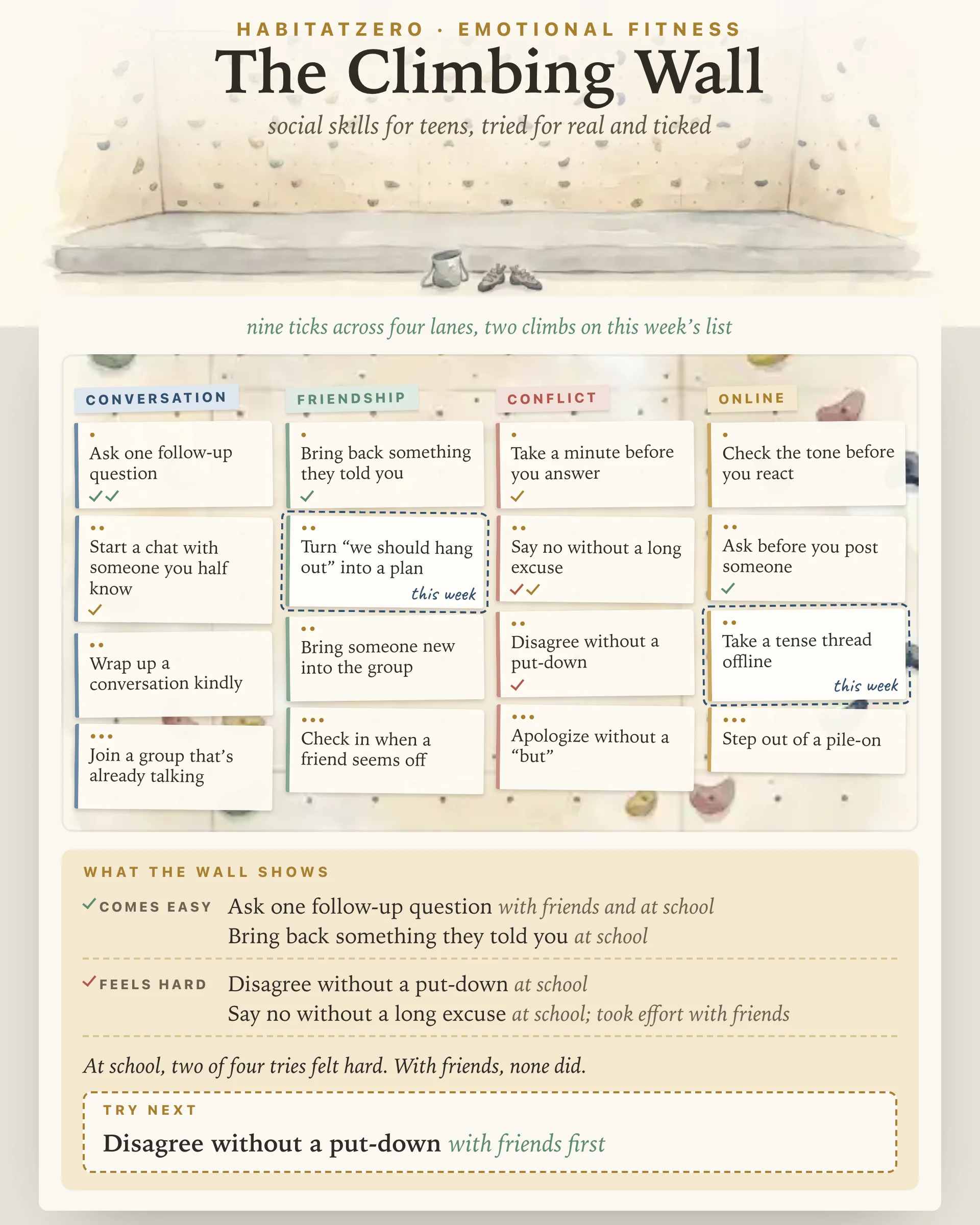
Most lists of social skills for teens read like a code of conduct: take turns, don't interrupt, listen well. A teenager can agree with every line and still freeze when the group at lunch is already mid-conversation. Knowing a skill and using it in the moment are different abilities, and the second one mostly grows through practice in situations that count.
So this page turns the list into a climbing wall. Each skill is a climb with a grade. The job is to try it for real this week, then record how it went and where it happened.
The wall follows the relationship strand of the CASEL framework for social and emotional learning. CASEL describes relationship skills as the ability to build and keep healthy, supportive relationships and to get along in groups of different people. Its examples include communicating effectively, resolving conflicts constructively and resisting negative social pressure.
The wall turns those into sixteen concrete moves in four lanes:
Online gets a lane of its own because so much teenage social life runs through a phone. In Pew Research Center's 2024 survey, nearly half of US teens said they are online almost constantly.
Every climb carries one, two or three dots. One dot is a warm-up that fits into an ordinary school day; three dots is a stretch. The grade describes the climb, never the climber. A skill that feels hard is not a verdict on your teen. It is simply the one they are still working on, what climbers call a project.
These skills can be taught: a meta-analysis of 213 school-based social and emotional learning programs, covering more than 270,000 students from kindergarten through high school, found better social and emotional skills, behavior and academic performance among participants, and results depended partly on whether programs used four recommended practices for developing skills. A page is not a program, but it can borrow the plain part: practice the move somewhere real, then look honestly at how it went.
The teenage years may be an especially good time to practice. A review in the Annual Review of Psychology describes the social brain as still changing through the second decade of life, possibly a sensitive period for adapting to one's social world, alongside a heightened social sensitivity.
Tap any climb to put it on this week's list. Three is the limit, since three fits around everything else a week holds. After trying one, your teen taps how it went (came easy, took effort, or felt hard) and where (school, home, friends, online, a team or job, somewhere new), adds a few words if they want, and ticks it. Every try earns a tick, whatever it felt like; the color only records how it felt.
Once a few ticks are in, the wall reads them back: what comes easy and where, what took effort, what still feels hard and where. When the numbers allow, it compares settings in one line, such as "At school, two of four tries felt hard. With friends, none did." Then it offers one climb to try next. A skill that felt hard comes back with a nudge to try it first where things have gone easiest so far. With no easier setting to move it to, a warm-up lower on the same lane comes next, and a lane that keeps coming easy gets its next grade up.
Let your teen choose the climbs. A skill they picked gets tried; a skill you assigned gets negotiated. Ask about the setting more than the result, because "What made it easier with friends?" opens a conversation and "Why couldn't you do it at school?" closes one. Leave the grading to the wall. Your part is curiosity.
If your teen would rather keep this to themselves, that works too. The page speaks to them directly, and the ticks are theirs.
The wall is for ordinary awkwardness. If social situations have started to feel frightening rather than awkward, Anxiety Worksheets for Teens is a gentler starting point, and a school counselor or doctor is worth a conversation. If the harder climbs keep stalling under a loud inner critic, the Teen Self-Esteem Worksheets work on that directly. And if saying no keeps showing up as a project, the Boundaries Worksheet helps write the exact sentence before it's needed.
Pick the week's climbs on a Sunday night or at a counseling check-in, and tick each one the same day it happens. After a few weeks, read the wall together and look first for a skill that comes easy in one setting and hard in another. That gap is where the next good conversation starts.
They are the everyday moves that make relationships work at this age: opening and closing a conversation, keeping friends and making new ones, handling a disagreement without it blowing up, and getting along in group chats. This page breaks them into sixteen specific climbs across four lanes, from warm-ups to stretches.
This page skips role-play and uses the week itself. Each climb comes with one concrete way to try it in a real moment, like asking a single follow-up question, turning a vague plan into a day and a place, or moving a tense group chat to a direct message.
Both. The wall works as a checklist of sixteen skills, and each tick records how the try went and where it happened, so after a few weeks it turns into a record of what comes easy, what still feels hard, and in which settings.
Small, repeatable moves are a practical place to start. Remember something a person told you and ask about it later, attach a real day to an invitation, and check in privately when a friend seems quiet. The friendship lane on this wall is built from moves like those.
Yes. Sit down together to pick the week’s climbs, then let the teen do the ticking. Ask about the settings more than the results, since a skill that comes easy with friends but hard at school says more than any score. It also works for a teen alone, and the page is written to them.
By the team behind Fabulous, the science-based self-care app used by over 30 million people.