
The Overwhelm Recovery ProtocolWellness & Routines · ~5 min
About this template · Updated November 2026
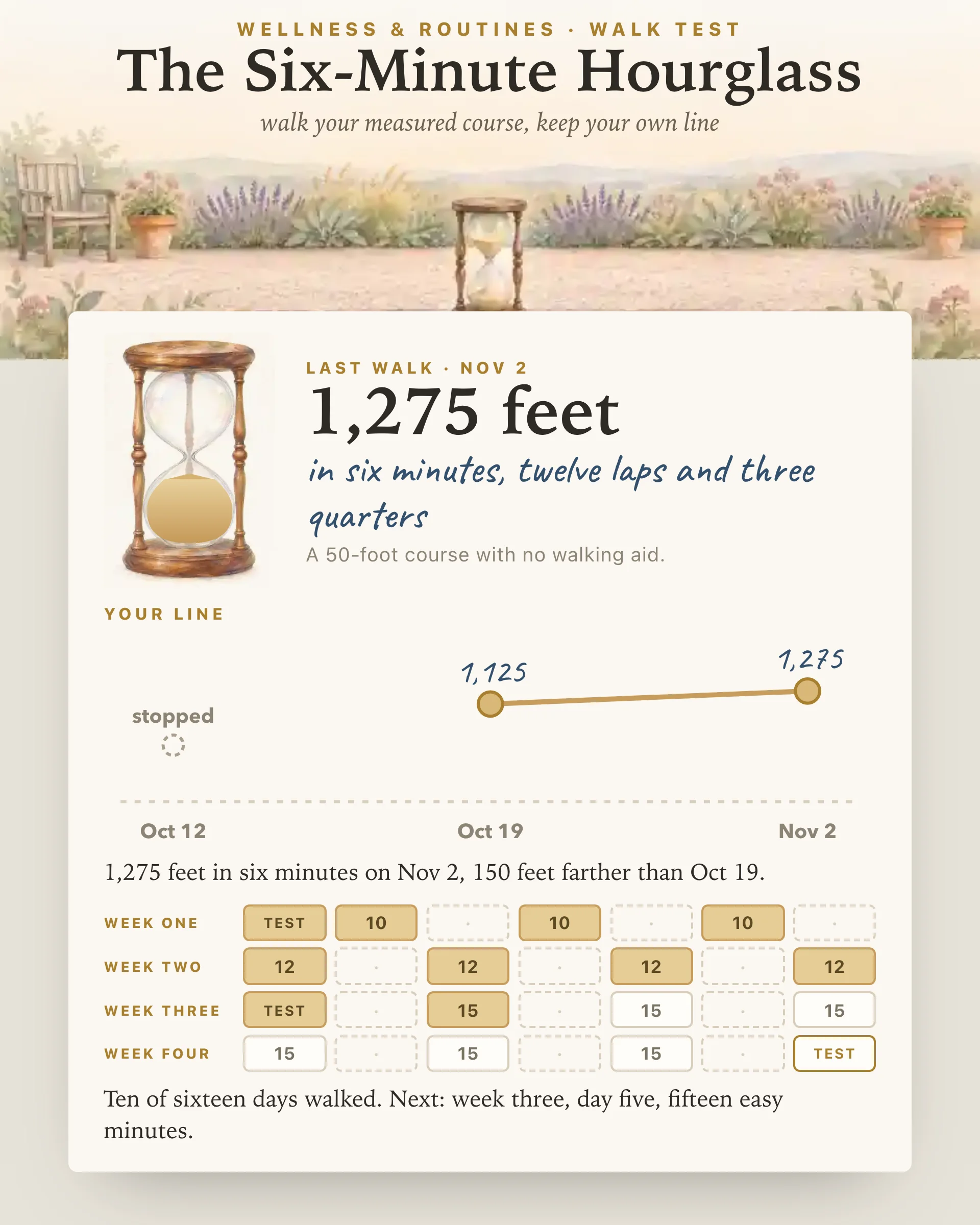
The 6 minute walk test asks one plain question: how far can you walk in six minutes on flat ground, at your own pace? You walk back and forth along a measured course, turning at a marker at each end, and the distance you cover is the result. This page gives you a timer drawn as an hourglass that keeps real time, a lap counter, and a dated line where each walk sits beside your own earlier walks and no one else's.
Respiratory teams lean on field walking tests like this one to judge exercise capacity, to help weigh a person's outlook and to see whether a treatment is making a difference, according to the technical standard from the European Respiratory Society and the American Thoracic Society. The same document warns that results shift with small changes in how the test is run, and it asks for two tests rather than one. Physical therapists use it as well: the core measure sheet from the Academy of Neurologic Physical Therapy treats it as a submaximal test of walking endurance.
On the therapists' sheet, a chair waits at one end of a hallway with a smooth floor and a turning marker at each end. The walker is asked to cover as much ground as they can without running, and may slow down, stop or lean on a wall to rest while the clock keeps going, then carry on. Someone counts laps. Once a minute that person says one short line of encouragement with the time left, and nothing more, because talking during the walk changes the result. If the walker needs to sit down, the test ends there and the distance so far is what counts. A cane or walker is fine, as long as it is noted and kept the same next time.
At home, measure a straight, level stretch with a tape: a hallway, a quiet driveway, a path with no curbs or traffic. Longer is better. The therapists' sheet notes that shorter tracks give shorter distances, so a hallway result will not match a clinic's, and the fair comparison is your own walk on the same course. Keep a chair at one end, wear your usual shoes, and have someone with you to count and to watch.
Check with your doctor or physical therapist before you try this if you have a heart, lung or blood pressure condition, have had recent surgery, a fall, dizziness or a joint replacement, or live with pain. With a heart or lung condition, or after surgery, walk the test only once your care team has said yes. Stop if anything hurts. Stop at once and sit down for chest pain, breathing that feels unusual for you, dizziness, leg pain or any sense of being unwell, and call 911 or your local emergency number if chest pain or trouble breathing does not settle with rest.
Enright and Sherrill tested 117 healthy men and 173 healthy women aged 40 to 80. The median distance was 576 meters for the men (about 1,890 feet) and 494 meters for the women (about 1,620 feet). Older and heavier walkers covered less ground, as did shorter men, and the equations the authors built from age, height and weight explained only about 40 percent of the spread between people. Casanova and colleagues later measured 444 healthy adults of the same ages in seven countries. Their average was 571 meters (about 1,870 feet), single results ran from 380 to 782 meters (roughly 1,250 to 2,570 feet), men walked about 30 meters farther than women, and distance fell clearly with age. They also found real differences between countries and test sites, and advised caution with any one prediction formula.
Treat those figures as a rough guide, nothing more. They come from healthy volunteers on a standard clinic course, and Enright and Sherrill meant their equations for a person's first test. They say nothing about your lungs, heart, medicines or history, a home hallway is not their course, and a walk below or above them is neither a diagnosis nor a clean bill of health. Reading your distance against your condition is your care team's job.
Set your course length and walking aid, check the four boxes, and turn the glass: the sand drains on the real clock, even on a locked phone. Your companion taps lap at each pass of the start and reads the line shown for each minute. Afterward, mark where the walk ended, to the nearest quarter of a lap, and how hard your breathing felt. A walk stopped early stays a hollow mark with its time and distance so far, never compared with a full walk, and a new course or aid starts a new line.
Walk the test on day one, as week three begins and on the last day of week four, at about the same time of day. Between tests, the plan asks for easy walks of ten to fifteen minutes. For more shape on those days, the Walking Workout builder lays out a session, and How Many Steps a Day helps set an everyday target. Before an appointment, bring your line and note your questions on Questions to Ask Your Doctor.
It measures how far you can walk in six minutes on a flat course, at your own pace, turning around a marker at each end. Clinicians use it to gauge everyday walking capacity, often for people with lung or heart conditions and before and after a rehab program.
No single figure fits everyone. Studies of healthy adults found that distance drops with age and weight, rises with height, and differs between countries and test sites. The article on this page names those studies and the limits of their numbers. Your own earlier walks on the same course make the fairer yardstick.
A home version can track your own walks over time if you measure a flat course, keep the same course and walking aid every time, and have someone beside you. With a heart or lung condition, or after recent surgery, walk it only with your care team's okay. A home figure is not the same as one taken in a clinic hallway.
Stop at once for chest pain, unusual breathlessness, dizziness, leg pain or feeling unwell, and sit down. Slowing down is fine, and so is standing still to rest while the clock keeps running, but needing to sit ends the walk.
Yes. The hourglass timer, the lap counter, your line of walks and the four weeks of easy walks between tests are all free to use.
By the team behind Fabulous, the science-based self-care app used by over 30 million people.


