
The Overwhelm Recovery ProtocolWellness & Routines · ~5 min
About this template · Updated September 2026
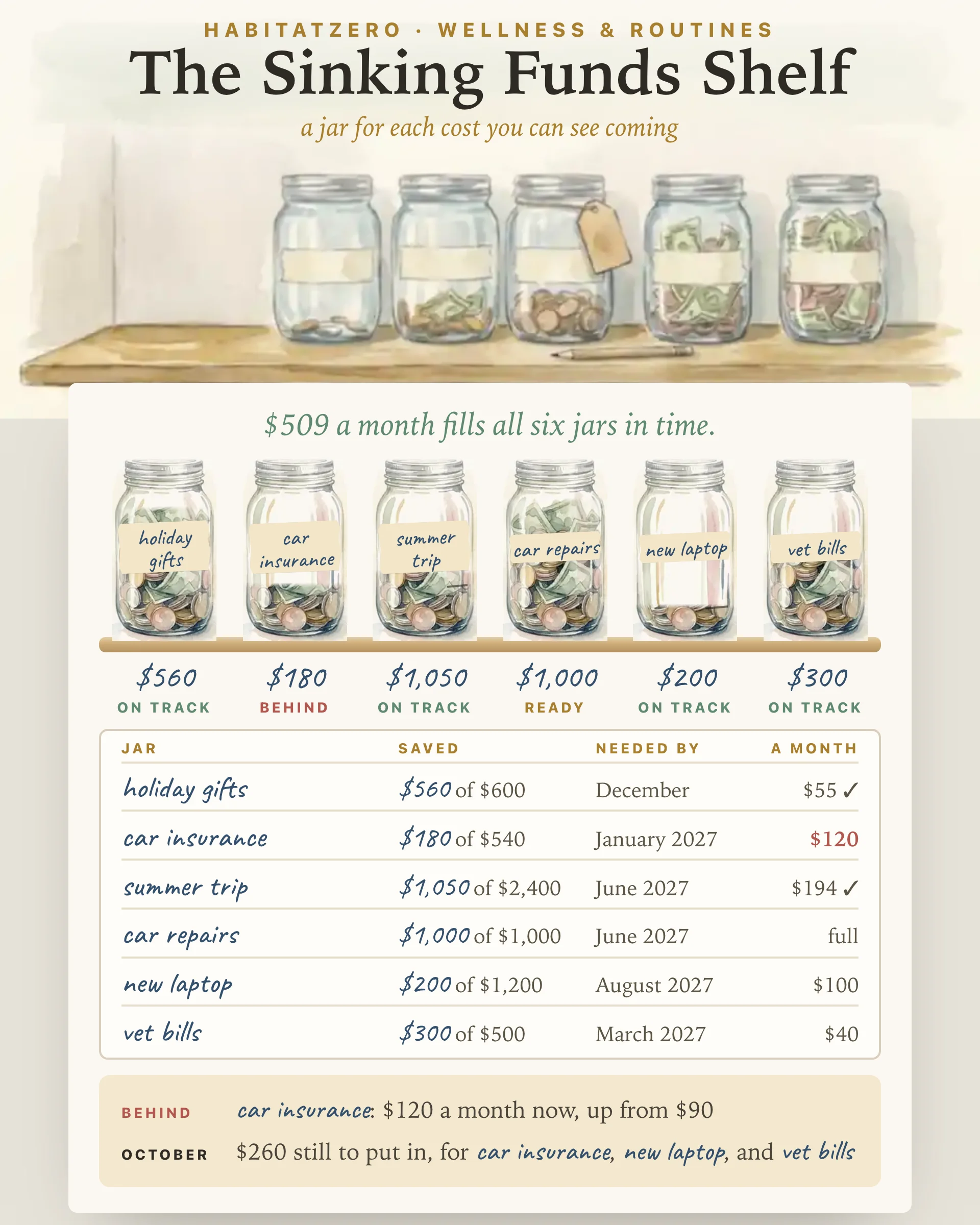
A sinking fund is money you put aside in small amounts for a cost you already know is coming. The car insurance premium that arrives every six months. Holiday gifts in December. The vet, the new tires, the laptop that will not survive another year. None of these is a surprise, yet each one tends to land like one, because it never shows up in an ordinary month's budget.
The fix is old and plain: give each known cost its own pot, work out what it needs each month, and feed it a little on every payday. When the bill arrives, the money is already sitting there. This page turns that habit into a shelf of jars you can keep.
It is not carelessness. Across seven studies, Sussman and Alter found that people predict their ordinary spending fairly well but underestimate what they will spend on exceptional purchases, the infrequent and unusual ones, and overspend on each of them. Their explanation is that every exceptional cost gets filed as a one-off, so nobody adds them up. They closed by proposing a fix that reduced the effect: thinking of those purchases as part of a larger set.
A later series of ten studies by Howard, Hardisty, Sussman and Lukas found the same pull in forecasts of total spending. People picture a typical month, so their guess lands below what they end up spending. Asking them to think of reasons a month might differ from usual raised their forecasts and made them more accurate.
A shelf of named jars is that prompt made permanent. Every irregular cost you can think of sits in one row, where you see them all at once instead of meeting them one at a time.
Tap a suggested jar to put it on the shelf. The suggestions are the sinking funds categories that come up most often, from car repairs and car insurance to birthdays, back to school and yearly subscriptions, and each arrives with a typical price and month. Change the price by typing it or stepping it, and step to the month it is needed by. You can also name a jar of your own.
The jar then does the sum a paper tracker leaves to you: whatever is still missing, divided by the months left, rounded up to a whole dollar. Add every jar's share together and you have one number, the month's set-aside, which the page shows right under the title. If you already have money put aside for a cost, count it once as already saved and the share drops to match.
On payday, move the money, then tap put in on each jar and watch the coins rise. A pencil tick on the glass marks where a steady pace would have the jar by now. If a month gets skipped, the jar falls below its tick and the reading says so plainly, with the new monthly share next to the pace you started with. Nothing scolds you. The numbers simply change to what will still fill the jar in time.
When the cost finally arrives, take the money out to pay it. A yearly jar can then go round again, so next year's premium starts filling right away. The shelf holds eight jars. If you want a ninth, one has to come off first, which is a useful question to be asked.
This is a way to organize money you already have coming in, not financial advice. The share assumes one deposit a month and a price that holds still; real bills rise, and a jar is only as good as the estimate on its label. Look over the prices once a year.
A sinking fund is also not an emergency fund. It pays for things you can name and roughly date, which leaves the emergency fund free for what nobody can schedule. That separation matters. In the Federal Reserve's report on household finances in 2025, 63 percent of adults said they would cover a hypothetical $400 emergency expense entirely with cash or its equivalent, and 12 percent said they could not pay it by any means. A car repair you have been filling a jar for since spring never has to become that kind of emergency.
Where the money lives is up to you. One savings account with the jars tracked here works, and so do separate accounts if your bank makes that easy. The page keeps the record, not the cash.
Set the shelf up the first time a once-a-year bill catches you short, or on the first payday of a month. Your regular monthly bills belong on The Bill Ledger; the jars are for everything that does not come every month. When the holiday gifts jar comes due, plan the spending itself with The Christmas Budget. And if you are saving toward one large goal rather than several known bills, a single chart like the Savings Tracker will suit it better.
Check the shelf each payday. It takes two minutes, and it turns the bills that used to ambush you into a line on a list.
It is money you set aside in small amounts for a cost you already know is coming, like a car insurance premium, a vet visit or holiday gifts. When the bill lands, the money is sitting there, so the month it arrives in does not have to absorb it.
Car repairs, car insurance and registration, holiday gifts, birthdays, vacations, vet bills, home repairs, medical and dental costs, back to school and yearly subscriptions come up most often. The best list is your own: scan the last twelve months of statements for anything that did not arrive every month.
Take the cost, subtract what is already saved for it, and divide by the months left until it is due. A $600 bill six months away with nothing saved needs $100 a month. This tracker does that sum for every jar, rounds each share up to a whole dollar and adds the shares into one monthly figure.
A sinking fund pays for a cost you can name and roughly date. An emergency fund covers what nobody can schedule, like a lost paycheck. Keeping them apart stops a predictable bill from quietly spending the money that was meant for a real shock.
The shelf on this page is a sample to look through. To keep a shelf of your own, with every jar, deposit and date still there on the next payday, personalize it in HabitatZero at no cost.
By the team behind Fabulous, the science-based self-care app used by over 30 million people.


