Leaves on a StreamEmotional Fitness · ~3 min
About this template · Updated September 2026
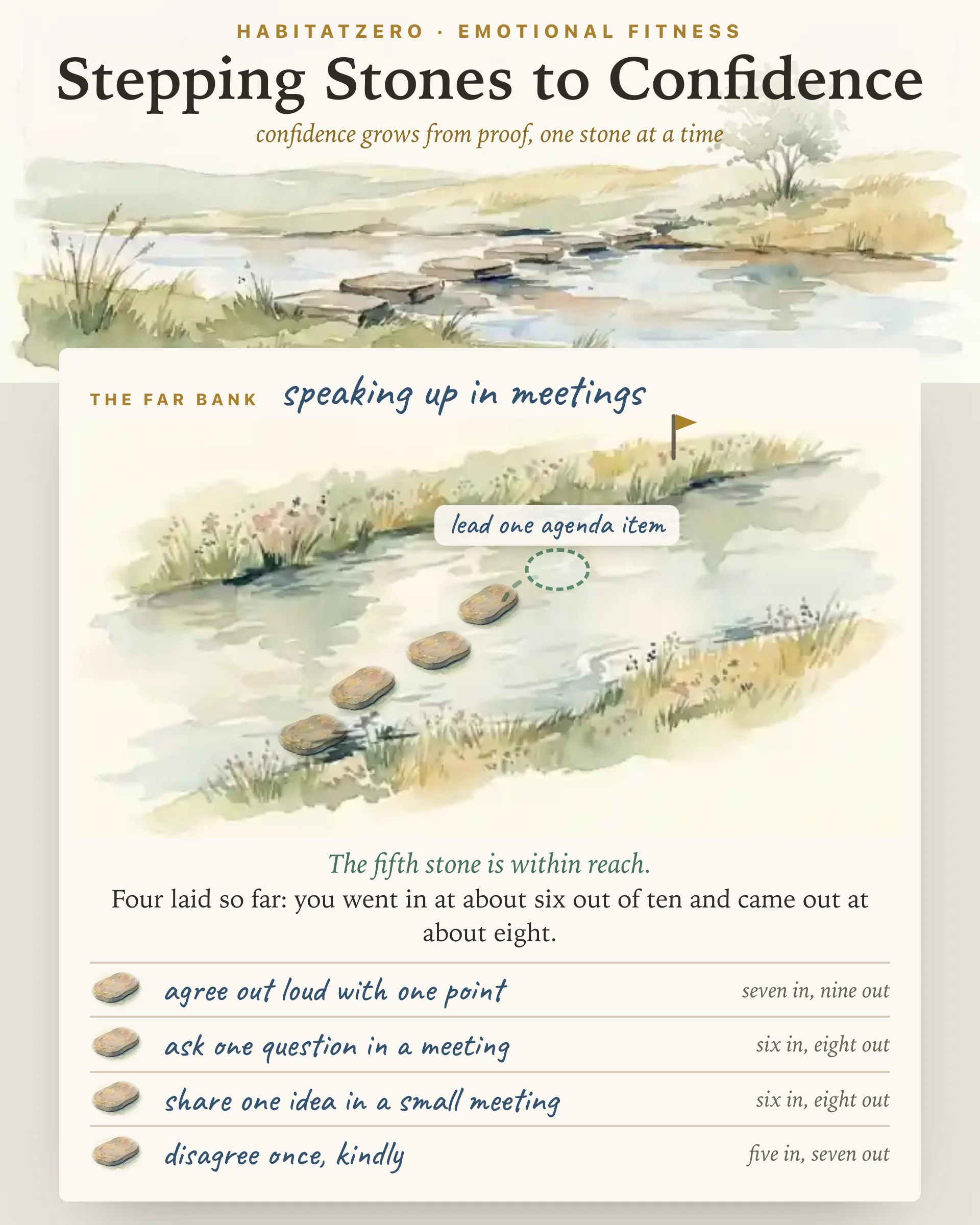
Most advice about confidence starts with how you feel. This worksheet starts with what you do. It treats self-confidence as what the psychologist Albert Bandura called self-efficacy: how sure you are that you can carry out a particular action, such as making a phone call, speaking up in a meeting or walking into a gym alone. In the paper that introduced the idea, Bandura proposed that this expectation shapes whether you start, how much effort you put in and how long you keep going when it gets uncomfortable.
The same paper names four places the belief comes from: things you have accomplished yourself, watching other people manage, being told you can, and the state of your body while you try. Bandura argued that the more dependable the source, the bigger the change, and that sticking with something that feels threatening but is in fact fairly safe builds self-efficacy through the experience of mastery. A compliment tends to fade by evening. A phone call you actually made is still evidence next month.
Self-confidence in this sense is narrower than self-esteem. Self-esteem is your overall sense of your own worth, while self-efficacy belongs to a task. You can like yourself and still dread public speaking, or feel sure behind the wheel and shaky on the phone. That is why the page asks you to name one far bank, a single thing you want to feel sure enough to do, rather than asking you to rate yourself as a person. If worth is the harder question for you right now, the Self-Esteem Worksheets take it on directly.
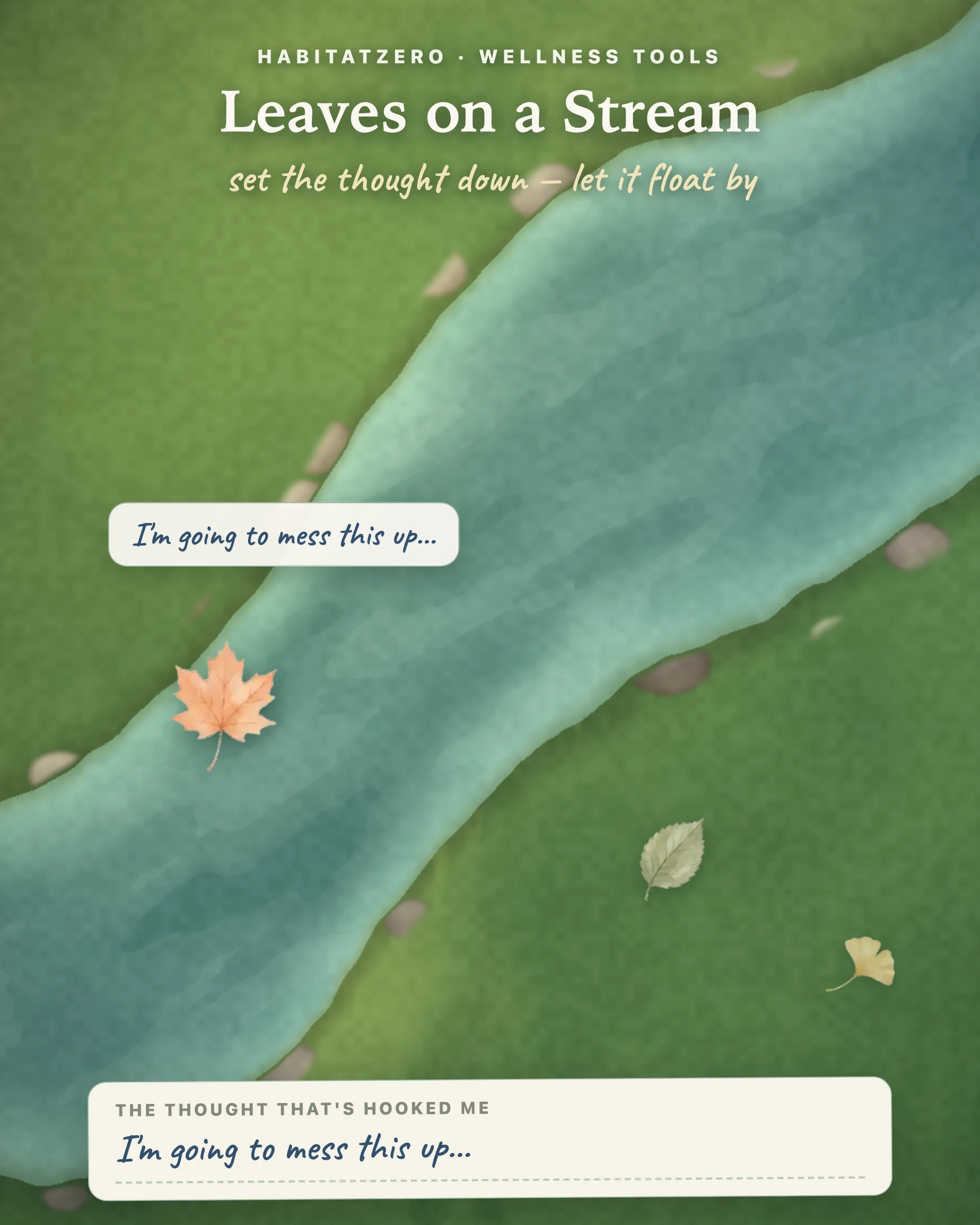
At the top, name your far bank or tap one of six suggestions. Below it, a painted stream waits for stones.
The next stone is one small step toward that bank. Tap an idea from the list, which runs from smallest to biggest, or write your own. Then slide to say how sure you are, from zero to ten, that you can do it in the coming week. The stone moves as you slide. Rated seven or more, it sits a comfortable stride from the last one. At five or six it drifts farther out and the page calls it a stretch. At four or below it lands out of reach, and the page offers you the smaller step from the list when there is one.
The seven comes from clinical practice rather than a laboratory. In a primary care study of behavior-change action plans, clinicians asked patients how confident they were in a plan, from zero to ten, and reset any plan that scored below seven, reasoning that success with even a small change builds self-efficacy. Treat the cutoff as a working habit, not a law of nature.
When you have taken the step, come back and press I took this step. Say how it went, rate how sure you are now that you could do it again, and lay the stone. Six stones cross the stream. When you reach the far bank, or feel finished with it sooner, start a new crossing, and the old one is filed below with the rivers you have already crossed.
The last section is an evidence log. List times you did something while doubting you could: the first day at a job where you knew no one, a toast given with shaking hands, the hard conversation you finally had. For each one, tap how sure you were going in. You may find that doubt came along for most of your proof. It was there, and the thing still got done.
The strongest support for this approach concerns direction. A meta-analysis of studies that measured the same people over repeated tasks concluded that self-efficacy was primarily a product of past performance: how well people had just done predicted their next confidence rating more strongly than their confidence predicted how well they did next. Confidence, in other words, behaves like a readout of your evidence. Feeling sure first is not a condition for acting.
That cuts both ways. Kind words about yourself are not useless, but they carry more weight when they point at something you did, which is the thinking behind the believable lines on the Positive Affirmations cards. And a row of stones guarantees nothing. Some steps will go worse than you feared, and the page lets you say so. A stone laid after a hard step still marks something you did.
This is a self-help practice, not treatment. If fear keeps you from work, school or the people you care about, a therapist trained in cognitive behavioral therapy can plan graded steps with you and help with what a worksheet cannot reach.
Plan a stone at the start of a week, when you know roughly what the days hold. Lay it the day you take the step, while you still remember how sure you felt going in. Reread your rivers before something that scares you. For a teenager who wants the same kind of practice in simpler words, the Teen Self-Esteem Worksheets include one small brave thing and a did-it list.
It is a guided page for building belief in your ability to do one particular thing. This one keeps a log of what you have already managed despite doubt, and it helps you shrink the next step until you are fairly sure you can take it.
Mostly through small actions you can finish, followed by noticing that you finished them. Studies that follow the same people over repeated tasks find that confidence tracks what they have just done, so a steady run of reachable steps tends to beat trying to feel sure first.
Not quite. Self-esteem is your overall sense of your own worth, while self-confidence in this sense is how sure you are about one task, like leading a meeting or making a call. Plenty of people think well of themselves and still dread the phone, so the two call for different practice.
The number sizes the step. Primary care teams using action plans have asked patients that same question and reworked any plan scored under seven, because succeeding at even a small change builds self-efficacy. Below seven, this worksheet points you to a smaller stone.
You can look through the sample crossing on this page without signing in. To keep your own far bank, stones and rivers, personalize the worksheet in HabitatZero, which costs nothing.
By the team behind Fabulous, the science-based self-care app used by over 30 million people.