Leaves on a StreamEmotional Fitness · ~3 min
About this template · Updated July 2026
Low self-esteem rarely announces itself as a belief. It shows up as a narrator — the voice that reads your day back to you with the generosity of a hostile reviewer: everyone else manages fine; that success was luck; you're behind. Arguing with the narrator from inside your own head mostly gives it more airtime. Paper works better. These two worksheets put the argument where you can see it — one builds the case for your worth from evidence, the other retrains the tone of the voice itself.
A note before the exercises, stated plainly: these are self-help practices, not therapy. They borrow structure from well-studied approaches, but they treat nothing and diagnose nothing. If the harsh voice is heavy, constant, or interfering with your life, the genuinely self-respecting move is talking to a mental-health professional — these pages will still be here afterward.
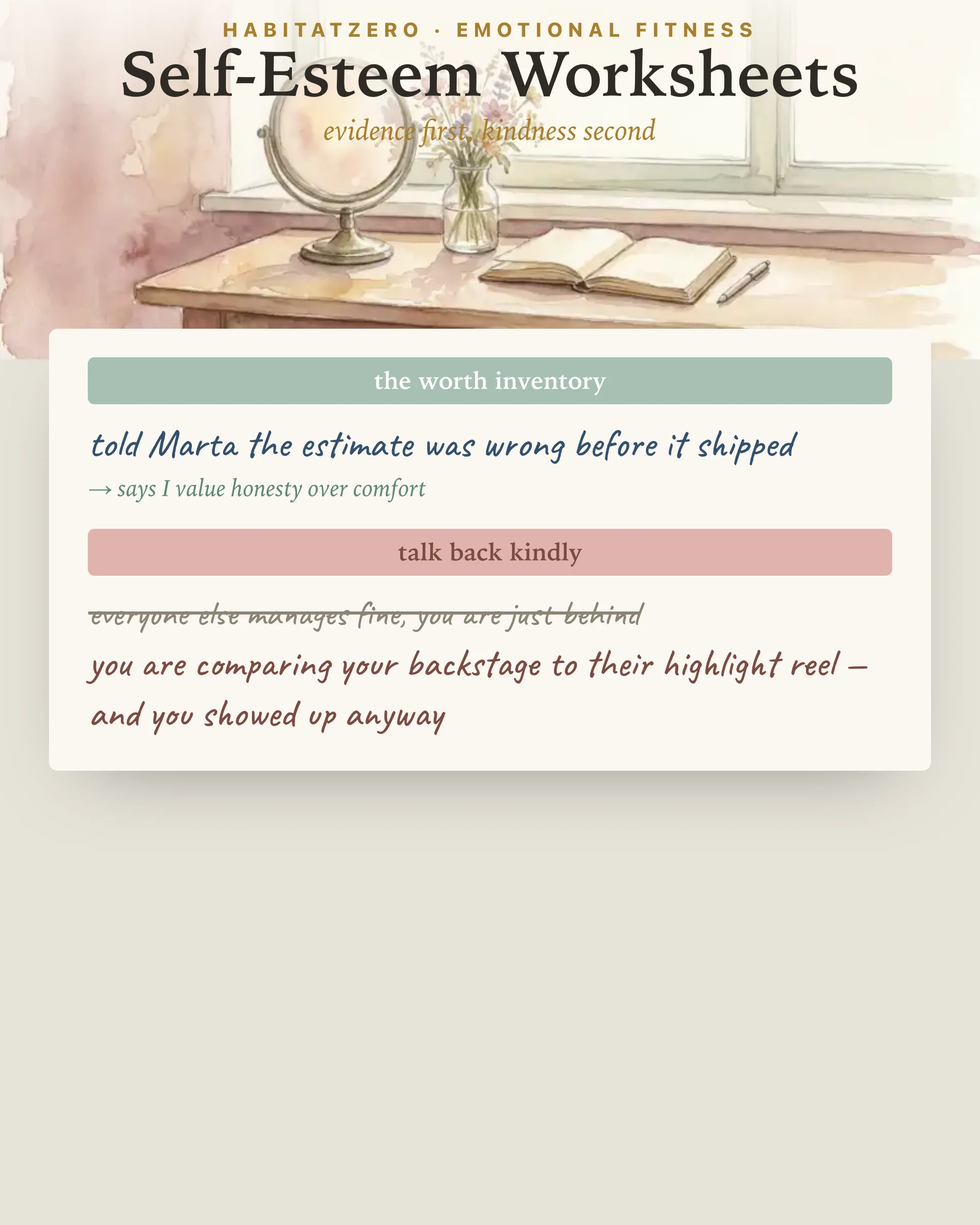
The inventory asks for two things per line: something you did — small and true counts double — and what it says you value. Told Marta the estimate was wrong before it shipped → honesty over comfort. Took the walk anyway → keeping promises to myself.
The second half of the line is the working part. Self-esteem that leans on outcomes is structurally fragile — it rises with the good quarter and falls with the bad review, because outcomes were never fully yours to control. Values-based reflection is sturdier ground, and it's the mechanism behind one of social psychology's most replicated interventions: self-affirmation exercises, in which people write briefly about values they hold and act on, measurably buffer the self against threat and improve performance under pressure — not by inflating the ego, but by widening the base it stands on (review: DOI 10.1146/annurev-psych-010213-115137). Twelve dated lines of deed → value is that intervention, kept where you can re-read it on the days the narrator gets loud.
The second sheet catches the narrator in the act. When a harsh line runs — you're just behind — you write it down word for word. Then, underneath, you answer it exactly the way you would answer a friend who said it about themselves.
That friend-clause is not a nicety; it's the whole technology. Most people already possess a fluent, believable kindness — they just reserve it for other people. Kristin Neff's research on self-compassion, treating yourself with the same warmth you'd extend to someone you care about, links the practice to steadier self-worth with less of the contingency and comparison that make high self-esteem brittle (DOI: 10.1080/15298860309032). The worksheet makes the redirection mechanical: the harsh line renders struck through and small; your reply prints larger, warmer, and last.
Two craft rules make the exercise land. Quote the voice verbatim — paraphrased criticism keeps its authority, quoted criticism usually sounds overwrought the moment it's visible. And answer, don't debate: a friend who said everyone else manages fine wouldn't get a lecture with citations; they'd get you're comparing your backstage to their highlight reel — and you showed up anyway.
The inventory caps at twelve lines, the talk-back at ten pairs. Deliberately. An endless log becomes homework, and homework gets avoided; a bounded page becomes a document — finishable, re-readable, and quietly persuasive precisely because you wrote every line of it. When a section fills, the sheet considers your case made. Re-read it; that's the practice paying out.
Add one line of evidence from the last twenty-four hours — something small enough that the narrator would call it nothing, tied to the value it expressed. Then wait for the next harsh line, catch it word for word, and give it the reply your best friend would get. Evidence first, kindness second. The voice can wait its turn.
Short structured exercises for practicing a steadier relationship with yourself. This page holds two: a worth inventory that records small true actions and the values they express, and a talk-back sheet where you write down a harsh inner line and answer it with the tone you would use for a friend.
Self-esteem tends to rise and fall with results — a good week lifts it, a bad review dents it. Self-worth is the layer underneath: the standing sense that you matter independent of the latest scoreboard. The inventory here deliberately feeds that deeper layer by tying each entry to a value you acted on rather than an outcome you won.
Most people speak to themselves in a tone they would never use on anyone they love. Writing the harsh sentence down, then answering it as you would answer a friend, borrows a kindness you already know how to give and points it inward — with practice, the kind reply starts arriving on its own.
Little and often beats rarely and long. One inventory line on ordinary days and a talk-back pair whenever the commentary gets loud is a sustainable rhythm — the page caps at twelve evidence lines and ten answered pairs, because a full page you re-read beats an endless one you avoid.
No. They are self-help exercises drawn from well-studied practices — self-compassionate reframing and values-based reflection — but they are not treatment and do not diagnose anything. If low self-worth feels heavy, constant, or is getting in the way of daily life, a mental-health professional is the right support, and these pages can wait.
Entries save with your HabitatZero worksheet answers and stay on your own devices — nothing on this page is shared or published, and removed lines are gone for good.
By the team behind Fabulous, the science-based self-care app used by over 30 million people.