
Leaves on a StreamEmotional Fitness · ~3 min
About this template · Updated September 2026
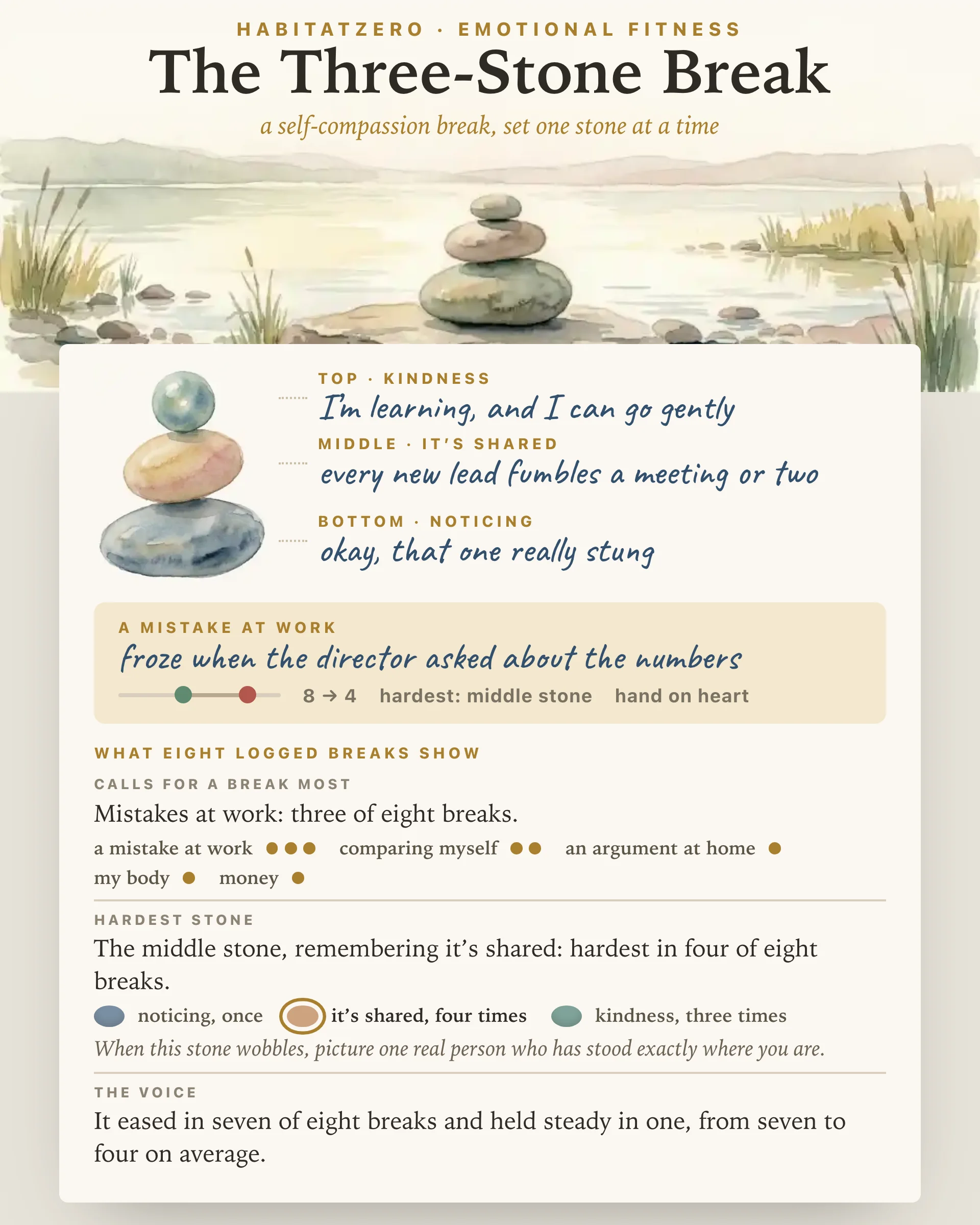
The self-compassion break is Kristin Neff's exercise, and her own short version is on self-compassion.org. In it you admit the moment is painful, remember that pain and failure turn up in every human life, and offer yourself some kindness, often with a hand over your heart. The Three-Stone Break is an independent practice sheet built on those three steps. Neff has no part in it and has not endorsed it, and the words you set on each stone are yours, not hers.
The bottom stone is noticing, which Neff calls mindfulness: saying plainly what is happening without shrinking it or blowing it up. It goes first because you can't comfort a hurt you are still arguing with. The middle stone is common humanity. The harsh voice likes to tell you that you alone keep getting things wrong, and the second stone answers with the plain fact that everybody does. The top stone is self-kindness, the tone you would use with a friend who called you after the same bad afternoon.
A cairn is a fair picture of how the steps lean on each other. Kindness balanced on nothing sounds hollow, and the reminder that everyone struggles lands better once you have admitted you are struggling, so the stones go on from the bottom up.
Start with the moment. Tap what happened, add a few words if you like, and rate how harsh the voice in your head is, from zero to ten. Then set the stones one at a time. Each has a short line for your own words and a few starters for when nothing comes, such as anyone in my shoes would feel this. Say the words to yourself slowly, set the stone, and watch it settle onto the cairn. Before the top stone you can pick a soothing touch: a hand on your heart, a hand on your cheek, your arms around yourself.
Your three lines stay on the page between breaks, so the next one takes about a minute. If you change the words on a stone that is already set, that stone comes off, along with anything resting on it, because you haven't said the new words yet.
When the cairn stands, rate the voice again and choose the stone that was hardest to set. The log keeps your last twelve breaks, and from the third one on it reads them back to you: which moments call for a break most often, which stone gives you the most trouble, and how far the voice tends to fall. If one stone keeps wobbling, the reading suggests a small way into it.
If you'd rather work on paper, print the page once your lines are written; the printout keeps your words, the reading and the log, and drops the buttons.
When researchers pooled twenty-seven randomized trials, they found that self-compassion interventions improved a range of outcomes against control groups, including self-criticism, rumination, stress, anxiety and depression, mostly by moderate amounts. Those trials tested full programs, run in groups or one to one, and they varied too much for the authors to compare types. So the review says nothing direct about a two-minute pause on a Tuesday. The honest reading is that this break is a small, repeatable piece of a skill with good evidence behind it as a whole.
The touch has a little evidence of its own. A randomized lab study of 159 adults aged eighteen to thirty-five found lower cortisol after a standard stress test in people who used a self-soothing touch or were hugged than in the control groups, although their heart rates and their own ratings of stress did not differ. Your body may settle a little before your mind agrees.
If you worry that kindness will make you soft on yourself, one set of experiments points the other way: people who were nudged toward self-compassion after failing a hard test spent longer studying for the next try than people given a self-esteem boost instead.
Treat your before-and-after ratings as notes, not measurements. Some breaks leave the voice exactly where it was; log those too.
Use it right after the sting: the email you wish you hadn't sent, the comparison that lands badly, the argument still replaying on the drive home. Practice on small moments as well, so the steps feel familiar when a big one arrives. If the harsh voice has specific sentences you want to answer, the Inner Critic Translator works on those directly. For a longer sitting practice, try The Loving-Kindness Circle, and if the touch turns out to be the part that helps most, The Butterfly Hug builds a whole practice around it.
This is a practice, not therapy. If the voice stays loud for weeks or starts to shape your days, talk with a therapist and bring the log along. If the harsh voice ever moves from what you did to whether you should be here at all, put the stones down and call or text 988 in the US, or your local emergency number, so a person can help you through it.
It is a short practice for the minute right after something hurts. You admit the moment is painful, remind yourself that struggling is part of every human life, and then treat yourself with some warmth. Kristin Neff designed it to fold the three parts of self-compassion into a pause of a minute or two.
In Neff's model they are mindfulness, which means seeing the pain clearly without inflating or dismissing it; common humanity, the reminder that everyone struggles and fails; and self-kindness, the warmth you would offer a friend. On this page each one is a stone, set from the bottom up.
There is no fixed script. Short lines that sound like you tend to work better than borrowed ones, so the page offers starters such as this is really hard right now, anyone in my shoes would feel this, or I can go easy on myself here, and then keeps whatever you write as your own three phrases for next time.
No. The Self-Compassion Break is Kristin Neff's exercise, and her own written and guided versions are on self-compassion.org. The Three-Stone Break is an independent worksheet that follows her three steps with its own wording, and neither Neff nor her organization is involved with it or has endorsed it.
You can read every step and see a filled-in example here without an account. Rating your own breaks, keeping your three phrases and building the log that shows your pattern all happen once you personalize the worksheet in HabitatZero, which is free.
By the team behind Fabulous, the science-based self-care app used by over 30 million people.


