Leaves on a StreamEmotional Fitness · ~3 min
About this template · Updated September 2026
The butterfly hug comes from Lucina Artigas, a Mexican therapist who developed it in 1998 while working with survivors of Hurricane Pauline in Acapulco. She has since described it with her colleague Ignacio Jarero, including in their chapter on the method. This worksheet stands on its own: it is not connected to Artigas, Jarero, EMDRIA or any other EMDR organization, and none of them has reviewed or endorsed it.
In its original setting, the butterfly hug is a working part of EMDR (eye movement desensitization and reprocessing) therapy. People tap themselves left and right while a trained clinician guides them through distressing memories, often in groups after disasters. Artigas and Jarero are plain about their view: in their 2021 write-up they state that the hug is not a self-soothing technique, and that the calm people report is a byproduct of that reprocessing.
This page borrows the gesture for something smaller: a few quiet minutes when ordinary stress has wound you up, like the hour before a big meeting or a night when your mind will not settle. It is not EMDR therapy, and it is not a way to process trauma on your own. If you are carrying trauma, do that work with a trained therapist, who can keep you steady while old material moves.
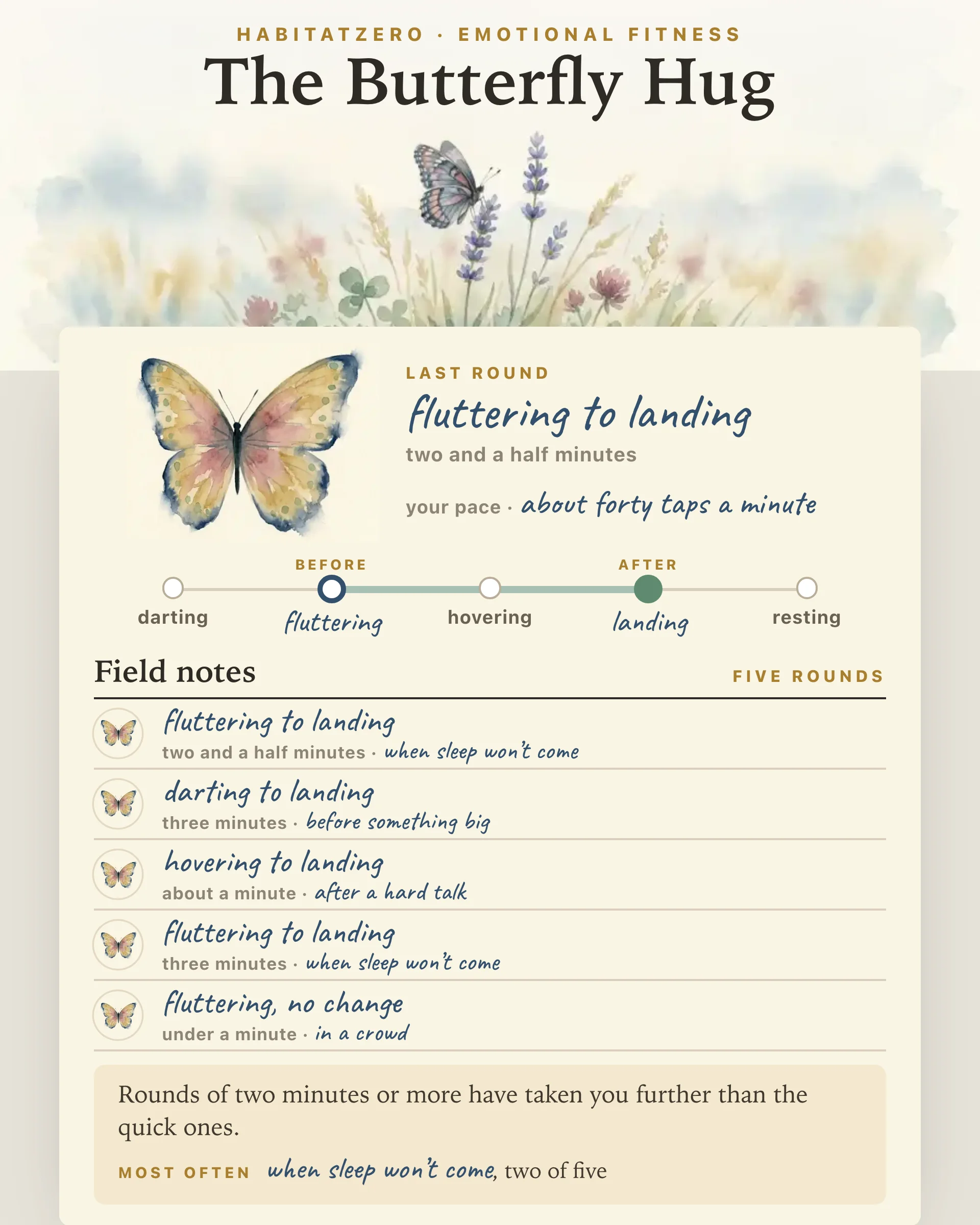
The painted butterfly stands in for your hands. Tap its wings in turn, as slowly as feels calm, and after four taps the page reads your pace in taps a minute and keeps it for next time. Mark how settled you feel on a five-step scale that runs from darting to resting, then begin. The wings take turns at your pace, in silence, so you can follow them for a few beats and then close your eyes.
Press enough when you are done, mark where you have landed, and name the moment if you like. Each round goes into your field notes, which keep twelve. From the third round on, the notes start telling you what tends to help: whether rounds of two minutes or more take you further than quick ones, which moments you reach for the hug most, and what your usual pace is.
Most studies of the butterfly hug sit inside EMDR programs, where it is one ingredient among several, so they cannot show what the tapping does by itself. Used alone for stress, the evidence is thin: a 2025 review of its use for anxiety in older adults found only three studies that met its criteria, with samples as small as two people and few rigorous controls, and its authors called for proper randomized trials.
The nearest solid evidence is about touch rather than tapping. In a randomized trial of self-soothing touch, 159 healthy young adults went through a standard lab stress test, and those who used a soothing self-touch, such as a hand over the heart, or who received a hug had lower cortisol afterward than the control groups. They did not report feeling any less stressed, though, and a hand resting on the chest is not the same thing as alternating taps.
So treat the hug as an experiment you run on yourself. That is why this page asks where you stand before and after every round: a few weeks of your own notes will tell you more about whether it suits you than a study of strangers can.
Try it in the ordinary tight spots of a week: before something big, when sleep will not come, after a hard conversation, while you wait for news. It needs both hands, so save it for a moment when you are not driving or carrying anything.
If an old, painful memory surfaces and starts to grow, stop. Open your eyes, press your feet into the floor and look around the room, then bring that memory to a therapist rather than pushing through it alone. When turning inward stirs you up, the outward-facing 5-4-3-2-1 Grounding walk can bring you back through your senses first.
To see why a small stressor tips you over on some days and not others, The Window of Tolerance maps the edges of your steady zone, and Somatic Exercises for Anxiety gathers other short body practices to compare with this one.
It is a way to give yourself slow, alternating taps. You cross your arms over your chest, rest your fingertips just below your collarbones, and let your hands tap left and right in turn while you breathe deeply and notice what passes through you. Plenty of people call it butterfly tapping.
Lucina Artigas developed it in 1998 while working with survivors of Hurricane Pauline in Acapulco, Mexico, and she has since written it up with Ignacio Jarero. It lets people give themselves the left-right stimulation used in EMDR therapy, and clinicians rely on it in group programs after disasters.
No. EMDR is a structured therapy led by a trained clinician, and within it the hug helps people reprocess painful memories with that support alongside them. Tapping on your own is a short calming practice for everyday stress; bring any trauma to a therapist trained to work with it.
A handful of small studies, mostly with students, nurses and older adults, report lower anxiety scores after sessions, yet few used solid comparison groups, and its creators say it is not a self-soothing technique. The fairest test is your own: rate how settled you are before and after each round and see what your rounds show.
Slow enough to feel calming, and for as long as your body wants. Its creators ask people to stop once they feel in their body that it has been enough, and they note that this takes about two or three minutes.
By the team behind Fabulous, the science-based self-care app used by over 30 million people.