
The Overwhelm Recovery ProtocolWellness & Routines · ~5 min
About this template · Updated November 2026
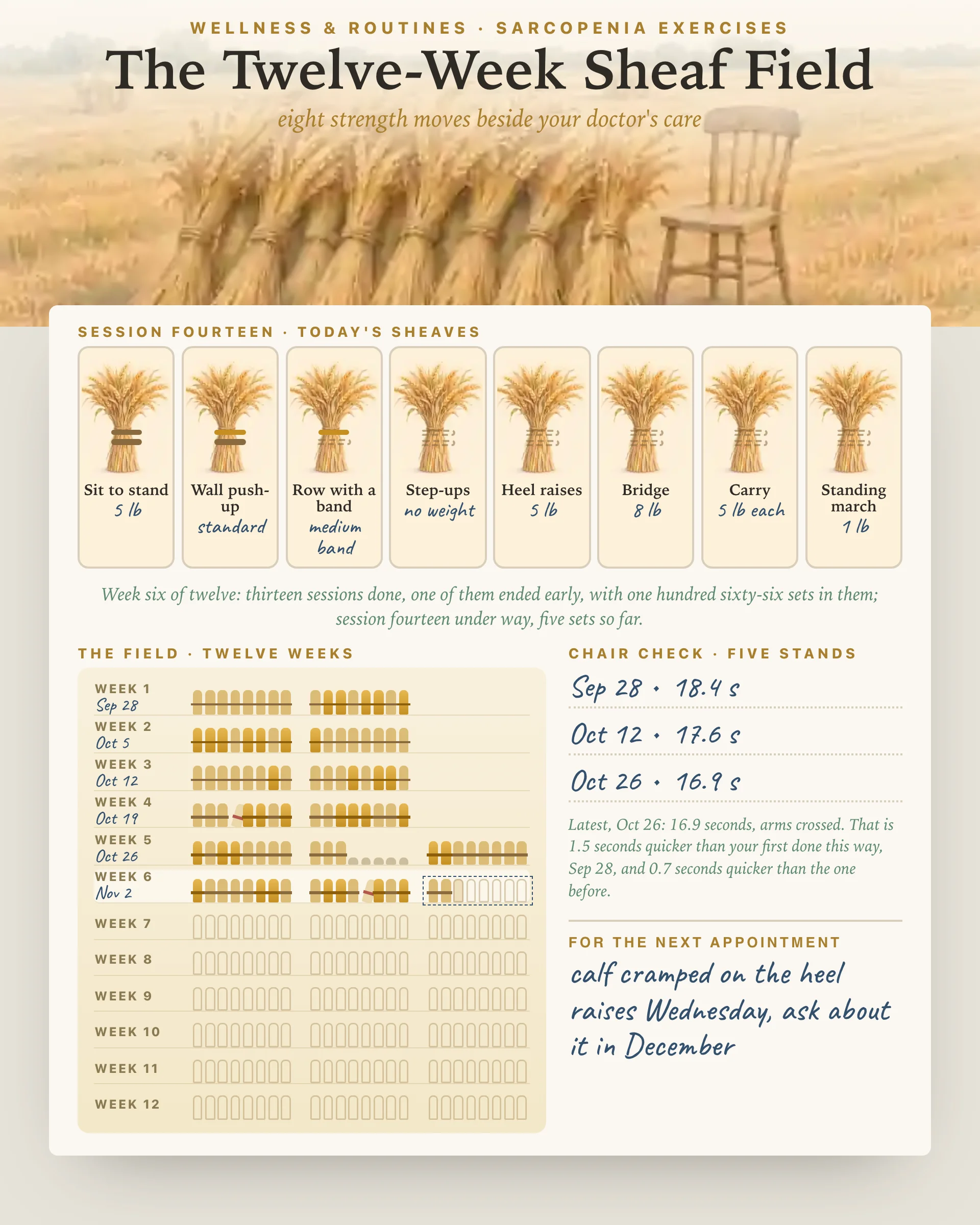
Sarcopenia is the loss of muscle strength and muscle mass that can come with age. A clinician names it from tests of grip strength or walking speed and a measure of muscle, and strength work is what the guidelines reach for first. This page is a twelve-week plan for that work at home, beside your doctor's care rather than in place of it, and it makes no promise to turn back the clock.
Talk with your doctor or physical therapist before week one if you have had a fall or dizzy spells, a heart or blood pressure condition, a joint replacement or recent surgery, a bone broken in a minor fall, or pain or weight loss nobody has explained. Stop a set if a joint hurts sharply, if you feel faint, dizzy or unusually breathless, or if your heart races or skips, and log it as stopped early. Chest pain, pressure or tightness that does not ease after a few minutes of rest means calling 911. Breathe out as you push, and keep a chair, counter or rail within reach whenever you stand.
The 2018 international clinical practice guidelines for sarcopenia, written by a task force of 38 researchers and clinicians from Europe, the Americas, Asia and Australia, make one strong recommendation for treatment: resistance-based physical activity. They rate its certainty as moderate and say plainly that trials in people diagnosed with sarcopenia were few and small. Protein supplements or a protein-rich diet get only a conditional recommendation on low-certainty evidence, with no amount named, and vitamin D and hormones get none.
A 1994 trial in a Boston-area nursing home gave 100 frail residents, 63 women and 37 men averaging 87, ten weeks of progressive resistance training. Their strength more than doubled and walking speed rose about 12 percent, though thigh muscle size did not change clearly, and a nutrition supplement alone did nothing for weakness. It was short and predates today's definition of sarcopenia.
The largest trial, SPRINTT, followed 1,519 people aged 70 and over with physical frailty and sarcopenia, most of them women, at 16 sites in 11 European countries for about two years. Center sessions twice a week, activity at home and nutrition counseling lowered the share who lost the ability to walk 400 meters: 46.8 percent against 52.7 percent among those with lower starting scores. It mixed walking, strength, balance and diet, so it cannot say what strength work did alone, and people with higher starting scores showed no benefit.
A network analysis of 42 randomized trials pooled 3,728 people with sarcopenia, mostly women in their seventies, followed for a median of twelve weeks. Strength work, alone or with aerobic and balance work, did most for quality of life. On a five-rise chair test, programs pairing strength with balance or aerobic work cut about two seconds, just under the 2.3 seconds the authors treat as a difference people notice.
In a Greek trial of 54 people with sarcopenia, 47 of them women, averaging about 73, a supervised class twice a week improved chair stands, walking and strength more than the same program done at home, even with four visits and four calls from a physical therapist for the home group. For a home plan that matters: if a class or a physical therapist is open to you, that is likely the better route, so take this log along.
The eight moves are sit to stand, wall push-up, row with a band, step-ups, heel raises, bridge, carry and standing march, each with a supported version and a standard one. Weeks one and two hold two sessions of one set per move, weeks three and four add a second set, and week five adds a third day. Each set goes in with the reps you finished and its load, then a minute of rest counts down in real time, even on a locked phone.
The go-harder rule waits for two sessions in a row with every set at the top of the range, at one version and load, neither ended early. The next step is the standard version, then the next weight or band. A set you stop partway keeps the reps you finished, is marked stopped early and never counts toward going harder; it suggests easing back instead.
Every other week, time five full stands from a chair. Trials use this test to see how legs are working, but the page shows no cutoff or verdict: your time means most beside your own earlier ones, with arms-crossed and hands-on-the-chair checks kept apart.
The page names no protein amount and no supplement. What fits depends on your kidneys, weight and meals, so ask your doctor or a registered dietitian, and take the field and your chair times to appointments.
The Whole-House Strength Routine uses similar household moves as a gentle four-week start, and The Brick-by-Brick Muscle Plan is an eight-week program at three levels that asks how many reps you had left. This page is built around a diagnosis: twelve weeks, a supported version of every move, loads to show a clinician, and a chair check for appointments. The Thirty-Second Chair counts chair stands in thirty seconds instead.
Strength work is the treatment the 2018 international sarcopenia guidelines recommend most firmly: moves that load your legs, hips, back and arms, made harder in small steps. Rising from a chair, step-ups, rows with a band, bridges and carrying a weight cover those muscles at home.
Trials show strength and walking can improve within ten to twelve weeks, even in people in their late eighties, while muscle size changes more slowly and less reliably. Whether your diagnosis changes is a question for your clinician, and no plan can promise it.
Most trials trained two or three times a week for around twelve weeks. This plan starts with two sessions a week of one set per move, adds a second set in week three and a third day in week five, and leaves a day of rest between sessions.
The guidelines give protein a conditional recommendation on low-certainty evidence and name no amount. The right intake depends on your kidneys, weight and usual meals, so ask your doctor or a registered dietitian rather than adding a supplement on your own.
For most people it is, once a doctor or physical therapist agrees and loads rise slowly. Start with the supported versions, breathe out as you push, and stop any set that brings sharp joint pain, dizziness, chest discomfort or a racing heart.
By the team behind Fabulous, the science-based self-care app used by over 30 million people.


