Leaves on a StreamEmotional Fitness · ~3 min
About this template · Updated September 2026
Credit first, and carefully, because nobody owns this routine. Scout crews hiking at Philmont are told to close each trail day with a circle called Thorns and Roses, and one crew-training handout by Al Thomson describes an optional third turn, a "rose bud", for something a Scout hopes to do next. The LUMA Institute later published Rose, Thorn, Bud as a design-thinking method using colored sticky notes, and LUMA's own description of the method names the Boy Scouts of America, now Scouting America, as where it came from. We found no named inventor and no first date we could confirm, so this page claims neither. It is an independent worksheet with no link to LUMA Institute or to Scouting America, and neither organization has seen or approved it.
You will hear the three words in every order. Most people search for "rose bud thorn", LUMA's method is titled Rose, Thorn, Bud, and the scouting circle actually starts with the thorn. What the scouting guidance is firm about is the ending: finish on something positive. This stem asks for the rose, then the thorn, then the bud, so the last thing anyone says points at tomorrow.
A printed sheet gives you three boxes this week and three unrelated boxes next week. Nothing connects them, so the most useful information, what repeats, is lost.
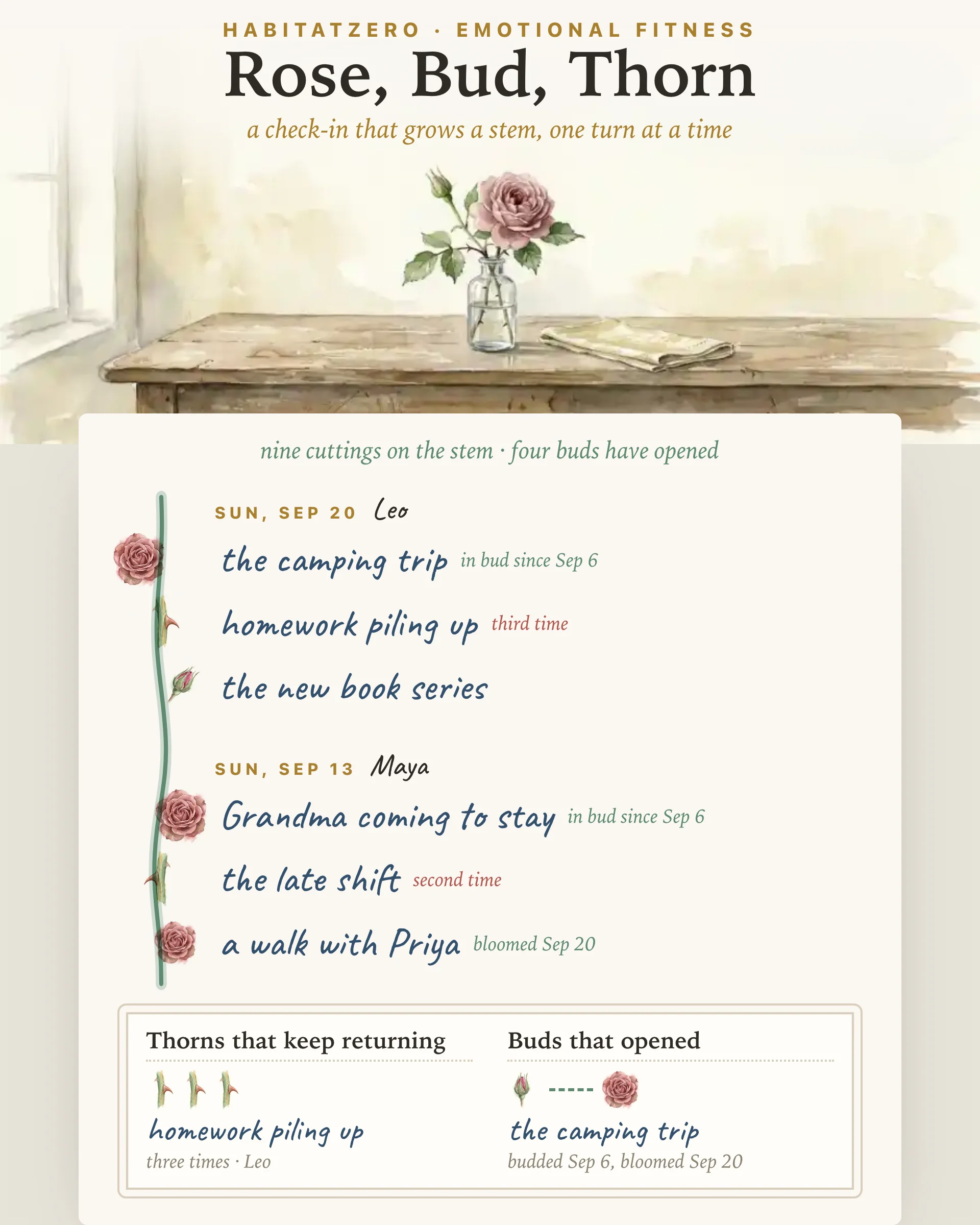
Here every check-in becomes a cutting on one painted stem. You tap a suggestion or write a short line beside the rose, the thorn and the bud, press grow the stem, and the cutting is painted on above the last one with its date. Only the rose is required. The scouting handout itself says a thorn is shared "if any", and some weeks there is nothing in bud yet, so the page will not make you invent one.
If you are doing this around a table, seat up to six names. The page hands the turn to the next person after each cutting and tells you when everyone has gone round once, which is also the scouting rule: one lap, no second helpings.
Two links tie the weeks together. When an old thorn pricks again, it is waiting under again, one tap instead of retyping, and the stem tags it second time, third time. When something you were looking forward to actually happens, your old bud is offered as this week's rose; choose it and the bud on the earlier cutting is repainted as an open bloom. Under the stem, a panel called Looking down the stem keeps the tally: which thorns keep returning, how many buds have opened, which are still closed, and which you have decided to let go.
Nobody has run a trial of rose, bud, thorn as such. Its parts have been studied separately.
The rose is close to the "three good things" exercise. In a randomized, placebo-controlled internet study led by Martin Seligman, three of five tested exercises produced lasting gains in happiness and drops in depressive symptoms, and writing down what went well each day for a week was one of the three.
The thorn leans on a quieter finding. In a brain-imaging experiment on putting feelings into words, labeling a negative image with an emotion word dampened the amygdala response compared with other ways of processing it. Naming a hard thing seems to take a little of its charge away.
Be honest about the distance, though. One study used adult volunteers online and the other used pictures in a scanner. Neither was about a family at dinner, a fifth-grade classroom or a Friday retrospective, and neither makes this routine a treatment for anything. What you can fairly expect is smaller: a few minutes in which everyone is heard, and a record that makes patterns hard to ignore.
Pick one slot and keep it. Dinner works because everyone is already sitting down; the last five minutes of class or of a team meeting work for the same reason.
Go round once. The scouting guidance calls it neutral time and warns that it is not a gripe session, which travels well: nobody fixes, debates or tops another person's thorn.
With children, the adults answer too, with real thorns sized for the audience. A parent who only ever has roses teaches that thorns are not for saying out loud.
With a team, aim the questions at the work. A thorn the stem has tagged third time has stopped being a complaint and become an agenda item.
This one is for a shared or repeating check-in whose payoff shows up across weeks. If you want a private line or two before bed that tomorrow morning picks up, the Daily Reflection Journal is built for that. If your week needs loose ends swept up and three moves chosen for the next one, use the Weekly Review. And when the stem is long and December comes, the Year in Review is the place to ask what all those roses added up to.
It is a three-part check-in. The rose is something that went well, the thorn is something that was hard, and the bud is something you are looking forward to or an idea that has not opened yet. Families use it at dinner, teachers use it to close a class, and teams use it as a quick retrospective.
It is a folk routine with no single named inventor that we could confirm. Scout crews have long ended trail days with a circle called Thorns and Roses, sometimes adding a rose bud, and the LUMA Institute later published Rose, Thorn, Bud as a design-thinking method, crediting the Scouts. This page is an independent tool and has no connection to either organization.
Both names describe the same exercise, and the scouting version even starts with the thorn. The order you say them in matters less than where you finish. This stem asks for the rose, then the thorn, then the bud, so every turn ends on something still to come.
Keep them plain. What went well today? What was hard? What are you looking forward to? With children, the adults answer too, and nobody fixes or debates another person's thorn. With a team, point the same three questions at the week's work, and treat a thorn that shows up three times as an agenda item.
You can read the method and study the filled example on this page without signing in. Growing a stem of your own, with your table's names and your history of thorns and buds kept between sessions, happens inside HabitatZero, which costs nothing.
By the team behind Fabulous, the science-based self-care app used by over 30 million people.