
The Overwhelm Recovery ProtocolWellness & Routines · ~5 min
About this template · Updated November 2026
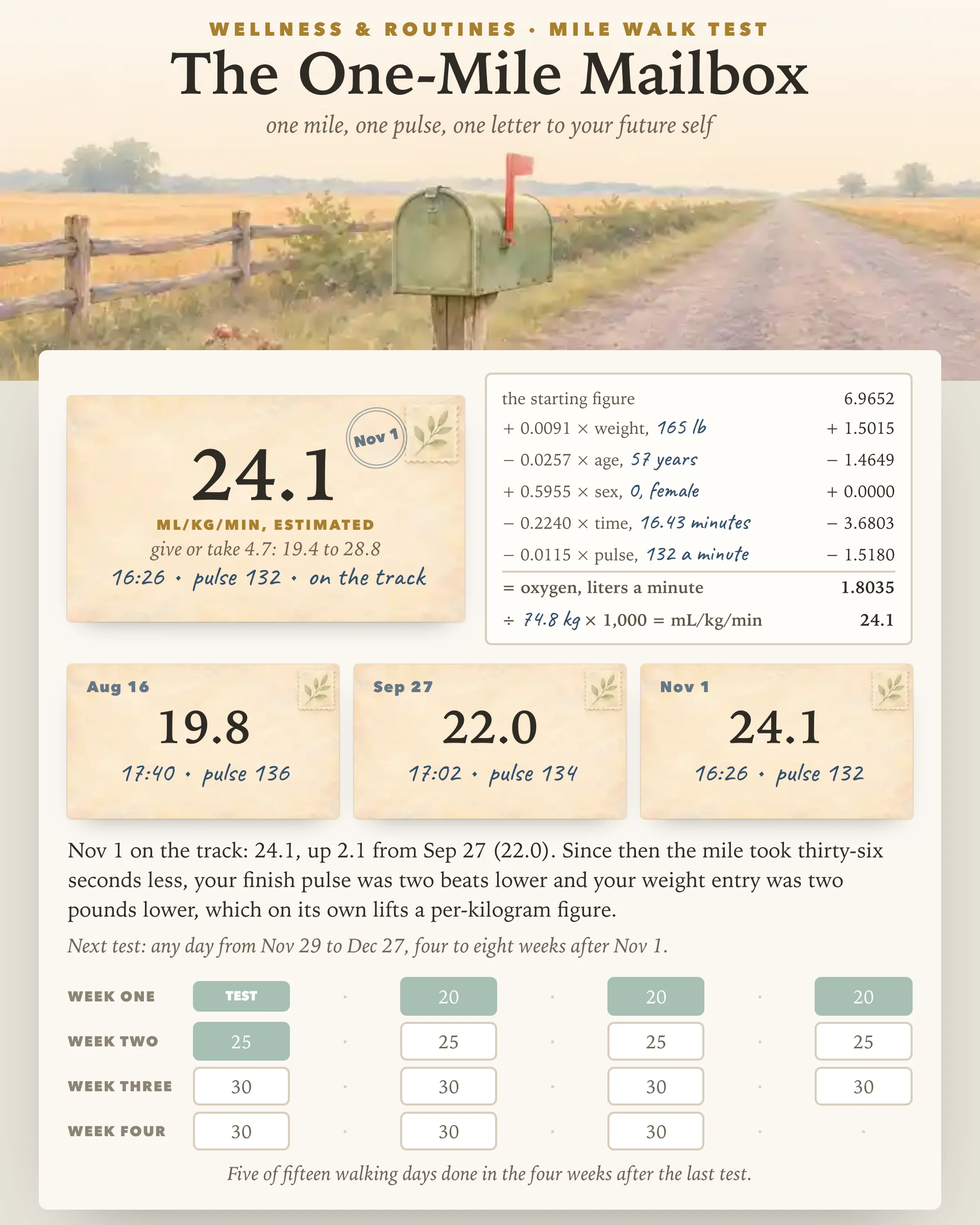
The Rockport walk test comes from a 1987 study by Kline, Porcari and colleagues, who built the equation it runs on. This page is an independent worksheet built on their published method; the study's authors had no part in it.
You walk one measured mile as briskly as you comfortably can, then take your pulse the moment you finish. Your time, that pulse, your age, sex and body weight go into one equation, and out comes an estimate of VO2 max: the most oxygen your body can use in a minute of hard effort, the usual yardstick of aerobic fitness. A 1 mile walk test needs no running and no lab.
Kline's team measured VO2 max directly, on a treadmill with a mask, in 343 healthy adults aged 30 to 69 (165 men and 178 women). Each then walked at least two timed miles around a track as fast as they could, heart rate recorded every quarter mile. From half the group they built this equation, in liters of oxygen a minute:
VO2 max = 6.9652 + (0.0091 × weight in pounds) − (0.0257 × age in years) + (0.5955 × sex, 1 for male and 0 for female) − (0.2240 × mile time in minutes) − (0.0115 × heart rate over the last quarter mile, in beats a minute)
Multiply by 1,000 and divide by your weight in kilograms for milliliters per kilogram per minute (mL/kg/min), the unit charts use. On the other 169 walkers the equation missed the measured result by a typical 0.355 liters a minute, about 4.7 points either way at 165 pounds.
The same group later asked whether the equation holds on a treadmill. In 304 healthy volunteers aged 40 to 79, average age near 58, it did not, so they built a separate treadmill equation. So a treadmill mile here gets no estimate, only its time and finish pulse, set beside your other treadmill miles.
Younger walkers fared worse. In college students tested on a field course, the original equations overshot measured VO2 max by 16 to 18 percent in men and 22 to 23 percent in women, and the authors advised against it at that age. Among 200 Royal Navy personnel aged 18 to 39, existing one-mile walk equations read the fittest too low and the least fit too high, by between 2 and 18 percent.
These studies tested healthy adults, students and service members; none tells you how the estimate behaves with heart or lung disease.
It is an estimate, not a measurement, and never a diagnosis; it says nothing about your heart's health or your risk of anything. A medicine that slows the heart, such as a beta blocker, lowers your finish pulse for reasons unrelated to fitness, so the estimate reads high. Outside the study's ages of 30 to 69 it is a rougher guess. Since it is divided by weight, a lower weight entry alone lifts it. The study's walkers went as fast as they could; this sheet asks for brisk but comfortable, safer on your own, so compare each result only with your own earlier ones.
So the sheet gives no band, rating or verdict. To see where an estimate falls among measured adults your age, the VO2 Max Chart by Age lays out reference percentiles, as a rough guide only.
Pick where you walk, check four boxes, and tap start as you set off. The clock runs from the real time, so it stays right if your phone locks, and a mile you stop partway fills nothing in. Count your pulse while the sheet times fifteen seconds, or type a watch reading, then add your age, sex and weight.
The result arrives as a letter: the estimate, its range, your time and pulse in your own hand, and the equation worked line by line underneath. Mail it and it joins your mailbox beside your earlier letters from the same kind of course. The sheet names what moved and gives your next test window, four to eight weeks on. What you type stays in this browser; nothing is sent anywhere.
Between tests, four weeks of walks run three or four days a week, twenty to thirty minutes, with a brisk middle stretch from week two. For a steady step rate on those walks, the brisk walk metronome keeps time.
The Six-Minute Hourglass fixes the time and measures the distance, a clinical test of walking endurance with no oxygen estimate. The mile test fixes the distance, times it and adds your pulse. The VO2 max chart is a reference chart with this walk as a side route to a number; here the test itself is the whole page, with no chart or rating on it.
Get your doctor's okay before a brisk timed mile if you have a heart, lung or blood pressure condition, have had chest pain, dizziness or fainting, a fall or a joint replacement, are recovering from an illness or surgery, or feel pain when you walk. Stop if anything hurts. Stop at once for chest pain, dizziness or unusual breathlessness, and call 911 or your local emergency number if chest pain or trouble breathing does not ease with rest.
It is a one-mile walking test from a 1987 study. Your mile time, your heart rate at the finish, your age, sex and body weight go into an equation that estimates VO2 max, the most oxygen your body can use in a minute of hard effort. It needs no lab, only a measured mile and a way to time it.
The study's equation gives VO2 max in liters a minute: 6.9652 + 0.0091 × weight in pounds − 0.0257 × age in years + 0.5955 × sex (1 for male, 0 for female) − 0.2240 × mile time in minutes − 0.0115 × heart rate in beats a minute. Multiply by 1,000 and divide by your weight in kilograms to get mL/kg/min. The sheet prints every step with your own numbers.
In a separate check group of healthy adults aged 30 to 69, the equation missed the treadmill-measured result by a typical 0.355 liters a minute, close to 4.7 points for someone weighing 165 pounds. Later studies found it read too high in college students and pulled young sailors toward the middle, so treat it as a rough guide and compare it with your own earlier tests.
You can walk the mile on a treadmill, but when the equation's own research group tried it on treadmill walks it did not fit, and they built a separate treadmill equation. This sheet logs a treadmill mile by its time and finish pulse, sets it only beside your other treadmill miles, and gives it no estimate.
Anyone with a heart or lung condition, anyone who has had chest pain, dizziness or fainting, and anyone getting over an illness or surgery. If a medicine slows your heart, such as a beta blocker, your finish pulse no longer reflects fitness alone and the estimate will read high, so ask whether the test is worth doing at all.
By the team behind Fabulous, the science-based self-care app used by over 30 million people.


