
The Overwhelm Recovery ProtocolWellness & Routines · ~5 min
About this template · Updated November 2026
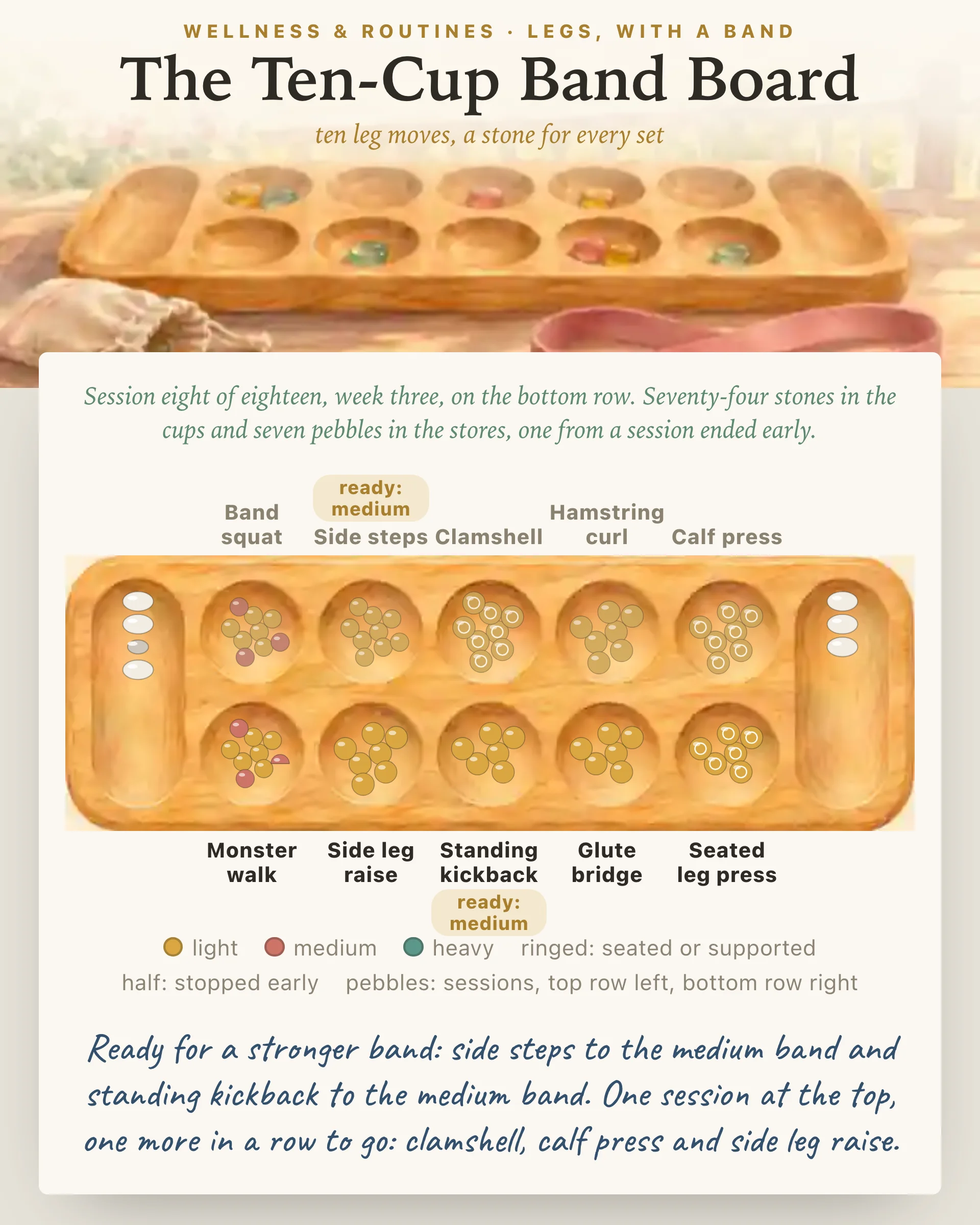
A loop band and a long band can work the fronts and backs of your thighs, your calves, and the outer hip muscles that steady you when you step sideways off a curb. The hard part is knowing when a band has become too easy. This page gives you ten resistance band exercises for legs, a clock that paces every set, and a carved board that fills with a glass stone for each set you finish.
The Resistance Band Rack is a full-body routine of eight moves over four weeks, where you tap how each move felt. The Three-Step Leg Routine works the legs with no band at all, using a chair, the counter and the stairs. This board is legs and bands only: ten moves, three band strengths each, reps counted by the clock rather than by feel, over six weeks.
The board has two rows of five cups, and each session works one row. The top row holds the band squat, side steps, the clamshell, the hamstring curl and the calf press. The bottom row holds the monster walk, the side leg raise, the standing kickback, the glute bridge and the seated leg press. The calf press, the leg press and the seated hamstring curl use a long band; the rest use a loop.
Every move has a second way that sits down or holds on. The squat lowers to a chair; the clamshell, hamstring curl, calf press and leg press are done in a chair; the bridge moves to a firm bed; and the standing moves hold the kitchen counter.
Pick a move, a band and a way, then tap count the set. After a three-second count-in, the clock names each part of every rep: three seconds down and two up for the squat. When the set ends, a stone drops into that move's cup: honey for the light band, coral for medium, green for heavy, with a pale ring when you did it the seated or supported way.
If you stop early, only whole reps count, and a one-sided move counts only reps done on both sides. A stop before the first full rep saves nothing. A later stop keeps the whole reps as a set marked stopped early, drawn as half a stone, and that set never counts toward a stronger band. A one-minute rest follows each set; it keeps real time even if your phone locks, and rests never go in the log. You can also add a set you counted yourself.
Each finished session drops a pebble into its row's store at the end of the board, and a session ended early drops a smaller one.
You train three days a week with a rest day between sessions. Weeks one and two ask for two sets of eight to twelve reps per move, about twenty-five minutes; weeks three to six ask for three sets, about thirty-five. The calf press runs ten to fifteen.
A move is ready for the next band once its two latest sessions, taken in order, each had every set whole at the top of the range on the same band and way. A session that ended before the move, a set stopped early, or a different band or way breaks the run. A set under the range suggests easing off, and you always decide.
A 2025 review pooled 25 randomized trials of elastic band training with 1,318 adults over 60, some living with conditions such as sarcopenia or lung disease, in programs of four to twenty-eight weeks. Compared with no extra exercise or usual care, the band groups did better on a leg strength test, the chair stand test and two balance tests. The trials varied a great deal, many were small, and the review had no data on falls or any comparison with other strength training.
Where the loop sits matters too. In a small lab study of monster walks and sumo walks, nine healthy young men wore the band at their knees, their ankles and their feet, and the side-of-hip muscles worked harder as the band moved down. It measured muscle activity in one visit, not strength over weeks, and included no women or older adults, but it explains why a loop at your ankles makes the same step harder.
For adults over 65, the CDC suggests muscle-strengthening activity on at least two days a week covering every major muscle group, so give your arms, back and chest another day.
No band can promise slimmer or reshaped legs; this page tracks reps and bands, nothing more.
Talk to your doctor or a physical therapist first if you have had a fall, dizzy spells, a hip or knee replacement, a heart or blood pressure condition, or pain in your back, hips or knees. Before each session, run every band through your fingers and retire any with a nick, a tear or a sticky patch: a worn band can snap. Anchor a long band around a heavy table leg or under both feet, never around anything that can slide. Keep a sturdy chair or the counter within reach for every standing move, and stop any move that hurts.
Band work builds strength rather than practicing balance, so on the days between, The Balance Ladder makes a good partner.
A useful set covers the front, back and sides of the hips and legs: a band squat, a glute bridge, a hamstring curl, a seated leg press, a calf press, and side steps, monster walks, clamshells, side leg raises and kickbacks for the outer hips and seat. This page puts all ten on one board, five per session.
Yes, that is why every move has a second way: squats to a chair, clamshells and hamstring curls while seated, a bridge on the bed, and standing moves with both hands on the counter. Ask your doctor or a physical therapist first if you have had a fall, a joint replacement, dizziness, heart or blood pressure trouble, or pain.
Start with the lightest band you own, at the bottom of each move's range, and judge it by feel rather than color, because makers color their bands differently. Move up only when the last few reps of every set stay clean at the top of the range, two sessions running.
Here it is two sets of eight to twelve reps per move in weeks one and two, then three sets from week three, with the calf press at ten to fifteen. Three sessions a week with a rest day between them leaves room for your legs to recover.
No exercise can promise a shape. What band work can build is strength for standing up, climbing stairs and walking. Research in older adults found gains in leg strength and chair standing after band training, and this page tracks reps and bands, not looks.
By the team behind Fabulous, the science-based self-care app used by over 30 million people.


