
The Overwhelm Recovery ProtocolWellness & Routines · ~5 min
About this template · Updated November 2026
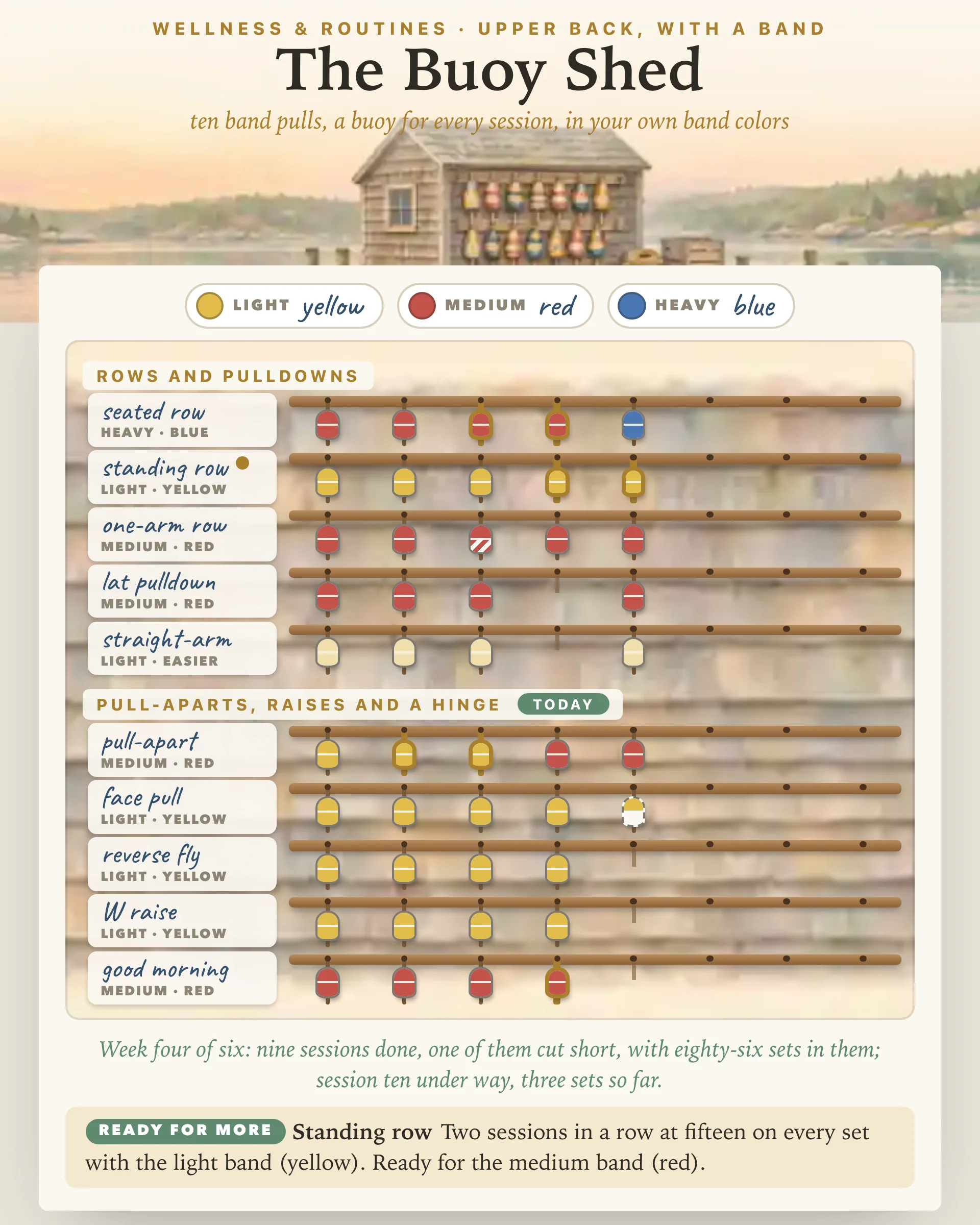
Lobster crews paint their buoys in colors of their own, so a glance at the water tells whose line is whose. This page borrows that habit for resistance band back exercises. You tell it the colors of your three bands, and each session hangs a buoy on a painted shed wall, striped set by set in the color of the band you actually pulled. Ten moves, six weeks, and a plain rule for when a move has earned a stronger band.
Check with a doctor or physical therapist before week one if you have had back, neck or shoulder surgery, a recent injury, osteoporosis, or a heart or blood pressure condition. Back pain that comes with numbness, tingling or weakness in an arm or leg, or pain that began after a fall, needs a doctor before any exercise plan. Stop any move that hurts. Retire any band with a nick, a tear or a sticky patch, use a door anchor only in a door that is shut and locked, with you on the side it opens away from so each pull presses it into its frame, and never let go of a stretched band.
Sessions take turns between two groups of moves.
Each move has an easier version on its card: a slacker start, a seated setup or a shorter range.
Start by naming your bands. Makers use colors differently, so you pick the color for each strength, and no color can belong to two bands. Every set you log keeps the color it was done with, even if you rename a band later.
Tap the reps you finished, using plus and minus outside eight to fifteen. A set that ended too soon gets marked stopped early. The next set always starts with no reps picked. After each set a rest begins, forty-five seconds to two minutes as you choose. It runs on the real clock, so a phone that locks mid-rest still ends it on time, and a rest is never logged.
On the wall, a buoy hangs for each session of a move, one stripe per planned set. A hatched stripe was stopped early, a pale one was the easier version, and a bare one never happened. When every set reached fifteen in the full version, the buoy gets a gold rim.
Two gold buoys in a row, on the band you use now, mean the move is ready for the next band, and a button offers the step. A session at another band, a stopped set, a session cut short, or one that ended before you reached the move breaks the run. The easier version never counts toward a stronger band. Easing off is gentler: two sessions in a row with a stopped set or fewer than ten reps suggest a lighter band, or the easier version once you are on the light one.
Weeks one and two have two sessions each, about thirty minutes: a five-minute warm-up, twenty minutes for two sets of each of the five moves with their rests, and a five-minute cool-down. Week three adds a third session. In weeks five and six every session grows to three sets, about forty minutes.
A 2019 meta-analysis by physical therapy researchers in Brazil pooled eight trials that compared training with elastic bands or tubing against dumbbells and weight machines. Strength gains in arms and legs came out about the same. The trials were small and varied, and none tested back exercises alone.
For older adults, a 2013 review of eleven trials covering 834 people aged 60 to 79 found that progressive elastic band training improved muscle strength, most clearly in healthy people and in those with some loss of function. The trials said little about training intensity, so the best dose remains open.
A 2010 laboratory study measured muscle activity in sixteen working women aged 26 to 55 with neck and shoulder pain. At each woman's heaviest load, elastic tubing produced shoulder and forearm muscle activity similar to dumbbells. It was one session of three arm exercises, not a training program, and the authors note it applies only to slow, controlled reps.
None of this shows that band work fixes posture or cures back pain, and this page promises neither. It does back the idea behind the rule: bands load muscles much as weights do, if the load keeps rising.
The Resistance Band Rack is a four-week, full-body plan where you rate how each move felt; this page stays on the back and logs the reps you did with your own band colors. The Bell Tent Back Plan suits a sore or stiff back better, with gentle supported moves on a guided timer; this page assumes you can already pull against a band without pain. The Plumb Line Posture Plan is a daily posture routine with a wall check; this page measures nothing about posture.
Rows and pulldowns train the large muscles that draw your arms back and down, and pull-aparts, face pulls, reverse flies and W raises reach the muscles between and around the shoulder blades. A good morning adds the long muscles of the lower back and the backs of the legs. This page alternates those two groups across two kinds of session.
Studies that compared elastic bands with dumbbells and weight machines found similar gains in strength when the training was progressive. The catch is the same as with weights: the load has to rise over time, which is why the page tells you when a move has earned a stronger band.
Use a door anchor in a door that is shut and locked, and stand on the side the door opens away from, so every pull presses it harder into its frame. Check the anchor before each set, look the band over for nicks before each session, and never let go of a band while it is stretched.
Colors mean different strengths from one maker to the next, so go by feel. Start each move with the band that lets you do ten slow reps with two or three still in reserve, and name its color on the page so your log stays readable.
Two or three days a week, with a day off in between, is plenty for most beginners. This plan starts with two sessions a week, adds a third in week three, and grows each move from two sets to three in week five.
By the team behind Fabulous, the science-based self-care app used by over 30 million people.


