Leaves on a StreamEmotional Fitness · ~3 min
About this template · Updated September 2026
A relationship agreement is a short list of how the two of you run the shared parts of life: who pays for what, whose turn it is to cook, how much time you spend together and apart, what happens at your parents' place, how an argument pauses, where the phones sleep. It is not a contract a court would enforce, and this page does not pretend to be one. It is a way of saying out loud what each of you has been quietly assuming, then keeping only the lines you both actually mean. Some people call this relationship contracting; the word matters less than the habit of asking instead of guessing.
Most couples never make these choices on purpose. The researchers Scott Stanley, Galena Rhoades and Howard Markman call the pattern sliding versus deciding: big transitions such as moving in together can happen by drift rather than by a clear decision, and the inertia that follows can hold a couple in place regardless of how well they fit. Their paper is about living together before marriage, not about written agreements, so treat it as a reason to decide, not as proof that a list will save anyone. Writing the lines down is simply the most concrete way to turn a default into a choice.
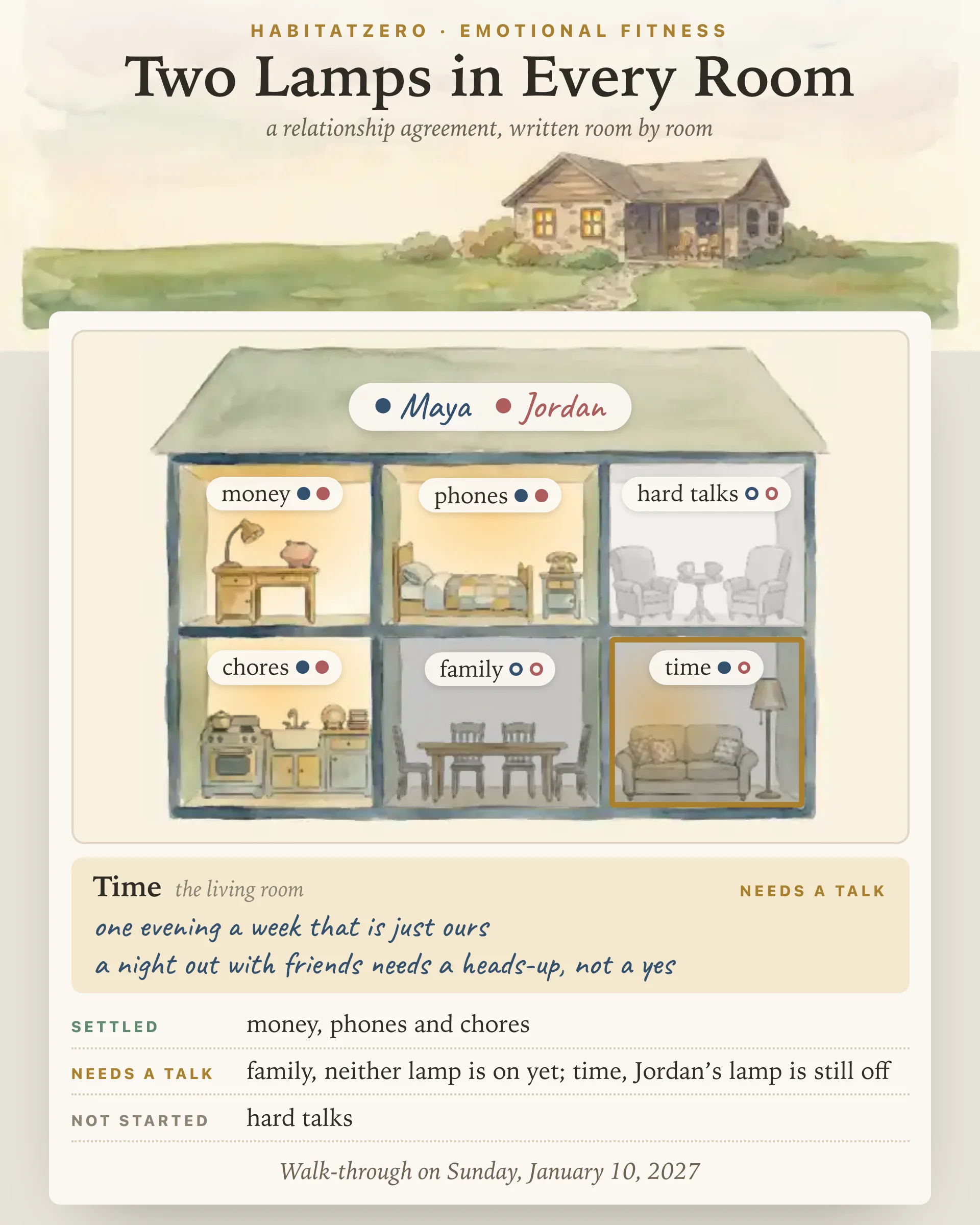
The page is a painted cutaway house with six rooms, and each room holds one part of your life together: money in the study, phones in the bedroom, hard talks in the sitting room, chores in the kitchen, family in the dining room, and time together and apart in the living room. Put your first names on the nameplate on the roof. Then open a room, tap a suggested line or write your own, and stop at four. A room that needs more than four lines usually needs a conversation first.
Every room has two lamps, one for each of you. When you both mean every line in a room, each of you switches on your own lamp, and the room lights up. If one of you hesitates, the room stays at dusk, which is useful information rather than a failure. Add, drop or reword a line and both lamps go off, because the thing you agreed to is no longer the thing written on the wall.
Under the house, the page reads the whole thing back: which rooms are settled, which still need a talk and whose lamp is off, and which rooms have nothing written in them yet. That short list is the agenda for your next evening together.
Money deserves the first evening. In a national study of more than four thousand couples, Jeffrey Dew, Sonya Britt and Sandra Huston found that disagreements about money predicted divorce more strongly than any other kind of disagreement they measured, for wives and husbands. Once those disagreements were counted, how well off a couple was stopped predicting divorce. The practical reading is that the arguing, not the balance, is what to settle: who pays for what, what needs a quick check first, and what each of you can spend without asking.
Phones earn a room of their own too. When Brandon McDaniel and Sarah Coyne surveyed married and cohabiting women, most said phones and other devices frequently interrupted their conversations, meals and time together, and the women who reported more interruptions also reported more conflict over technology and lower satisfaction with the relationship. It was a single online survey, so it shows a link rather than a cause, but it makes a fair case for two plain lines about the table and the bedroom.
For the kitchen, The Couples Chore Chart goes deeper than four lines can, and if the sitting room keeps staying dark, Our Fair Fighting Rules is built for exactly that room.
Write it on a calm evening, not the night of a fight. Word each line as something the two of you do rather than something one of you owes: we trade the jobs nobody wants every month holds up better than you never take out the trash. Keep lines small enough that you would both notice if one slipped.
Pick a walk-through date before you close the page, a few months out or tied to a day you already mark, like an anniversary. When it arrives, switch every lamp off and go room by room. Switch back on what still holds, rewrite what has drifted, and let a room stay dark for a while if it needs a longer talk. If those talks keep going sideways, Pass the Floor gives each of you an uninterrupted turn to speak.
This page is for two people who both feel safe saying no. If you are afraid of your partner, or you are being hurt, threatened or controlled, a list of agreements will not fix that and can be turned against you. Reach the National Domestic Violence Hotline instead: call 1-800-799-7233 or text START to 88788, at any hour, free and confidential. And if what you need is an arrangement about property, debts or children that stands up legally, that is work for a family law attorney, not for a painted house.
It is a short written list of how two partners handle the parts of shared life that cause the most friction, such as money, chores, time together and apart, family, disagreements and phones. Both of you sign off on every line, and you return to it on a set date because lives and needs keep changing.
Not the kind on this page. It is a practice tool between two people, and nothing in it would hold up in court. For an agreement about property, debts or children that does, such as a cohabitation agreement or a prenuptial agreement, speak with a family law attorney in your state.
Most couples cover money, housework, time together and time apart, family and in-laws, how hard conversations go, and phones and screens. Short, concrete lines beat big promises: no phones at dinner is easier to keep, and to check, than always be present.
There is no fixed rule. Many couples choose a day three to six months out, plus an extra look after any big change such as a move, a new job or a baby. This page keeps the date for you, and on the day you switch every lamp off and walk through the rooms again.
The filled-in house on this page shows how it works. Writing your own rooms, switching on your lamps and keeping your walk-through date all happen once you personalize it in HabitatZero, which is free.
By the team behind Fabulous, the science-based self-care app used by over 30 million people.