Leaves on a StreamEmotional Fitness · ~3 min
About this template · Updated September 2026
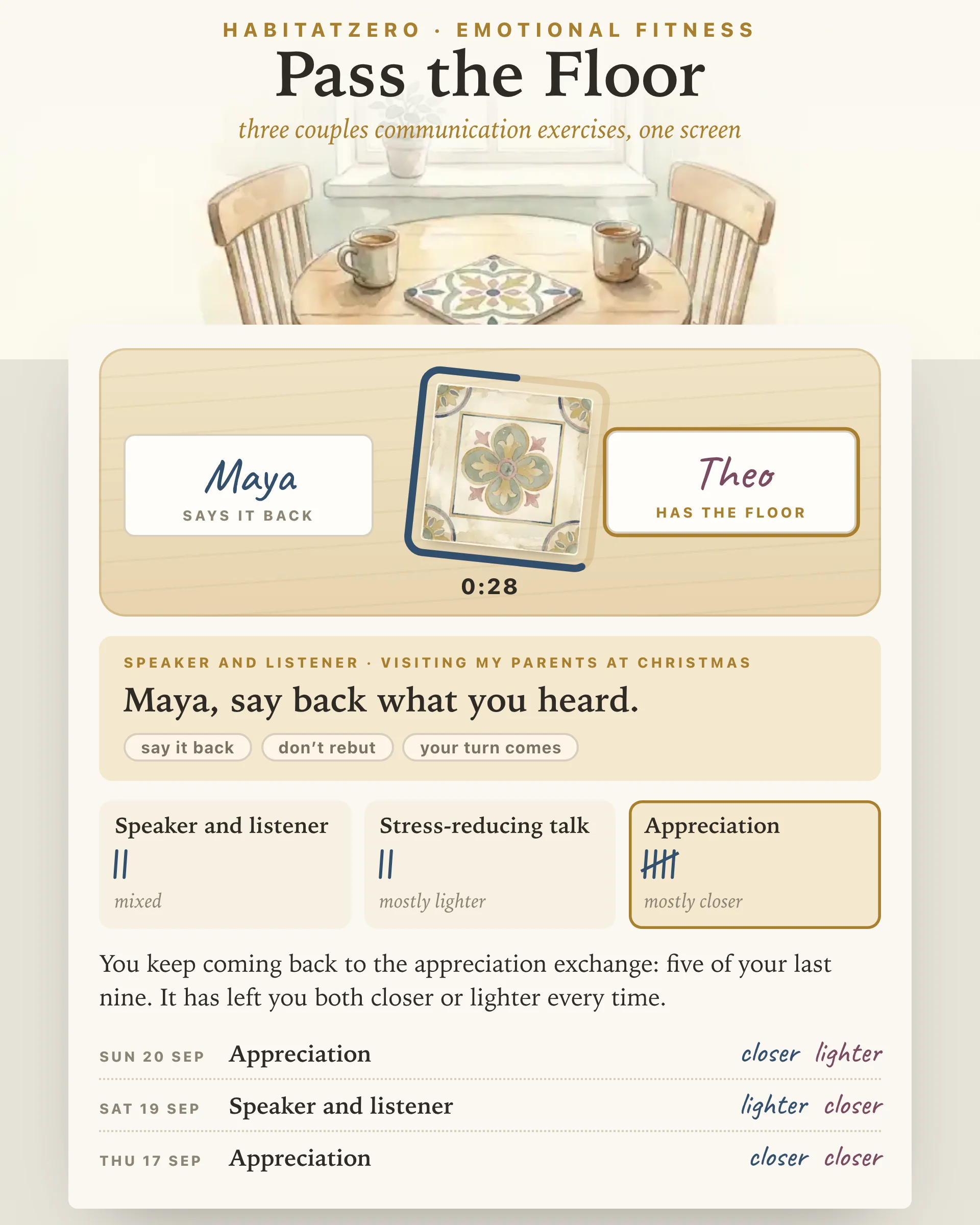
Two of these exercises have known authors, so they come first. The speaker-listener technique comes from PREP, the Prevention and Relationship Education Program, which Howard Markman founded and then developed with Frank Floyd and Scott Stanley out of research on what puts couples at risk. The stress-reducing conversation is taught by the Gottman Institute, which sets it out as eight plain rules. The appreciation exchange belongs to nobody in particular. HabitatZero built this page from what PREP and the Gottman Institute have published, and neither organization made it, reviewed it or endorses it.
Pick the exercise to fit the conversation, not the other way round. All three suit married and unmarried couples alike, so they double as marriage communication exercises.
Speaker and listener is for the subject that keeps turning into the same argument, like the holidays or money. One of you holds the floor and talks in short pieces about your own thoughts and feelings, starting from I. The other says each piece back in their own words before adding anything of their own, and the speaker confirms or corrects it. Then the floor changes hands, and solutions wait until both of you feel understood. PREP makes the floor a physical thing: at its seminars couples are handed a small card or a scrap of linoleum or carpet to hold. On this page that object is the painted tile.
The stress-reducing conversation is for days when the trouble comes from outside the two of you: the manager, the commute, a parent who is unwell. One of you talks and the other listens, then you swap. The Gottman Institute's rules ask the listener to show genuine interest, take their partner's side even when part of the story sounds unreasonable, and hold back advice, because understanding has to come first. It works best when you are not the subject of the complaint.
The appreciation exchange is the everyday one. Each of you names one specific thing the other did lately and why it mattered, and the other receives it with a thank-you instead of waving it away or paying it back on the spot. Five minutes covers it.
Write your two names on the place cards, choose an exercise and say who starts. The tile leans toward whoever holds the floor, and its edge drains like a slow clock: a minute for a speaking piece, forty-five seconds to say it back, twenty seconds to take in a thank-you, and five, ten or fifteen minutes a side for the stress talk. Nothing rings. When the edge runs out, finish your sentence or ask for one more minute.
In speaker and listener, the page asks the speaker after each paraphrase whether it landed, and not quite hands the floor back for the part that got lost. Finishing stays locked until each of you has held the floor, and next time the page suggests the other person starts.
At the end, each of you taps one word for how it felt: closer, lighter, awkward or heavy. The log keeps your last twelve sessions, draws a tally for each exercise, and says which one you keep coming back to and whether it tends to leave you both closer or lighter. Over a month, you learn which one suits you both.
In a four- and five-year follow-up of one PREP trial, couples who had taken the five-session program communicated more positively and less negatively than a control group five years on, and had lower levels of marital violence. The same report looks at couples who declined the program and discusses selection effects, a fair reminder that couples who volunteer for skills training may differ from those who do not. They also took a full course, not a tile on a phone.
For appreciation, a study in which romantic partners thanked each other during a laboratory conversation found that the more responsive the thanked partner found the thanker, the more the quality of the relationship improved over the following six months. So the page asks for one specific thing, because specifics show you were paying attention.
Nobody has tested this page, and neither study shows that a timer improves a relationship. The Gottman Institute presents its rules as practical guidance, and the page linked above does not describe a trial of the conversation itself. Treat the exercises as practice and the log as a record of what you did, not a grade.
Try speaker and listener on something small first, a weekend plan rather than a holiday dispute, so the turns feel familiar before they have to carry weight.
For a weekly rhythm around these, the Couples Check-In gives you three short rounds and a shared aim for the week. If one argument needs untangling on your own before you talk, the Conflict Resolution Worksheet walks it through four stations. And for an evening that needs no talking through at all, The Date Night Jar will pick something to do.
All of this assumes two people who feel safe with each other. If one of you is frightened of the other, or talks end in threats, a structured conversation is the wrong tool, and a counselor or a domestic violence service is the right place to start.
Short, structured ones you will actually repeat. This page runs three: speaker and listener from PREP for a topic that keeps turning into an argument, the stress-reducing conversation from the Gottman Institute for pressure that comes from outside, and a five-minute appreciation exchange for ordinary evenings. Married couples can use the same three as marriage communication exercises.
One partner holds the floor, often marked by a real object, and speaks in short pieces about their own view. The listener paraphrases each piece before adding anything of their own, the speaker confirms or corrects, and then the floor passes across. Problem solving waits until both people feel understood. The technique comes from PREP, the program founded by Howard Markman, who was later joined in its research by Frank Floyd and Scott Stanley.
A regular talk, taken in turns, about stress from outside the relationship: work, family, the commute. The Gottman Institute asks the listener to show genuine interest, take their partner's side and keep unrequested advice to themselves, since understanding has to come first. Complaints about each other belong in a different conversation.
Aim for short and regular rather than long and rare. An appreciation exchange takes five minutes and suits most days, the stress-reducing conversation fits evenings when one of you comes home loaded, and speaker and listener is kept for the particular topics that keep going wrong. The log on this page shows which of the three you really keep doing.
This page shows the table itself and a filled-in example of a session partway through. Running the turns and the timer for real, keeping your two names and building a log of your own all happen once you open the exercises in HabitatZero, which is free.
By the team behind Fabulous, the science-based self-care app used by over 30 million people.