The Overwhelm Recovery ProtocolWellness & Routines · ~5 min
About this template · Updated September 2026
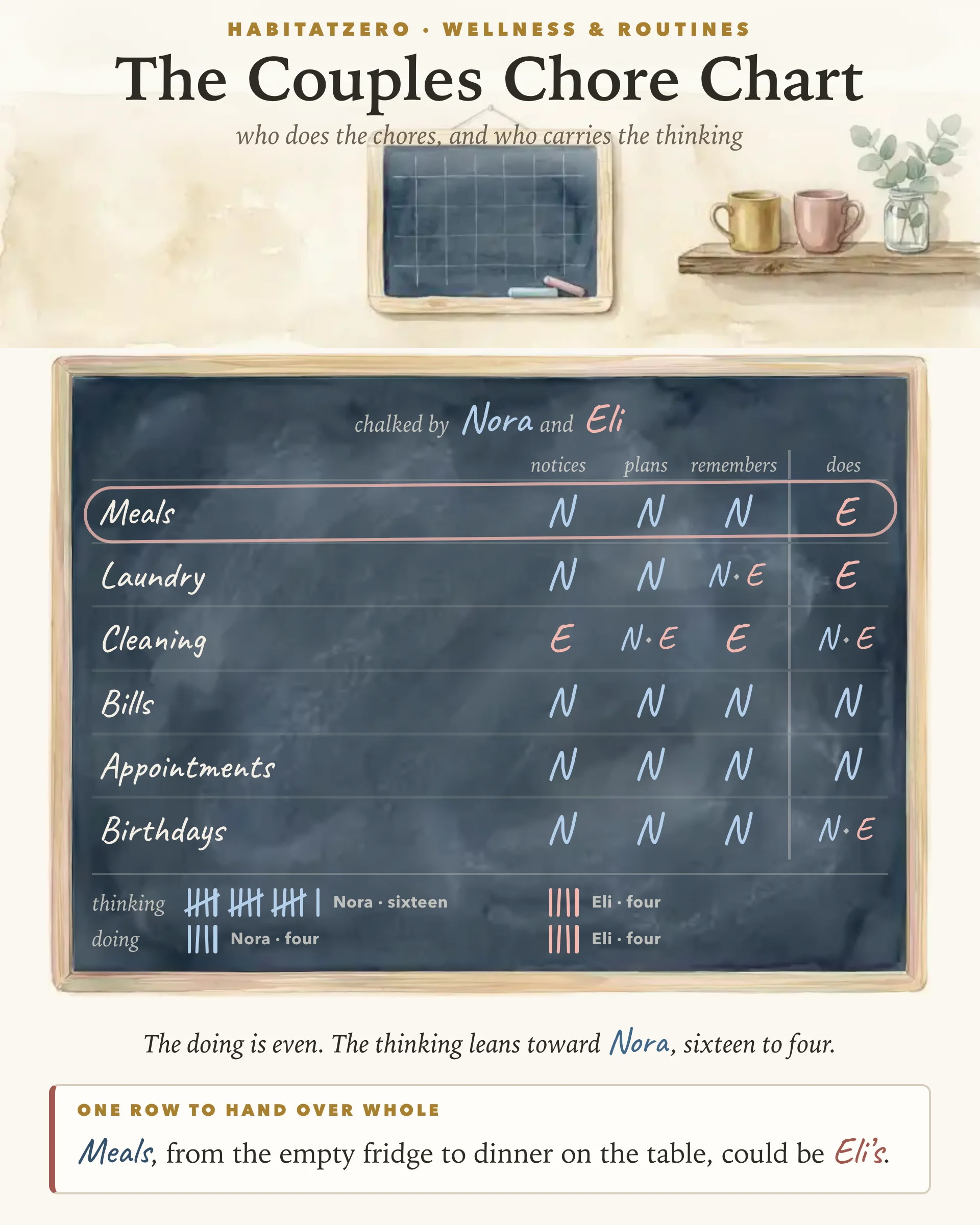
A chore chart usually has two columns: the job, and the name of whoever does it. That is the visible half of running a home. The other half happens before anyone picks up a sponge. Someone notices the milk is almost gone, works out what to cook this week, remembers that the car registration runs out in May, and checks that the dentist appointment really got booked. This chart puts both halves on one kitchen slate, so the two of you can see who does each chore and who carries the thinking behind it.
The sociologist Allison Daminger interviewed seventy people, the members of thirty-five couples, about how their households ran. She argued that the planning side of housework is a dimension of its own, which she called cognitive labor, and broke it into four parts: anticipating needs, identifying options for filling them, making decisions, and monitoring progress. That work was taxing and often invisible, both to the person doing it and to their partner, which made it a frequent source of conflict.
Her findings show where the gap hides. The women in her study did more of it overall, and more of the anticipating and monitoring in particular. Decision-making, the part most closely tied to power and influence, was shared roughly equally. So a couple can decide everything together and still leave one person holding the noticing at the start and the checking at the end.
Write your two first names at the top, one in blue chalk and one in pink. Each row is an area of your household, and each row asks four questions: who notices it needs doing, who plans it, who remembers it until it is finished, and who does it. The planning column folds Daminger's options and decisions into one, because at a kitchen table they tend to happen in the same breath.
Tap a cell once for one of you, twice for the other, and three times for both. The slate starts with meals, laundry, cleaning, bills, appointments and birthdays. Add a suggestion such as pets or the car, or write your own; ten rows is the limit, so the board stays readable from across the kitchen.
As you fill it in, chalk tallies count the thinking and doing cells each of you has a hand in. Below the slate, a short reading says which way each half leans. It also names any row where one of you does the work while the other did all the noticing, planning and remembering. That is what asking for help looks like on paper: the chore changes hands, and the thinking stays put.
When the thinking leans one way, the board circles one row to hand over whole, from the first time someone notices it to the last of the doing. It picks the row that evens out the thinking best without tipping the doing, and it favors one the other partner already does, so only the thinking has to move. One tap rewrites the row in the other chalk, and one more puts the old marks back.
If the doing moves but the anticipating and the monitoring stay behind, the person who used to own the job still carries three of its four parts. That logic comes from the four-part model, not from a trial of this chart, so treat the circled row as an opening for a conversation rather than a ruling.
A systematic review of thirty-one studies on mental labor found that women do the larger share of it, especially around childcare and parenting decisions, and report more of its costs, including stress and lower satisfaction with life and relationships. The people studied were mostly middle-class women and men in the United States and Europe, so these are averages, not a portrait of your home.
A second Daminger study helps explain why the imbalance lasts in couples who believe in equality. In interviews with thirty-two college-educated couples, partners described their uneven arrangements as the incidental result of necessary compromises and kept gender out of the story. That way of telling it kept the peace, and it may also have kept things from changing. A chart cannot settle whether your split is fair. It can put the whole pattern in front of you both before you decide.
A mark is a rough unit, too. Paying the bills and wrapping a birthday gift each fill one cell, and they are not the same size. Fair does not have to mean equal: a board that leans can suit a home where one person works much longer hours or looks after an aging parent, provided you can both read it and agree.
Pick a quiet twenty minutes with nothing boiling over. Fill in the slate together, and argue about the marks rather than about each other. If you also want to know how long each chore takes, The Household Chore List adds up each person's minutes in a week. A weekly Couples Check-In is a natural moment to ask how the handed-over row is going. If the talk about the load runs hot, agree on Our Fair Fighting Rules before you come back to the board.
The chores, and the thinking that comes before them. For each area of the home, such as meals, laundry or bills, mark who notices it needs doing, who plans it, who keeps it in mind until it is done and who does the hands-on part. A chart with only that last column can look perfectly even while one partner carries most of the load.
It is the unseen work of running a household: anticipating what the home will need, weighing the options, deciding, and checking that things actually happened. The sociologist Allison Daminger named it cognitive labor and found it taxing, easy for both partners to overlook and a frequent cause of conflict between them.
This one works for any two adults who share a home, married or not and of any gender. Each person gets a chalk color, and the board talks about you by first name rather than by role.
The jobs somebody has to hold in mind, not just carry out: planning meals and the grocery list, laundry, cleaning, bills and due dates, doctor and dentist visits, birthdays and gifts, school forms, pets, car upkeep, repairs and vacations. The chart turns each of those into a row and asks the same four questions of every one.
The board on this page is a sample chalked in by Nora and Eli. Writing your own names, adding the areas your home has and finding the same slate next month all happen in HabitatZero, which costs nothing to join.
By the team behind Fabulous, the science-based self-care app used by over 30 million people.