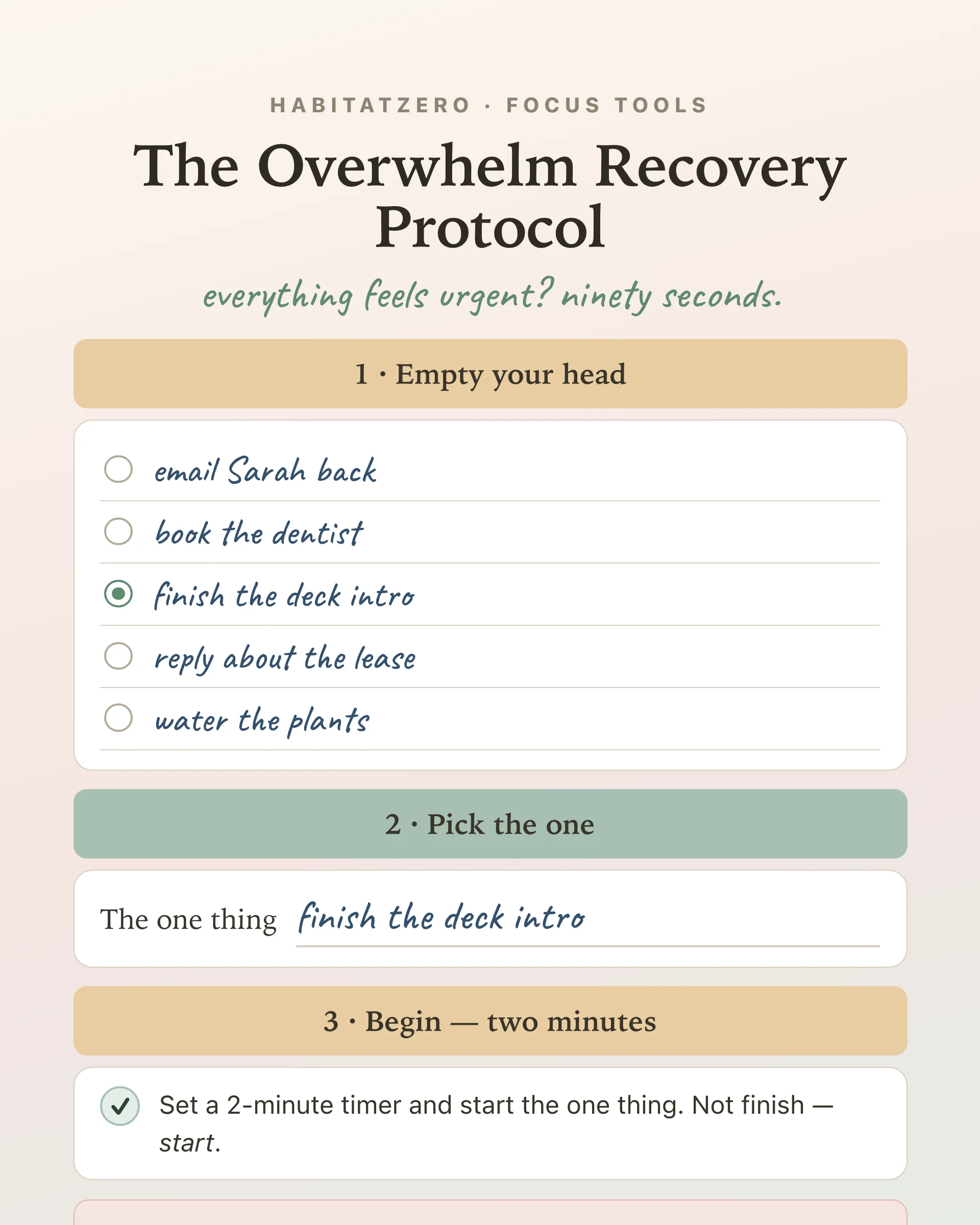
The Overwhelm Recovery ProtocolWellness & Routines · ~5 min
About this template · Updated September 2026
Most fights about housework are not really about the dishes. They start because two people who share a home carry two different pictures of who does what, and both pictures are sincere. A household chore list replaces them with one picture on the fridge: every recurring job, sorted by how often it comes back, with a name beside each.
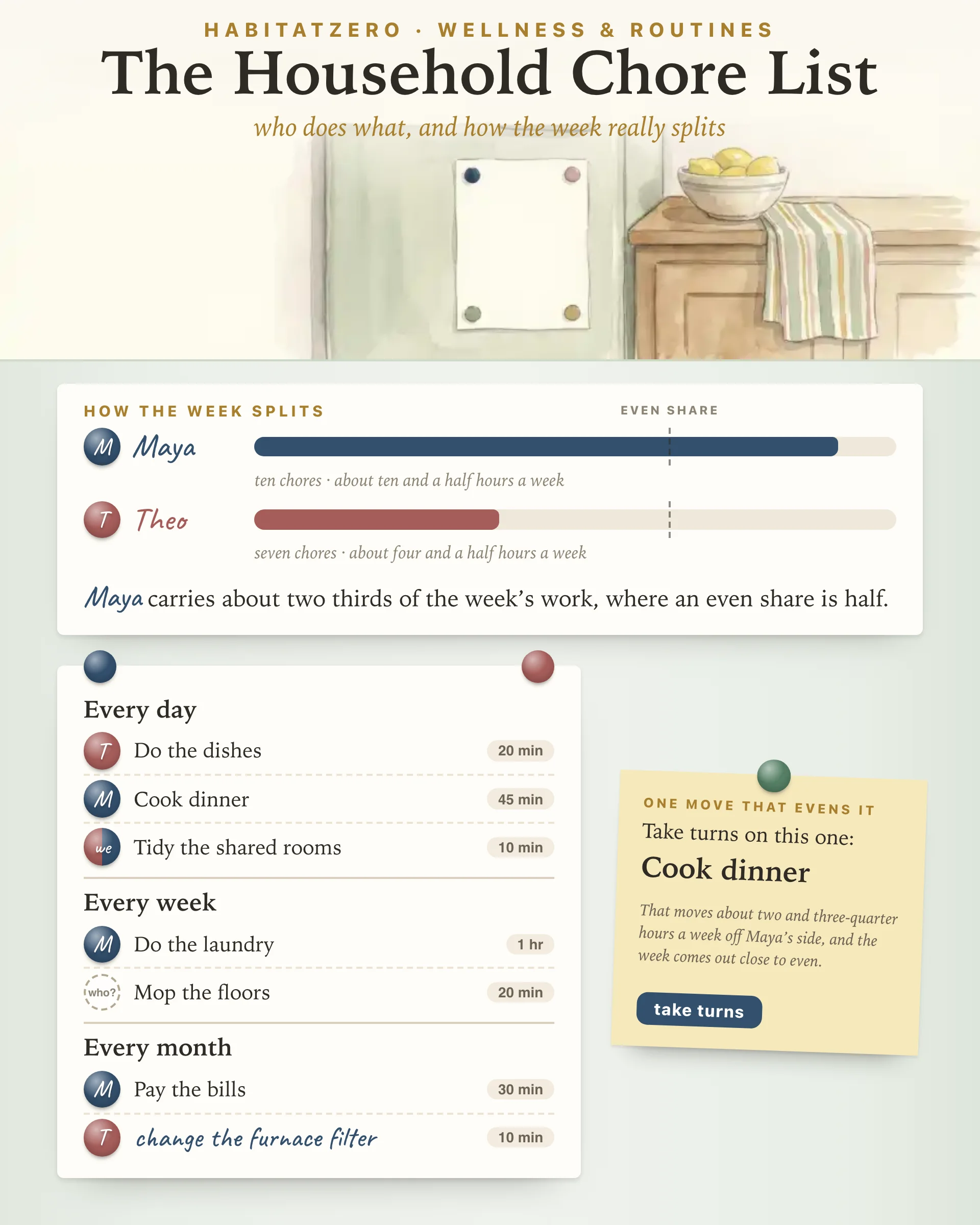
This one goes a step further. It adds up the minutes behind the names, so you can see how the week actually splits while the split is still a detail and not yet a grievance.
In 1979 the psychologists Michael Ross and Fiore Sicoly asked thirty-seven married couples to mark, each spouse on their own, who was responsible for twenty parts of their shared life, from making breakfast and cleaning the dishes to taking out the garbage. Added together, the two answers usually came to more than the whole. Twenty-seven of the thirty-seven couples overestimated, on sixteen of the twenty items on average. The overestimates were modest and nobody was lying. Asked for examples, people simply remembered more of their own contributions than their partner's, and the more their memories leaned toward their own work, the bigger the share they claimed.
The same paper holds a warning. In pilot interviews the researchers first asked for percentages, and couples who compared their numbers afterward ended up arguing over them. Treat what this page shows as a shared record to talk from, not a scoreboard.
The list opens with seventeen chores that most homes have, in three rhythms:
Several of those are not cleaning at all. Shopping, meal planning and bills take real hours, and leaving them off is one of the fastest ways to make a split look fairer than it is. Take off whatever your home does not have, tap a suggestion such as walking the dog or changing the furnace filter, or write a line of your own. Each rhythm stops at ten chores, which keeps the list short enough to read standing at the fridge.
Put up a magnet for each adult who shares the work; the door has room for four. Then tap the circle beside a chore to hand it to someone. Every tap passes it along to the next magnet, then to taking turns, then back to nobody. Tap the minutes on a chore to match how long it takes in your home, because dinner for two and dinner for five are different jobs.
The strip near the top does the arithmetic. It multiplies each chore's minutes by how often it comes around, totals everyone's week, and draws a bar per person against a dashed line for an even share, with one plain sentence about who carries how much. When one bar runs long, a sticky note names the single change that would balance the week best, either handing a chore over or taking turns on it, and one tap makes the change. If no single swap would help, the note says that too.
The minutes are rough on purpose. A chore that takes you twenty minutes and your housemate forty is worth a conversation, not a stopwatch.
On average, the gap is real. In the American Time Use Survey results for 2025, eighty-seven percent of women and seventy-five percent of men did some household activity on an average day, and on the days they did, women spent a little under three hours on it against a little over two for men. Those are national averages, not a verdict on your home.
For a relationship, how the split feels may matter as much as the minutes. A national study of dual-earner marriages found that feeling the housework was divided unfairly went with lower marital happiness for husbands and wives alike, and with higher odds of divorce among wives. That is an association in survey data, not proof that a chore list protects a marriage. It does suggest where to aim: at a split every adult in the house would call fair, which is not always an equal one. If one of you works longer hours or looks after a parent, an uneven split can be the fair one, as long as it was chosen rather than drifted into.
Fill it in together on a quiet evening, not halfway through a disagreement. Come back when a job changes, when someone moves in or out, or when a baby or a dog makes the week bigger.
If children pitch in, give each of them a Chore Chart with their own name on it rather than a line on this list. And if the cleaning jobs need a sheet of their own, the Cleaning Checklist sorts them by rhythm and prints on a single page.
The jobs that keep a home running, at three speeds. Daily: dishes, cooking, wiping the counters and a quick tidy. Weekly: laundry, floors, the bathroom, sheets, groceries, trash day and planning meals. Monthly: clearing out the fridge, dusting, the oven, the windows and paying the bills. Cross off what your home does not need and add what it does, such as a dog to walk or a lawn to mow.
Count time rather than tasks. Ten small chores can weigh less than two big ones, so this list gives every chore a rough number of minutes and totals each person's week. Fair does not have to mean identical: if one of you works longer hours, a lopsided split can still feel right to both. What counts is that everyone agrees with the picture, and a list you can all read makes that talk easier to start.
Yes. Once your household is filled in, printing the sheet drops the buttons and keeps what belongs on paper: each chore under its rhythm, the colored magnet of whoever owns it, the minutes, and the week's split at the top. It usually runs to two letter pages.
Every home differs, but a common rhythm is cooking, dishes and counters every day; laundry, floors, the bathroom, sheets and trash once a week; and the fridge, dusting, the oven and the windows once a month. Frequency is only half of it. A fifteen-minute daily job quietly adds up to almost two hours a week, more than most weekly chores.
What you see here is a filled-in example for a two-person home. Putting your own names on the door, handing out the chores and keeping the list between visits all happen in HabitatZero, and joining costs nothing.
By the team behind Fabulous, the science-based self-care app used by over 30 million people.