Leaves on a StreamEmotional Fitness · ~3 min
About this template · Updated September 2026
Jeff Bezos gave this idea its name. In his interview with the Academy of Achievement, he describes weighing, in 1994, whether to leave a secure job at a Wall Street firm and start selling books online, and settling it with what he called a regret minimization framework, adding that only a nerd would call it that. This page is an independent worksheet built around that idea. It has no connection to Bezos or Amazon, and neither has reviewed or endorsed it.
The move itself is simple. Picture yourself at eighty, looking back over your life, and ask which choice leaves you with the fewest regrets. Bezos said he knew he would not regret trying and failing, but that never having tried might haunt him every day. The long view also shrank a snag of the moment: leaving mid-year meant walking away from his annual bonus, a detail that looms large up close and small from a rocking chair.
Most big decisions get argued by whatever is loudest this month: the bonus, the awkward talk with a boss, the fear of looking foolish. Jumping decades ahead turns the volume down on all of it. What remains is a quieter question about the life you want to have lived.
It also fits how regret changes with time. Thomas Gilovich and Victoria Medvec reviewed the evidence and found a pattern over time: things people did and wish they hadn't bring more regret in the short run, while things they never did bring more regret in the long run. A view from eighty borrows the long run on purpose, which is why it often tips toward trying.
You begin by writing the decision in one line and choosing the age you will look back from. The chair starts at eighty, the age Bezos used; if eighty is not far off for you, move it older.
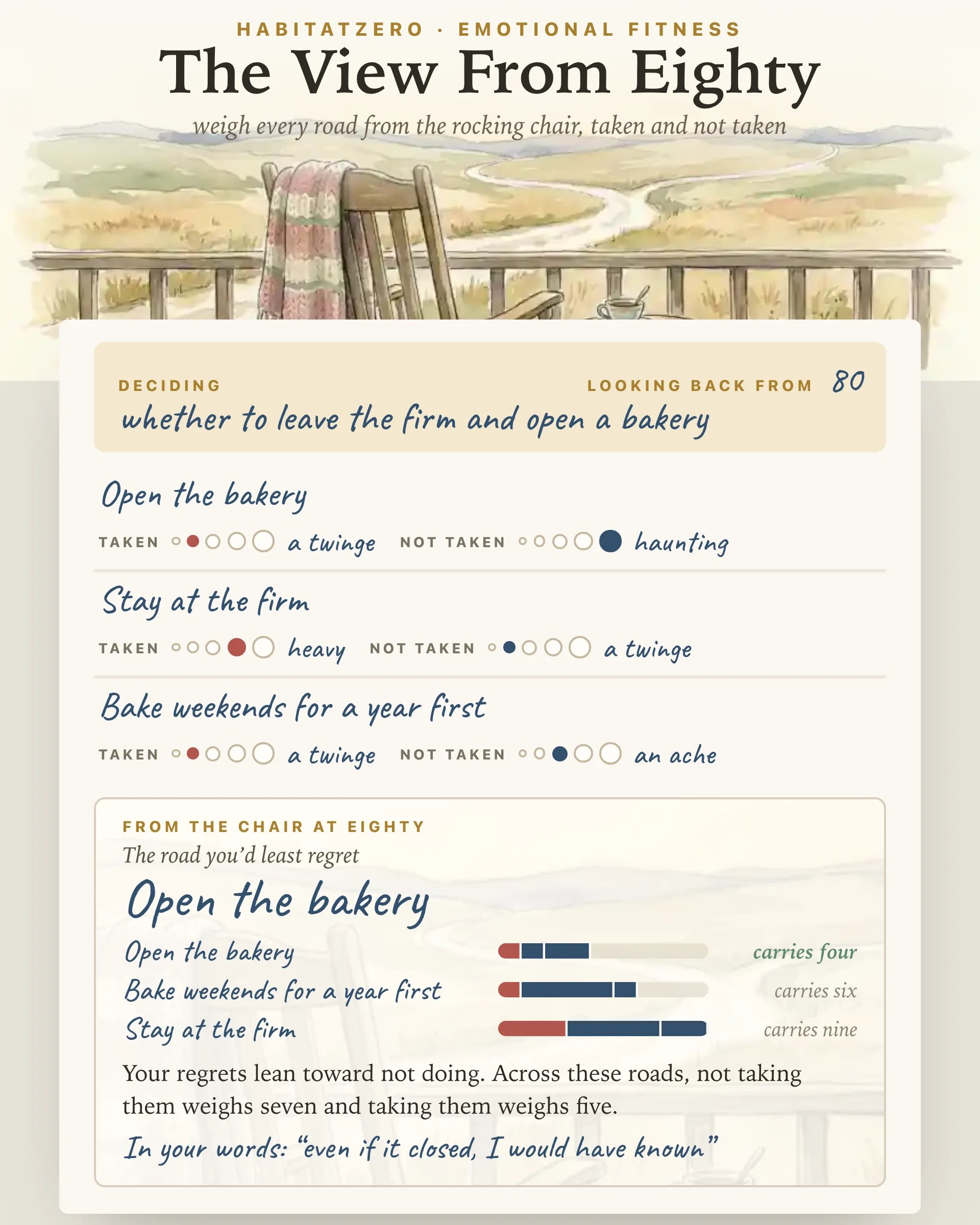
Then you name the roads: two to four real ways this could go. Staying where you are counts, and usually belongs on the list. For each road you weigh two things from the chair, from none to haunting: how much you would regret having taken it, and how much you would regret never having taken it. A short note in your older voice is optional, and it is often the line you remember.
The sheet then adds up what each road would leave you carrying. Choosing a road means living with whatever it cost you, plus the regret of every road you left behind. In the sample, opening the bakery carries four: a twinge for taking it, a twinge for leaving the firm, and an ache for never baking on weekends first. Staying at the firm carries nine, mostly because leaving the bakery untried is rated haunting. The road with the lightest load is the one you would least regret. When two roads tie, the page says so instead of inventing a winner.
Beneath the verdict, taken weights are totaled against not-taken ones, showing whether your regrets lean toward doing or not doing. If you move the age after weighing, each road marks the age its weights came from, so you can re-weigh any that feel different from further out.
The whole exercise rests on forecasts, and forecasts of feelings are shaky. In studies by Daniel Gilbert and colleagues, subway riders predicted that barely missing a train would bring far more regret than clearly missing one, yet the riders who actually missed trains showed a much smaller gap. The authors concluded that people are less prone to regret than they imagine. A road you rate haunting today may sting less once you are living with it, so treat your ratings as a way to hear what you care about rather than as a prophecy.
Shai Davidai and Thomas Gilovich found that people's most enduring regrets come more often from falling short of their ideal selves than from neglecting duties, partly because failed obligations get repaired while unmet hopes stay open. So when you weigh the not-taken side of a road, ask whether passing it up means letting go of someone you meant to be.
The chair is also a narrow lens. It weighs regret and nothing else. It cannot see your savings, your health, or the people who depend on you, and Bezos, by his own account, had his wife's full support when he chose. A road can be the lightest on this page and still be the wrong move this year.
Reach for the view from eighty when a choice is big, slow to undo, and being argued by worries of the moment: a career change, a move across the country, going back to school, starting something of your own. It adds little to small daily choices, where the regret on either side is faint.
If the nearer future deserves a hearing too, The 10-10-10 Rule walks the same choice through ten minutes, ten months and ten years. If fear is what keeps you from trying, Fear-Setting spells out the worst case and how you would recover. And when the decision turns on several practical criteria, The Judging Card scores each option against them.
It is a way to settle a big choice by picturing yourself at eighty, looking back over your life, and asking which path leaves the fewest regrets. Some people call the same move the rocking chair test. It helps most when the noise of the moment, like a bonus you would forfeit, is drowning out what you care about across decades.
In his interview with the Academy of Achievement, which inducted him in 2001, Bezos recalled deciding in 1994 whether to leave a secure Wall Street job and start selling books online. Projecting himself to eighty, he knew a failed attempt would not bother him, while never having tried might haunt him every day.
Both, on different clocks. Thomas Gilovich and Victoria Medvec found that regrettable actions sting more at first, while the chances people never took come to dominate their regrets over the long run. Looking back from eighty borrows that long view on purpose.
No. The View From Eighty is an independent worksheet from Fabulous, built around an idea Bezos described in public. Neither he nor Amazon is connected to it, and neither has reviewed or endorsed it.
The filled-in bakery example above shows how a finished view from the chair reads. To weigh your own roads and return to them after sleeping on the decision, open the sheet in HabitatZero, where it is free.
By the team behind Fabulous, the science-based self-care app used by over 30 million people.