Leaves on a StreamEmotional Fitness · ~3 min
About this template · Updated September 2026
The 10-10-10 rule is Suzy Welch's. The author and journalist set it out in a 2006 essay for O, The Oprah Magazine and later built a whole book around it, 10-10-10 (2009); her books page is the place to find her own telling. This worksheet is a practice page we made on our own, using her three questions. Welch had no part in building it, and she has not endorsed it.
Her method fits in a breath. When no option will please everyone, ask what each choice leads to in ten minutes, in ten months and in ten years, and let the three answers argue it out before you decide.
Most hard choices are loud at one distance and quiet at the others. Skipping a friend's farewell dinner feels like relief tonight. Ten months on, it can feel like a friendship that quietly thinned. Ten years on, it may be the evening you still wish you had shown up for. Ask the question only once, from where you stand right now, and the relief wins before the other two get a word in.
Welch's own stories show that no single distance always decides. One evening work and home both needed her, and she stayed late: ten years out it would not matter, and ten months out, leaving could have cost her more at the office than one late night would cost at home. When an executive meeting fell on the day of her son's karate test, both options felt bad in the moment and both would have faded by ten months, but ten years out only one of them still hurt, so she went to the test. Someone who wrote to Welch about the method added a twist worth keeping: notice which distance your decisions keep leaning on, because if it is nearly always the ten-minute one, you may be living more on impulse than you intend.
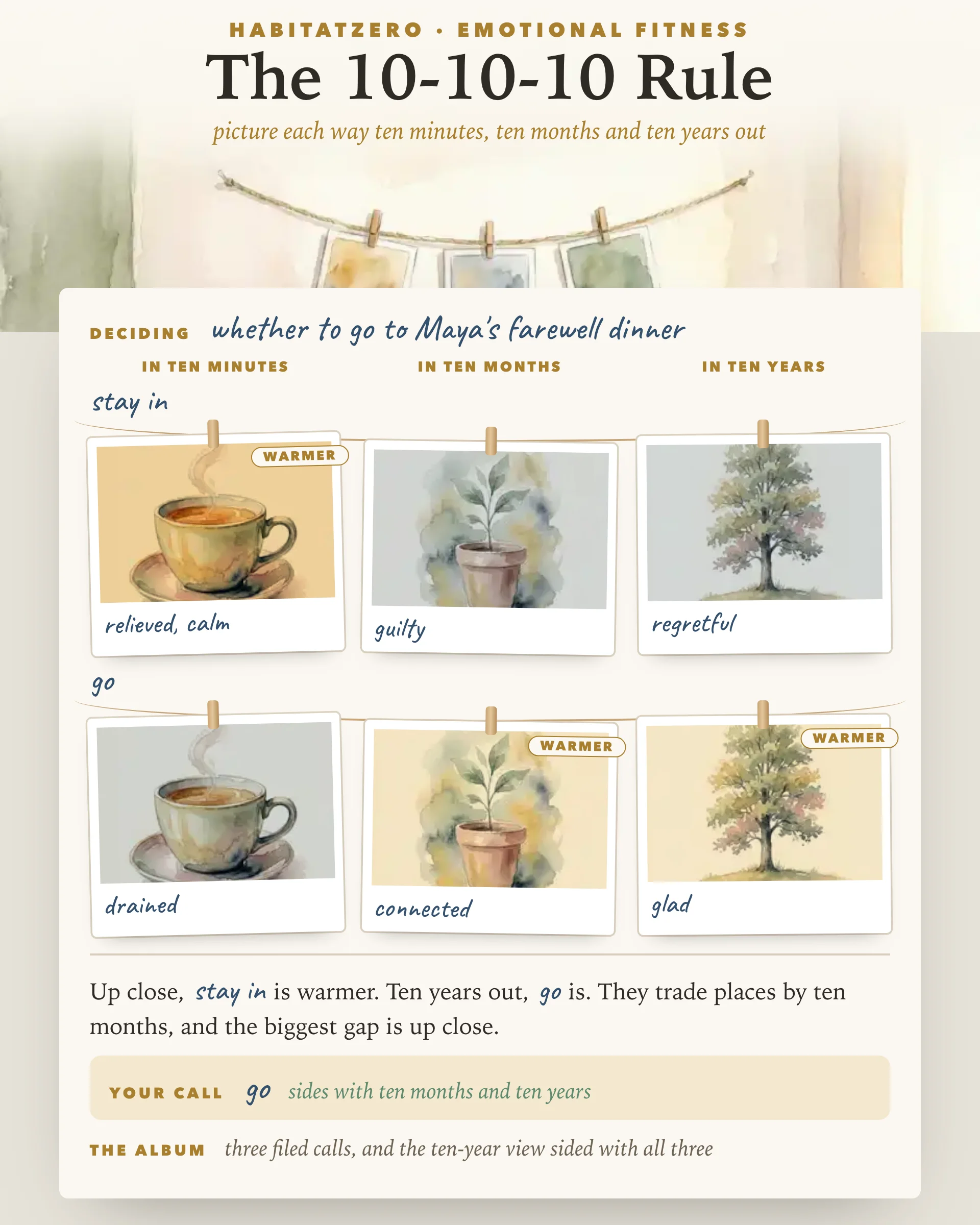
Each way your choice could go gets its own line of three snapshots, one for each distance. You develop a snapshot by naming how that moment would feel. Tap up to two words, light ones such as relieved or proud, heavy ones such as guilty or stuck, or write your own word and say which kind it is. Light words warm the picture toward gold, heavy words cool it toward blue, and "won't matter" leaves it even.
Once every snapshot is developed, the sheet reads the lines side by side. It marks the warmer picture at each distance, tells you whether the near and far views agree, names the point where the pictures trade places, and points to the distance where the gap between them is widest. Then you make the call, and the page tells you which views your choice sides with and which it goes against.
Filing a call clears the line for your next decision and keeps a one-line record in an album. After a few calls, the album counts how often each distance sided with what you chose. That is the reader's twist, turned into a tally you can look at.
The tug between near and far is more than a hunch. Reviewing how regret behaves over time, Thomas Gilovich and Victoria Husted Medvec found a steady temporal pattern: the things people did bring more regret soon after, while the things they failed to do bring more regret in the long run. The three questions can bring that shape to light: the bold option stings at ten minutes, the cautious one at ten years.
Stepping out to a far horizon can also cool a charged moment. Across a set of studies by Emma Bruehlman-Senecal and Özlem Ayduk, people who looked at a recent stressor from a distant-future vantage point felt less distressed than people who took a near-future view, largely because the far view drew their attention to how temporary the trouble was. The ten-year question borrows some of that calm.
We could find no published trial of the 10-10-10 rule itself, so this page makes no promise that your decisions will get better. Ten-year snapshots are guesses, and the warmth on each one is a plain count of light and heavy words, not a measurement of anything. When the pictures disagree, the rule has done its work: you can see which feeling you are about to decide with.
Use it for choices that pull two ways at once: tonight's plans, whether to speak up, a purchase, a job, a move. It works best when you are honest about the ten-minute picture instead of skipping to the answer you think you ought to give. Welch notes that the method can surface your priorities as well as serve them, so pay attention to which split bothers you most.
If a choice needs its consequences followed step by step rather than felt, The Long Forecast walks each way forward with the question "and then what?". If you are unsure what should count most, the Core Values Worksheet helps you name it before the next split arrives. And if one of your ways is really a way of putting something off, The Cost of Avoidance adds up what the delay is already costing you.
It is a way of testing a decision against three distances. For each option you ask what it brings, and how you will feel about it, ten minutes from now, ten months from now and ten years from now. Asking all three keeps the strongest feeling of the moment from settling the matter on its own.
The author and journalist Suzy Welch described it in a 2006 essay for O, The Oprah Magazine and built her 2009 book 10-10-10 around it. This worksheet is our own practice page, made apart from her, and she has not put her name to it.
That split is the most useful thing the rule can show you. It usually means one option buys comfort now and the other pays off later, or the other way around. Neither view wins by default, but seeing the split lets you choose which feeling you are deciding with.
No. In one of Welch's own examples the choice made no difference ten years out, so the nearer consequences carried it. Some choices turn on the months in between. The rule asks you to look from all three distances, not to crown one of them.
No. Welch set out the rule in her essay and her book, and this practice page was made apart from her, with credit for her three questions. She did not review or endorse it; her book 10-10-10 is where to read the method as she tells it.
The example on this page shows how a finished line of snapshots reads. To develop your own pictures and keep an album of your calls, personalize the sheet in HabitatZero, which costs nothing.
By the team behind Fabulous, the science-based self-care app used by over 30 million people.