
Leaves on a StreamEmotional Fitness · ~3 min
About this template · Updated September 2026
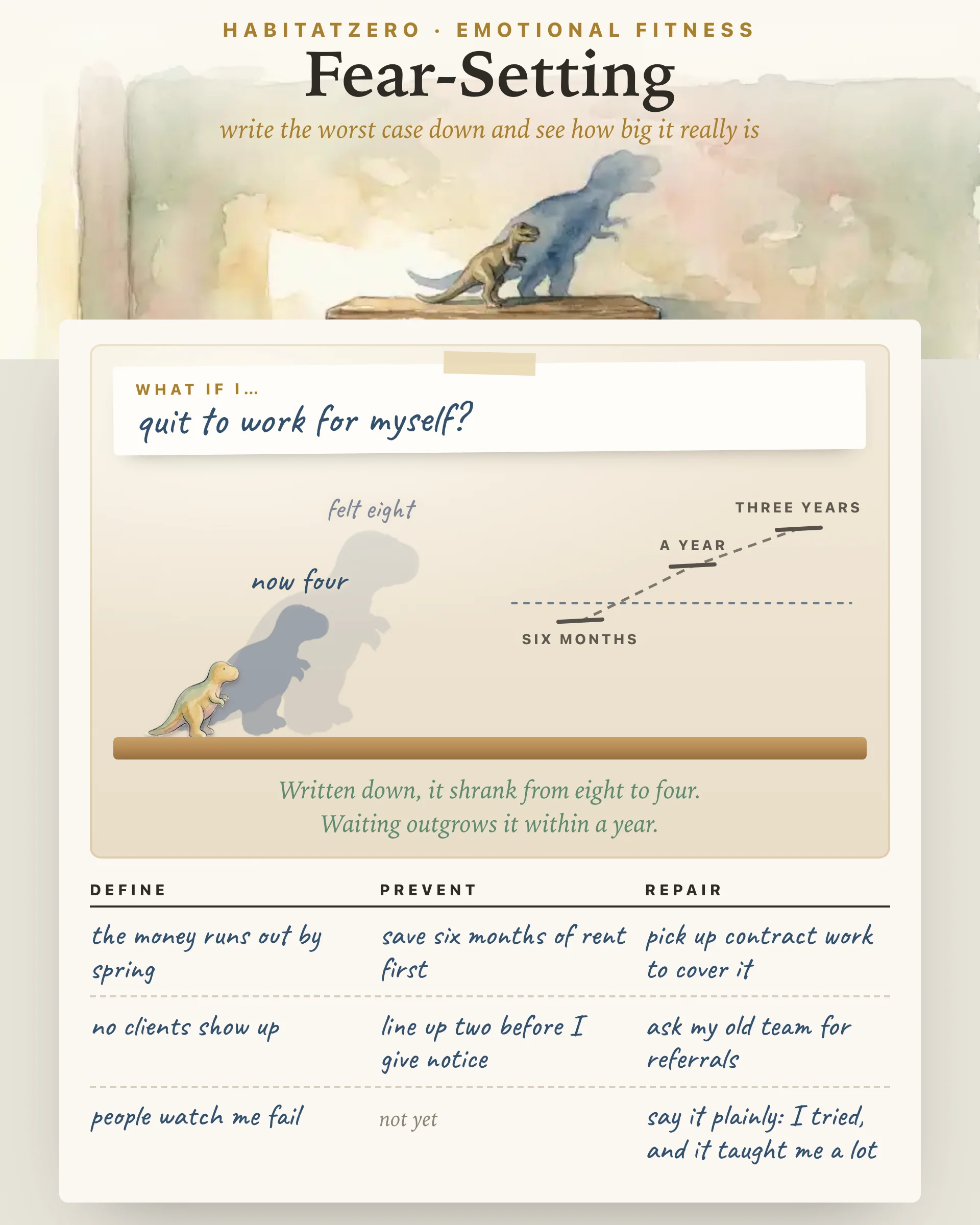
Fear-setting is Tim Ferriss's exercise. He set it out in his 2017 TED talk, Why you should define your fears instead of your goals, and traced it back to the Stoic writer Seneca and a practice called premeditatio malorum, the rehearsal of misfortune before it arrives. What you are reading is an independent, interactive take on his three pages. Neither Ferriss nor TED made it, checked it or vouches for it.
Goal-setting asks what you want. Fear-setting asks what you are afraid will happen if you go after it, and then makes you answer on paper. A fear held in your head has no edges; it is a general sense that everything could come apart. Written down, it turns into specific events, like savings that run out or a client who never calls back, and specific events can be planned for.
In the talk he applies it to his first vacation in four years: a rainy month in London that might sink his mood, prevented with a portable light each morning and repaired, if needed, with a flight to Spain for the sun.
Page one: define, prevent, repair. At the top goes the decision as a question, What if I…?, above three columns. In Define, list the worst things you can imagine happening if you went ahead; Ferriss aims for ten to twenty. In Prevent, write what you could do to stop each one, or make it even a little less likely. In Repair, write how you would limit the damage if it happened anyway, and who you could ask for help.
Page two: the upside of trying. What might an attempt, or even a partial success, bring? Confidence, a skill, a new contact, a clearer idea of what you want. Ferriss's phrase is a base hit; the fears were played up, so the upside stays conservative.
Page three: the cost of inaction. If you leave things exactly as they are, what does your life look like in six months, a year and three years, emotionally, physically and financially? He stops at three years because anything further out starts to feel abstract, and he calls this page possibly the most important of the three.
Here the three pages hang below a wall. Before you write anything, you slide the shadow of a toy dinosaur up the wall to match how big the fear feels, then work down the sheet.
With a worst case on page one, you measure again. The first shadow stays behind as a ghost, so you can see whether the fear shrank, held or grew, and pencil marks for the waiting sit beside a dashed line at the fear's current height. The sheet then tells you where, if anywhere, waiting outgrows the fear.
The measurements and the pencil marks are this page's additions. Ferriss's slides have no rating scale, though in the talk he weighs his London trip as a temporary, reversible one to three of pain against a possible eight to ten of life-changing upside. And where he suggests ten to twenty worst cases, this sheet holds five, so each one gets a real plan.
Nobody has run a trial of fear-setting itself, so any claim that it works is borrowed from neighboring research.
Psychologists Julie Norem and Nancy Cantor studied people who deliberately expect the worst before a challenge, a strategy they named defensive pessimism. Low expectations helped these people keep their anxiety from becoming debilitating, and when the researchers interfered with the strategy, performance dropped.
Therapists treating generalized anxiety sometimes use worry exposure, in which a person pictures the feared outcome in vivid detail instead of pushing it away. In a randomized trial with seventy-three adults, fifteen sessions of worry exposure helped about as much as applied relaxation, an established treatment, and the gains held a year later.
And across four experiments, two of them in real classrooms, students who did a short writing exercise about their worries just before a high-stakes exam scored better, especially the ones who usually dread tests.
None of this shows that three pages will make a hard choice easy. It does suggest that looking at a worst case on purpose, in writing, is a different act from lying awake with it.
Reach for fear-setting when a choice has a real upside and fear keeps moving the date: a new job, a move, going back to school, a conversation you have rehearsed for months. Fill it in once, then again a month later if you are still circling.
It is the wrong tool when the fear is about your physical safety, your health or a person who might hurt you. Those belong with a doctor, a counselor or someone you trust, not in a weighing of upsides and downsides. And if fear is shaping most of your days rather than one decision, a therapist will help more than any worksheet.
If your what-ifs are small and constant rather than tied to one leap, The Worry Tree sorts them one at a time. To rehearse the day's troubles each morning the way the Stoics did, try The Stoic Journal. And for a task that grows heavier each week you put it off, The Cost of Avoidance adds up what the delay is charging you.
Fear setting is a written exercise for a decision you keep putting off. Rather than listing goals, you spell out the worst that could happen, how you might prevent each outcome, and how you would repair the damage. Then you set that against what an attempt could bring and what staying put costs over time.
Tim Ferriss named it and made it popular. An earlier version appears in his book The 4-Hour Workweek, and he laid out the three-page form in a 2017 TED talk, crediting the Stoic habit Seneca wrote about of rehearsing misfortune before it arrives. This worksheet is an independent interactive version with no connection to Ferriss or TED.
Page one has three columns: define the worst things that could happen, prevent each one or make it less likely, and repair the damage if it happens anyway. Page two asks about the benefits of an attempt or a partial success. Page three describes the cost of inaction at six months, one year and three years.
No study has tested fear setting itself. Nearby research is encouraging but indirect. Some anxious people do better when they brace for the worst, a therapy technique built on picturing the worst case has helped people with generalized anxiety, and writing worries down before an exam has lifted scores. Treat it as a thinking tool, not a treatment.
No. Ferriss laid out the three pages in his 2017 TED talk, and this interactive take was built separately, with credit to him. It was not made, reviewed or endorsed by Ferriss or by TED, so watch his talk to learn the exercise in his own words.
The page shows a finished example you can read through. To fill in your own three pages and measure your own fear, open it in HabitatZero, where it is free and keeps your answers as you go.
By the team behind Fabulous, the science-based self-care app used by over 30 million people.


