
The Overwhelm Recovery ProtocolWellness & Routines · ~5 min
About this template · Updated November 2026
Joseph Pilates built his method in the early twentieth century, and the reformer is the best known of the machines he designed for it. Penelope Latey's history of the Pilates method traces where his ideas came from and how they spread. This page is not part of that lineage: it is an independent class builder, and no Pilates studio, teacher training school or equipment maker had a hand in it or vouches for it.
A reformer is a padded carriage that slides along a frame. Springs underneath pull it back toward a footbar, and straps on ropes let your arms or legs pull against those springs. Most of what it teaches is control: pressing the carriage out and letting it come home slowly.
You can copy each of those parts on a living room floor. A long resistance band takes the place of the springs and straps. Two sliders, or two small hand towels on a smooth wood or tile floor, take the place of the gliding carriage. A kitchen counter gives you something steady for the standing work. That is all the equipment reformer Pilates at home needs, or Pilates without a reformer at all.
The typewriter is here for its own carriage on a spring, which a good typist never lets slam back either.
There are nine reformer moves, in an order that starts on your back and ends on your feet: footwork with a band, bridging, leg circles with a band, a side-lying leg press, rowing arms with a band, a kneeling arm series, knee stretches on sliders, elephant on sliders and a standing lunge at a counter. Each has a home version, an easier one and its machine form.
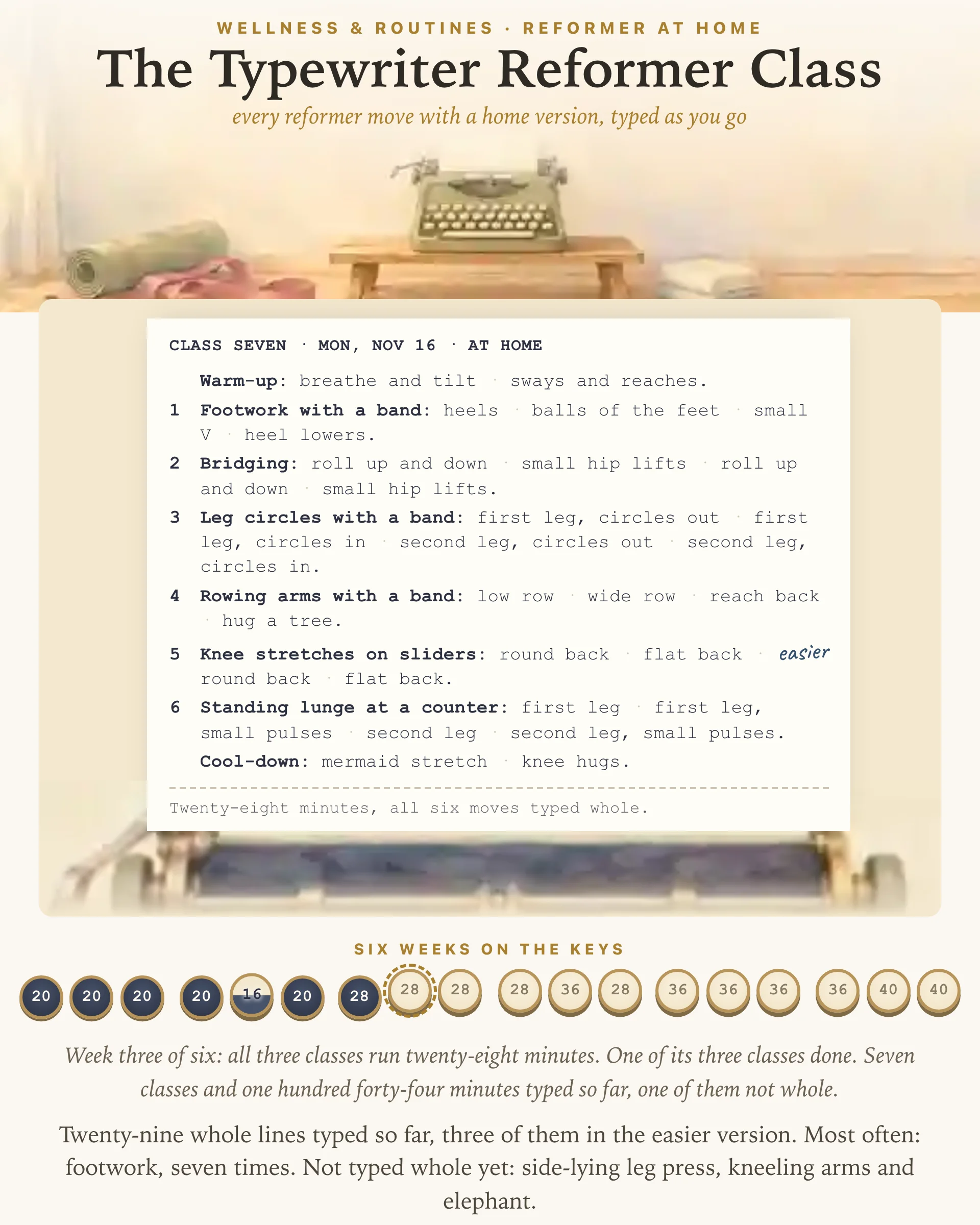
A class is a two-minute warm-up, four to nine moves of four minutes each, and a two-minute cool-down, so it runs from twenty to forty minutes. Every move splits into four one-minute stages, such as heels, balls of the feet, a small V and heel lowers for footwork. A sliding pacer below the typewriter goes out for three seconds and home for three, so your tempo stays slow.
Press begin and the sheet at the top types itself. Each stage's words appear letter by letter as its minute runs, and only a stage whose whole minute ran stays in ink. Skip a part and its time never comes back; stop early and the log keeps whole minutes only.
Below the builder sit eighteen round keys, one per class in a six-week plan of three classes a week. Week one holds at twenty minutes and four moves, the weeks after it build through twenty-eight and thirty-six, and the last two classes reach forty minutes with all nine moves. A key presses down when its class runs whole and sits half down when it stopped short.
Switch to your reformer and the names and cues follow. Springs differ between machines, so set them by your machine's own guide and note each move as light, medium or heavy. Before every class you confirm the springs are hooked and the straps and ropes are sound, and every machine cue ends the same way: bring the carriage home slowly, never letting it snap back. This page does not compare, rate or recommend any machine.
Studies of reformer Pilates are few and small. In a trial of eighty-six adults with long-term low back pain, half did twelve sessions of mat Pilates over six weeks and half did the same on equipment. The two groups did not differ on pain, and six months later the equipment group reported somewhat less disability and less fear of movement. In a trial of thirty-eight people with multiple sclerosis, split between mat Pilates, reformer Pilates and breathing exercises at home for eight weeks, both Pilates groups improved in balance, mobility, fatigue and quality of life to a similar degree, and the reformer group gained more trunk strength.
The mat versions are not a lesser copy. An ultrasound study of twenty-six experienced Pilates students found the deep abdominal muscles switched on during classic mat moves; one reformer version drew a little more from one of those muscles, measured in a single session. None of it proves a machine is needed, and none of it tested a home class like this one, so treat the plan as practice, not a promised result.
Talk to a doctor or physical therapist before starting if you are pregnant, have had recent surgery or a joint replacement, have osteoporosis, have a heart or blood pressure condition, or have back pain that keeps coming back. Elephant puts your head below your hips, so use its chair version or leave it out if you have high blood pressure, glaucoma or dizziness. Stop any move that hurts.
If you would rather learn the classic order on a mat, The Mat Pilates Class Deck deals a class from cue cards, and The Beginner's Pilates Mat brings in one move a week. For a small prop instead of a band, The Pilates Ring Squeezebox paces every squeeze. This page follows the reformer's own moves and finds each one a place on your floor.
Yes. Most reformer moves come from the same mat work, so each one here has a floor version: footwork and leg circles with a long band where the footbar and straps would be, knee stretches and elephant with sliders or towels standing in for the carriage, and a lunge with a hand on the kitchen counter.
Three cheap things do most of the work. A long resistance band gives the pull of springs and straps, two sliders or small hand towels on a wood or tile floor give the glide of the carriage, and a sturdy counter or chair gives you something steady for standing moves.
The trials are small and say less than the marketing does. In one with eighty-six adults with long-term low back pain, the machine group did no better on pain, though it scored a little better on disability six months on. In a trial of thirty-eight people with multiple sclerosis, both groups improved alike on almost every measure.
This plan asks for three classes a week with a rest day between them, starting at twenty minutes and building to forty over six weeks. Missing a day just moves the next class along, since each class takes the next key in order.
No. It is an independent class builder made from moves taught on reformers and mats, and no Pilates studio, teacher training school or equipment maker wrote it, checked it or backs it.
By the team behind Fabulous, the science-based self-care app used by over 30 million people.


