
The Overwhelm Recovery ProtocolWellness & Routines · ~5 min
About this template · Updated November 2026
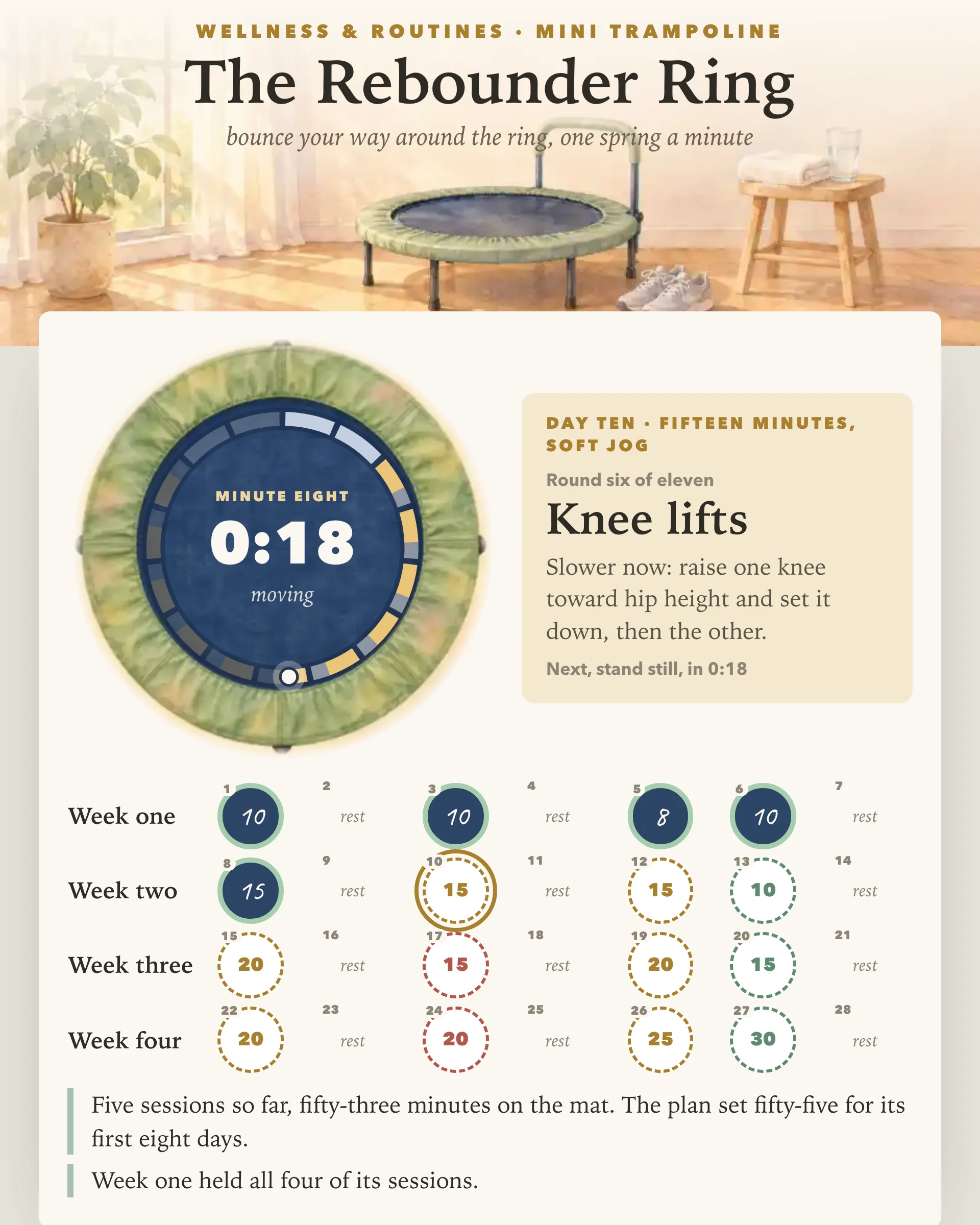
A mini trampoline workout asks very little of your living room: a round mat, some headroom and ten minutes. What it needs is a plan, because the bounce feels so easy that it tempts you to go too high, too soon. This page gives you one. You pick a level and the minutes, and the rim of a painted rebounder turns into a ring with one spring for every minute of the session. A timer walks you around it while a coach names each move, and four weeks of sessions fill in as you go.
Each round is one minute of moving, then standing still. The health bounce moves for forty-five seconds and rests for fifteen, the soft jog splits forty and twenty, and jacks and twists split it down the middle. Every session opens with two warm-up minutes and ends with two cool-down minutes, the last a calf stretch off the mat.
Choose ten to thirty minutes and the ring redraws: one colored arc per minute, the moving part bright and the still part pale. A fifteen-minute soft jog, for example, comes out as eleven rounds and seven minutes and twenty seconds of actual moving. Press start in the middle of the mat, step on, and a marker travels around the rim while the clock counts down each move.
The timer reads the real clock rather than keeping its own count, so a locked phone does not throw it off, and a pause never counts. Stop early and the page keeps the whole minutes you did. Stop for pain or dizziness and it also leaves a note on the sheet. A finished session lands on its day by itself, and the reading underneath adds up your minutes and levels against the plan.
Week one keeps you on the health bounce for ten minutes on four days. Week two brings in the soft jog at fifteen minutes. Week three adds twenty-minute jogs and a first fifteen minutes of jacks and twists. Week four mixes all three levels, ending with a thirty-minute session that is, on purpose, the gentlest one. Rest days sit between most sessions. If a week felt like a stretch, repeat it, or choose a lower level on any day.
The evidence on rebounding is young and small, but it points somewhere useful. In a six-week study of forty-seven adults with an average age of seventy-one, twenty-minute mini-trampoline sessions three times a week were compared with walking. Both groups improved their walking distance and a stepping test, and only the trampoline group got better at standing on one leg.
A small randomized trial in forty women with low bone mass, aged fifty-six to eighty-three, ran a twelve-week mini-trampoline program mixing balance, strength and jumping, twice a week for up to an hour. Balance, mobility, strength, walking speed and fear of falling all improved compared with women who did not take part. Bone density was the exception: the difference between the groups was not statistically significant. So treat rebounding as practice for balance and stamina, not as a bone treatment. Claims about lymph flow and detox were not measured in either study, and this page makes none.
Doctors in Seoul described seven people who developed compression fractures in the middle of the spine a few weeks into regular home rebounding. The patients described bouncing hunched forward, gripping the safety bar with both hands and barely bending their knees. That is why every move on this page starts with standing tall and soft knees, and why the bar is for a light hand, not for leaning on.
If you have had a fall, dizzy spells, a joint replacement, joint or pelvic floor trouble, low bone density, or a heart or blood pressure condition, ask your doctor or a physical therapist before your first session. When your balance feels uncertain, use a rebounder with a stability bar or set it where you can touch a wall. Step off at any pain, and if you feel dizzy, stop, sit down and let it pass before you stand again.
If the bounce is not right for you yet, The Low-Impact Stepping Stones keeps one foot on the floor the whole time, The Balance Ladder builds steadiness with a chair close by, and The Living Room Mile turns walking in place into an indoor route.
Open the ring when the rebounder is out and you have ten minutes. Let the plan pick the level and minutes, or change them before you press start. On a stiff morning, the health bounce still counts.
It is a short cardio session on a small home trampoline, often called a rebounder, built from gentle bounces, jogging in place and small hops. The springy mat gives under your feet, so you can keep a steady rhythm at whatever pace suits you that day.
Begin with the health bounce: stand tall with soft knees and let the mat raise your heels while your toes stay down. Ten minutes on four days is plenty for the first week. Add the soft jog in week two, and try small jacks only once the first two levels feel easy.
Ten to thirty minutes covers most home sessions. This plan starts at ten minutes and builds to a single thirty-minute session in week four, with rest days in between. A shorter session on a tired day is fine, and every whole minute you bounce counts in the log.
It can be, with some care. Choose a rebounder with a stability bar or set it beside a wall, stand tall rather than hunching over the bar, and step off if you feel dizzy or anything hurts. If you have had a fall, dizzy spells, joint or pelvic floor trouble, low bone density, or a heart or blood pressure condition, check with your doctor or a physical therapist first.
Yes. Personalizing the ring costs nothing and keeps your four weeks of sessions. Week one stays on the health bounce, week two brings in the soft jog, week three adds twenty-minute jogs and a first try at jacks, and week four mixes all three levels up to thirty minutes.
By the team behind Fabulous, the science-based self-care app used by over 30 million people.


