Leaves on a StreamEmotional Fitness · ~3 min
About this template · Updated September 2026
Credit first. The RAIN acronym was coined by the Buddhist teacher Michele McDonald, and the psychologist and meditation teacher Tara Brach carried it to a wide audience. Her post on the two versions of the acronym sets McDonald's original, where N meant non-identification, beside her own, where N means Nurture and the older N becomes what she calls after the RAIN. The Rain Chain is a separate project of ours: neither teacher made it, reviewed it or vouches for it.
A feeling arrives, dread before a meeting or shame after something you said, and most of us either argue with it or get busy. RAIN asks for a third move: turn toward the feeling and meet it in four steps, slowly enough that it has room to shift on its own.
Then comes a pause that Brach treats as part of the practice. After the fourth step, rest for a moment and notice the awareness that has been doing all the noticing. The feeling may still be around. It is no longer the whole of you.
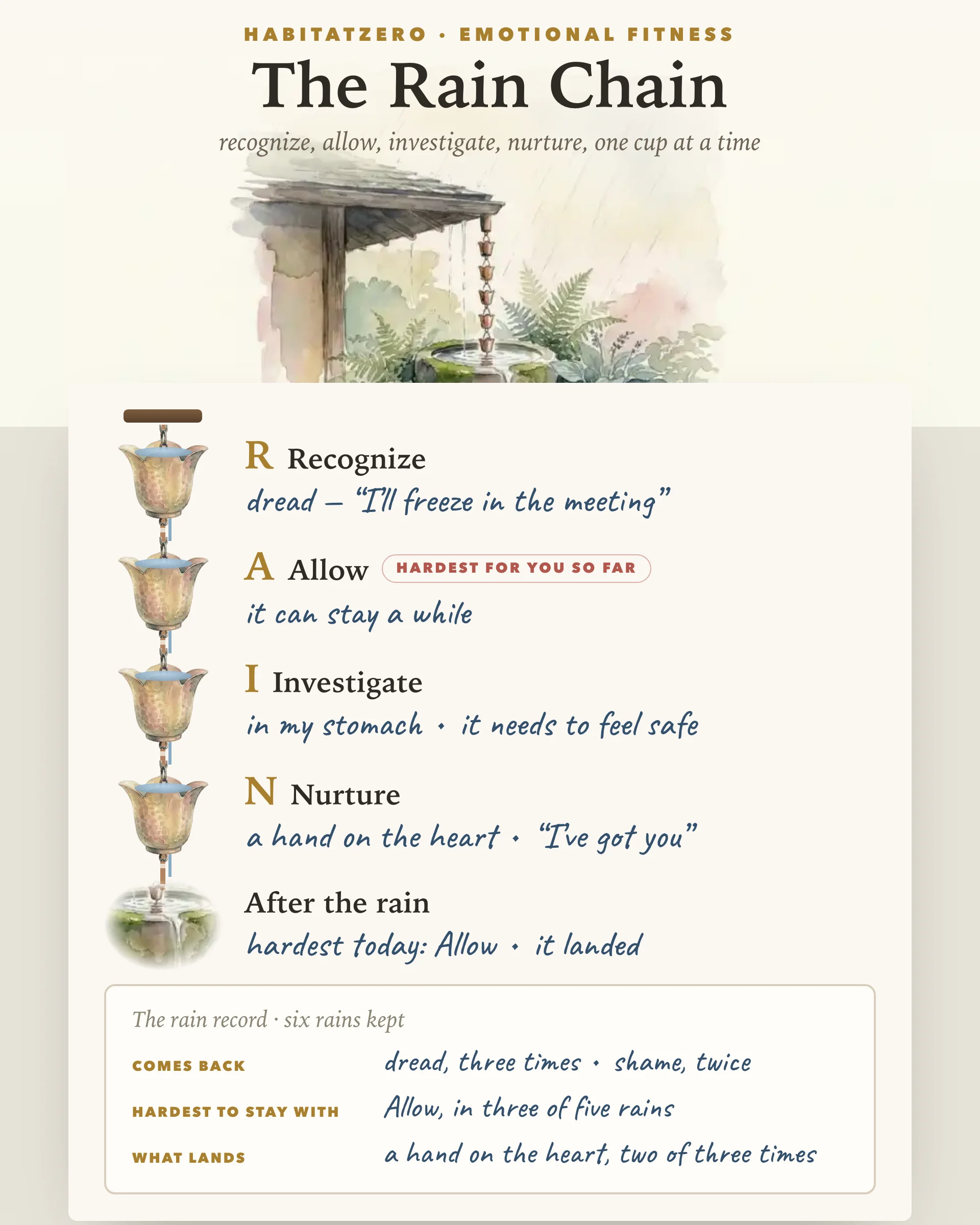
The page is drawn as a copper rain chain, the kind that guides water from a roof down into a garden, cup by cup, instead of letting it pour off the edge. Each cup is one step, and the feeling travels down them. You name it in the top cup by tapping a word or writing your own, then let it run on. A finished cup keeps your words in handwriting, and a thread of water runs down to the next one. Nothing is timed: a cup can hold you for three breaths or several minutes, and you can back up a cup if you moved on too soon.
When the feeling reaches the stone basin at the bottom, you rest. Then come two optional marks: which cup was hardest to stay with, and whether the kindness landed. Keep the rain and it joins your record.
The record is where the page does something paper cannot. From the second rain on, it reads your own practice back to you: the feelings that keep returning, the step you find hardest to stay with, and the kind of nurturing that actually lands for you. The cup that has been hardest most often wears a small tag on the chain itself, and a feeling that keeps coming back moves to the front of the first cup's words. The record holds twelve rains, so keeping a thirteenth means letting an older one go.
RAIN as a four-step package has very little direct research behind it, so be wary of anyone who calls it proven. Its separate moves have been studied, and they point the same way.
Naming a feeling is more than a formality. In a brain-imaging study, putting feelings into words dampened the amygdala's response to distressing pictures compared with other ways of processing the same images.
Allowing has support too. When sixty people with anxiety and mood disorders watched an upsetting film, the group told to accept their emotions rather than suppress them felt about as distressed during the film, but recovered with less negative feeling afterward, and their heart rates fell while the suppression group's rose.
Nurture rests on the broadest base. A meta-analysis of twenty-seven randomized trials found that self-compassion interventions led to moderate improvements in anxiety, depression, stress and self-criticism compared with control groups.
None of this shows that RAIN will work for you, with your feelings, this month. That is the job of the record: after a handful of rains, you hold a small body of evidence about your own practice.
Reach for RAIN when a feeling has its hooks in you and you are safe enough to stay with it: before a hard conversation, after a sharp word at dinner, on a heavy Sunday evening. It is a self-compassion practice, not a treatment for anything. If a feeling becomes overwhelming partway down the chain, stop, look around the room, and reach out to someone you trust or to a professional. The cups will still be there another day.
If Investigate keeps coming up empty, practice locating feelings in the body on their own with The Emotions Body Map. If Nurture is the cup that sticks because a harsh inner voice talks over every kindness, the Inner Critic Translator works on that voice directly. And on a calm day, The Loving-Kindness Circle is a gentle way to rehearse warmth before you need it.
RAIN is a four-step way to meet a difficult feeling instead of outrunning it. You recognize what is happening, allow it to be there, investigate it with care, and nurture the part of you that is hurting. It is usually learned as a short guided meditation and then used on your own in hard moments.
The acronym was coined by the Buddhist teacher Michele McDonald, and the meditation teacher and psychologist Tara Brach made it widely known. In the original, N stood for non-identification; Brach made Nurture a full fourth step and moved the older N to what she calls after the RAIN, a loosening of the narrow sense of who you are. The Rain Chain is an independent worksheet with no tie to either teacher.
One pass can take three minutes in a stairwell before a meeting or twenty minutes as a sitting practice. Nothing on this page runs on a timer: you let the feeling move to the next cup when you are ready, and a short rain counts as much as a long one.
RAIN is a self-compassion practice rather than an anxiety treatment, though its moves echo things researchers have studied: naming a feeling, accepting it rather than suppressing it, and treating yourself kindly. Pooled trials of self-compassion training found moderate improvements in anxiety and stress. If anxiety is constant or growing, bring it to a professional and keep RAIN as a companion to that care.
What you see on this page is a sample rain carried all the way down to the basin. Your own rains, and the record that learns from them, live in HabitatZero, which costs nothing to use.
By the team behind Fabulous, the science-based self-care app used by over 30 million people.