Leaves on a StreamEmotional Fitness · ~3 min
About this template · Updated September 2026
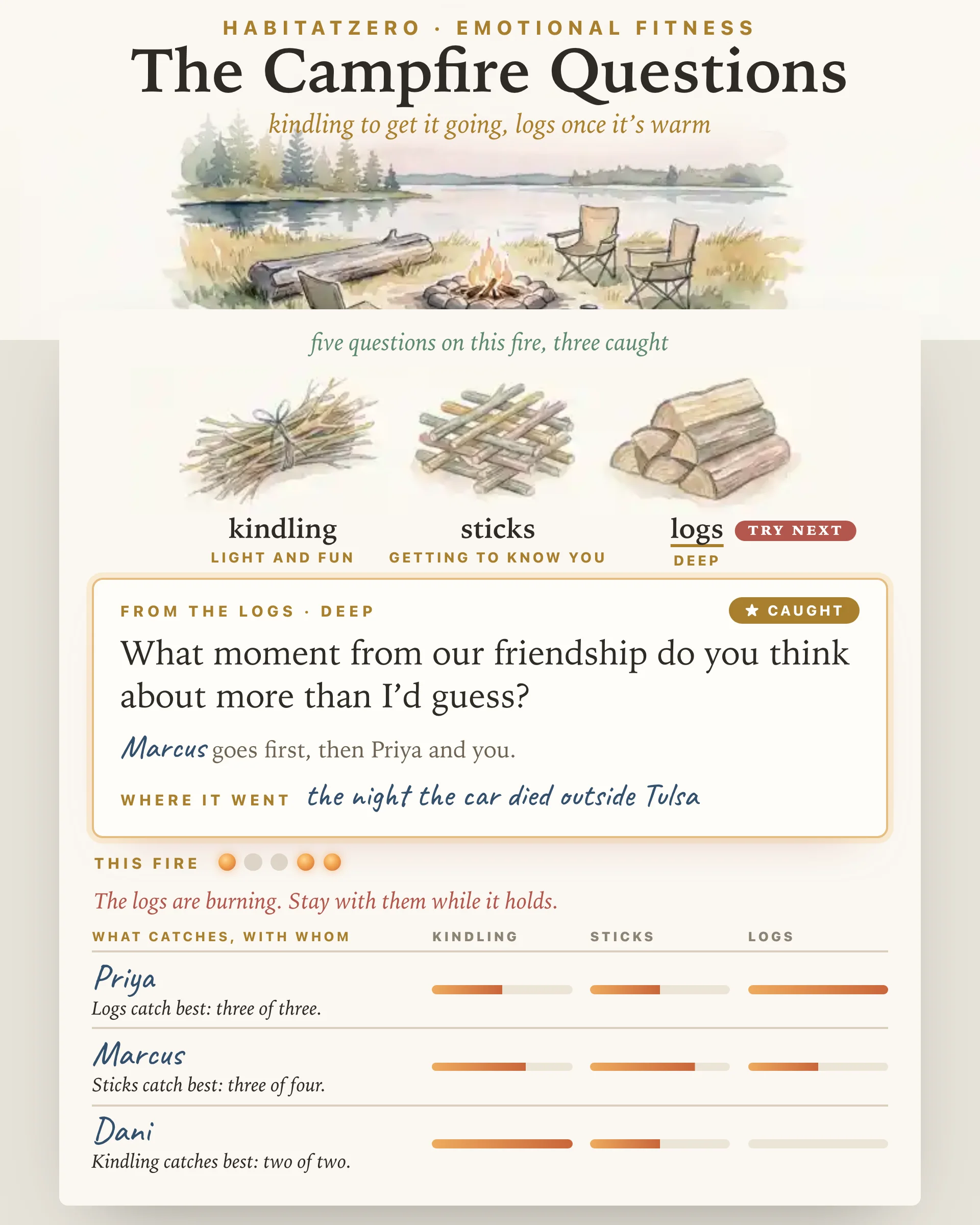
You are probably here because a conversation needs something. Maybe it is a new friend you would like to know past the small talk, an old friend you mostly text about plans, or a table of people who have run out of things to say. Any list of questions to ask friends helps a little. The order you ask them in helps more.
This page stacks ninety-six questions in three woodpiles. Kindling is light and fun, sticks are for getting to know each other, and logs are the deep ones. You build a conversation the way you build a fire: small stuff first, bigger pieces once something has caught.
Plenty of evenings stay on the kindling because the logs look heavy. In a series of experiments, Kardas, Kumar and Epley found that people expected deep conversations to feel more awkward than shallow ones and underestimated how much the other person would care about what they shared. The deep talks went better than predicted, and people came away feeling more connected than after small talk. Most of those pairs were strangers; with close friends, people predicted more accurately. Still, the fear of the log tends to be bigger than the log.
So the page nudges in both directions. Two catches in a row, and it suggests going one pile deeper. Two deep questions that fall flat, and it points you back to the sticks.
Add the friends you talk with and tap whoever is here. Each question has one person who answers first, and everyone else can answer after; that first answer passes around the circle with every new question, and it comes to you too. Tap a pile to draw. If a question does not suit the moment, swap it; it slides under the pile and is not counted.
When a question turns into a real conversation, tap it caught and jot down where it went, like the night the car died outside Tulsa. A row of embers shows how the current fire is going, and when the evening winds down, you bank it.
Over the weeks, a quiet record builds up for each friend: how many questions from each pile you have shared, how many caught, and, once a pile has two or more, which one catches best. You can also add six questions of your own to each pile, the inside ones only your friends would get.
From the kindling: Which animal would be the rudest if it could talk? What would your walk-up song be if every room you entered came with music? What's the strangest thing in your fridge right now?
From the sticks: What were you like in middle school, honestly? What rule did your family have that other families found strange? What are you quietly proud of that nobody ever asks about?
From the logs, for friends you already trust: What are you carrying right now that you haven't said out loud? When did you realize we were actually friends? What do you need from friends that you find hard to ask for?
The card is only the match. In studies of get-to-know-you conversations, Huang and colleagues found that people who asked more questions, and especially more follow-up questions, were liked more by their partners, and that people did not expect asking to make that difference. What happened next? What did your parents say? Would you do it again? Questions like those turn an answer into a conversation. Answer the card yourself, too. A fire that only one person feeds goes out.
A study that recorded snippets of people's everyday talk found that deeper conversations and more self-disclosure went along with greater well-being, especially with feeling connected. That is an association, not proof that deep questions make anyone happier, and the link showed up more clearly in people's own ratings than in outside observers' ratings.
Friendship itself runs mostly on time. Jeffrey Hall's study of new friendships found that hours spent together tracked how close people became; by his estimates it takes roughly fifty hours to go from acquaintance to casual friend and more than two hundred to become close. A question game is a good way to spend some of those hours, not a way around them.
The record here counts only what you mark. A friend whose best pile is kindling is not a lesser friend. That is the friend you laugh with.
Nobody owes an answer, and a pass is always allowed. If a log opens something painful, listen more than you advise. And if a friend tells you they are thinking about suicide, stay with them and call or text 988 together in the US, or your local emergency number anywhere else.
Bring it to dinners, road trips, sleepovers and long walks, or to the friend you keep meaning to really talk with. For one long sitting with one person, The Thirty-Six Questions follows the original study's three sets. To hear how a close friend sees you, try The Johari Window together. And if big evenings leave you drained, The Social Battery helps you plan them around your energy.
Good friendship questions are open, specific and easier to answer with a story than with a yes or no. Mix three kinds: light ones that get people laughing, getting-to-know-you ones about people, places and firsts, and a few deep ones about what matters now. What snack would you defend in front of a jury, what story does your family always tell about you, and what do you need more of in your life right now cover all three.
Ask about the present and about the friendship itself. What are you carrying right now that you haven't said out loud? When did you last feel really understood by someone? What moment from our friendship do you think about more than I'd guess? Save them for after a few lighter rounds, answer them yourself as well, and let a pass be a pass.
Fun questions work best when they are oddly specific. Which animal would be the rudest if it could talk? What would you sell if you ran a tiny food truck? Which movie villain secretly had a point? Each one takes seconds to answer, costs nothing to share and warms up a quiet table quickly.
Start in the middle of the woodpile: what they are into lately, who their first best friend was, what they were like in middle school, or what a good weekend looks like for them these days. Then ask one more thing about whatever they say. In studies of get-to-know-you conversations, people who asked more follow-up questions were liked more by the person they were talking with.
Reading the questions and examples on this page takes no account at all. The drawing, the turns, the stars and the record of what catches with each friend live in the worksheet, which opens for free in HabitatZero and keeps your fires between visits.
By the team behind Fabulous, the science-based self-care app used by over 30 million people.