Leaves on a StreamEmotional Fitness · ~3 min
About this template · Updated September 2026
Credit first. The questions on this page were written for a 1997 paper by Arthur Aron, Edward Melinat, Elaine Aron, Robert Vallone and Renee Bator, The Experimental Generation of Interpersonal Closeness, where they sit in an appendix as three sets of slips. They reached most of the world through Mandy Len Catron's January 2015 Modern Love essay, To Fall in Love With Anyone, Do This, which is also where the four minutes of eye contact come from. This page is an independent worksheet built on the published procedure; it is not affiliated with the authors, with Catron or with The New York Times, and none of them have reviewed or endorsed it.
Aron's team paired up strangers, sat each pair down for forty-five minutes, and handed them three sets of slips. The instructions in the appendix are the whole method: one of you reads a slip aloud and answers it first, then the other answers the same slip, and you alternate who reads aloud with each new one. No skipping, no reordering. Each set had a third of the time, and the pairs were told it did not matter if they ran out of slips before the time was up. The questions grow more personal as they go, from dinner guests and telephone calls in Set I to family, regret and crying in Set III.
A comparison group spent the same forty-five minutes on small-talk questions. Afterwards both groups rated how close they felt to their partner, including on a picture scale Aron had published a few years earlier, a row of overlapping circles where you pick the pair that looks most like the two of you. The pairs who had worked through the escalating slips felt closer than the pairs who had chatted. That is the finding. It was measured minutes after the conversation, between strangers, in a lab.
The paper reports nobody falling in love, and the authors were not trying to make anyone. When the list went viral, Elaine Aron told Berkeley's news office that the questions had not been created to help anyone fall in love; the procedure was built to produce a temporary sense of closeness on demand so that closeness itself could be studied. Catron's essay is honest about this too. Her argument was that closeness can be chosen and built, not that a list conjures romance, and the story of a pilot pair who later married and invited the lab to the wedding is an anecdote she recounts rather than a result in the paper.
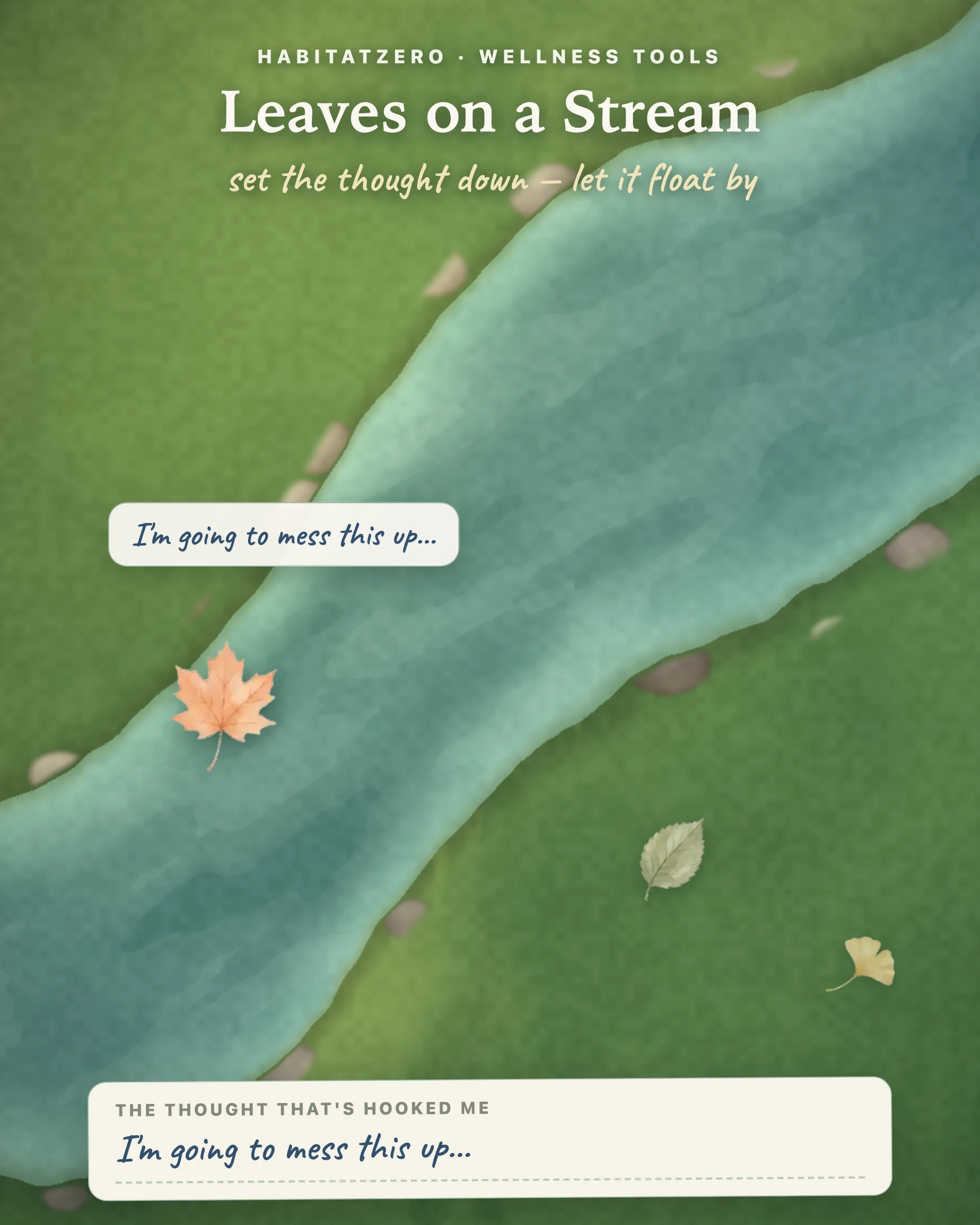
The four minutes of looking come from Catron, not from the slips. Mutual gaze has its own small literature: a 1989 lab study found that strangers asked to hold each other's eyes for two minutes reported warmer feelings towards each other than pairs who had looked at hands or counted blinks. Catron and her partner did it for four, standing on a bridge in Vancouver. So this page treats the gaze as optional and keeps it quiet: no sound, no countdown, just a painted night lifting off a river while you look somewhere else.
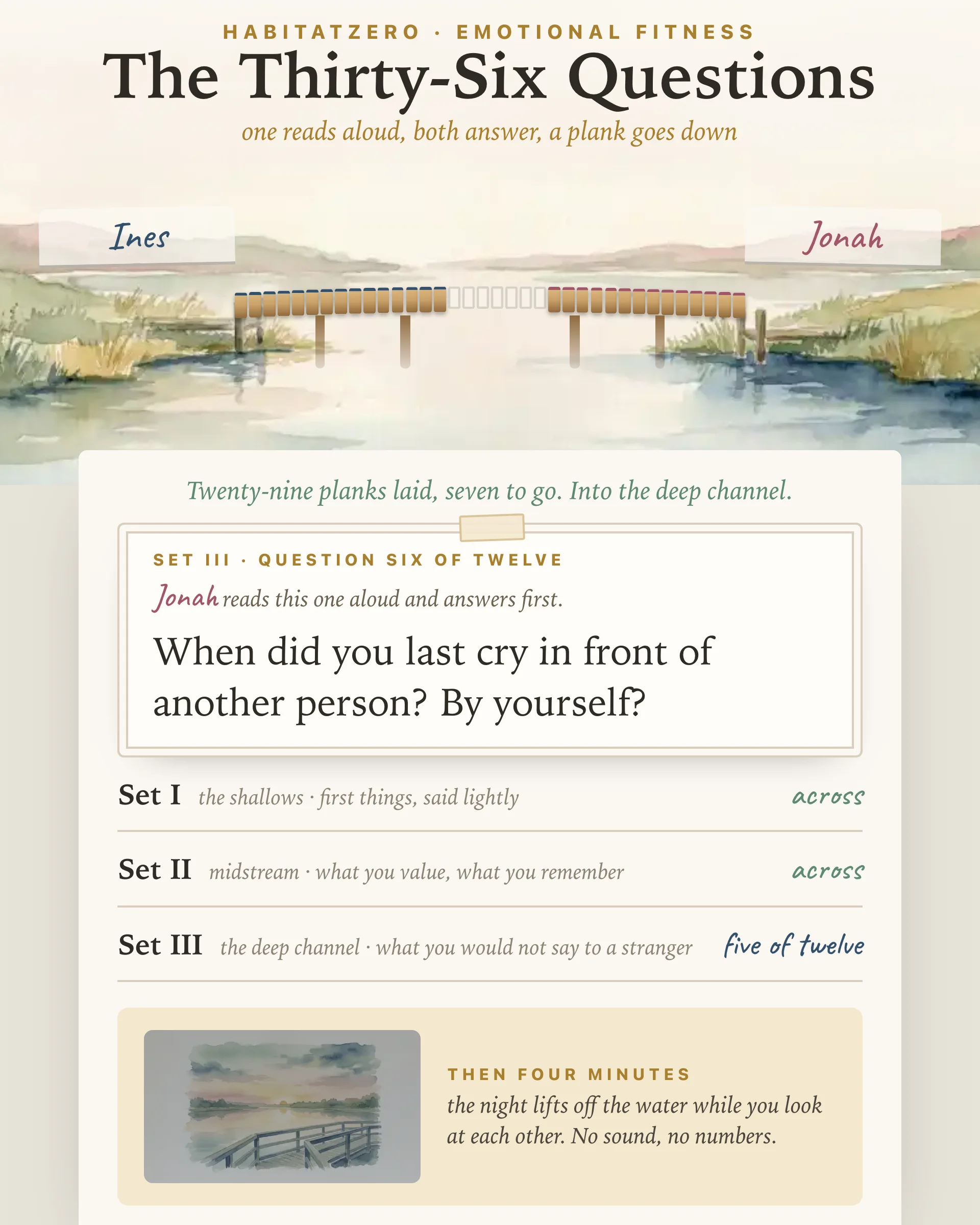
Write two names on the two banks. The first slip is read aloud by the left bank, who answers it first; the second passes to the right bank; and so on through thirty-six, exactly as the appendix asks. Each time you both finish a question, one of you taps and a plank of a footbridge goes down from the reader's side, blue from the left, rose from the right. Set I builds the shallows at either bank, Set II reaches midstream, and the twelve slips of Set III meet in the deep channel in the middle. The bridge is the only score, and it counts one thing: that you got there.
Between sets the page stops and says so, which is your cue to refill the glasses. You can pause anywhere and your place is kept, with the next slip face down until you are both back. A mis-tap can be lifted with two taps, so nothing is lost. After the thirty-sixth plank the four-minute panel appears, and two short handwriting lines ask what each of you will keep from the evening.
Set I
Set II
Set III
Bring it to a first date that has run out of small talk, or to someone you have known for ten years and been careful with for nine of them. The slips have since been used between strangers of every kind, and the closeness they produce is not aimed at romance; friends and siblings get as much out of the deep channel as couples do. If you would rather warm up with something lighter, The Couples Quiz deals twelve guess-the-answer cards with no confessions required. If the evening goes well and you want somewhere to put the next one, The Date Night Jar is built for that, and the Couples Check-In gives an established pair a weekly rhythm once the bridge is across.
They are three sets of twelve questions written by Arthur Aron and colleagues for a 1997 study on generating closeness between strangers. The sets get more personal as they go, from dinner guests and telephone calls to family, regret and what you would grab from a burning house. The full list, in its original order and sets, is on this page and inside the worksheet.
The study never tested that. It found that pairs of strangers who spent forty-five minutes on these questions felt closer afterwards than pairs who made small talk. Closeness is what was measured, minutes later, in a lab. Whether closeness turns into anything more depends on the two people, not on the list.
From the appendix of a 1997 paper in Personality and Social Psychology Bulletin by Arthur Aron, Edward Melinat, Elaine Aron, Robert Vallone and Renee Bator. They became famous in January 2015 when Mandy Len Catron wrote about trying them in the Modern Love column of The New York Times.
No. The paper ends after the third set. The four minutes of looking into each other's eyes come from Catron's essay, where she and her partner did it on a bridge. This page includes it as an optional, silent closing timer and says plainly that it was her addition.
Reading all thirty-six here costs nothing and needs no account. To lay the planks, keep your place between evenings and run the four minutes, open the worksheet in HabitatZero, which is free as well.
By the team behind Fabulous, the science-based self-care app used by over 30 million people.