Leaves on a StreamEmotional Fitness · ~3 min
About this template · Updated September 2026
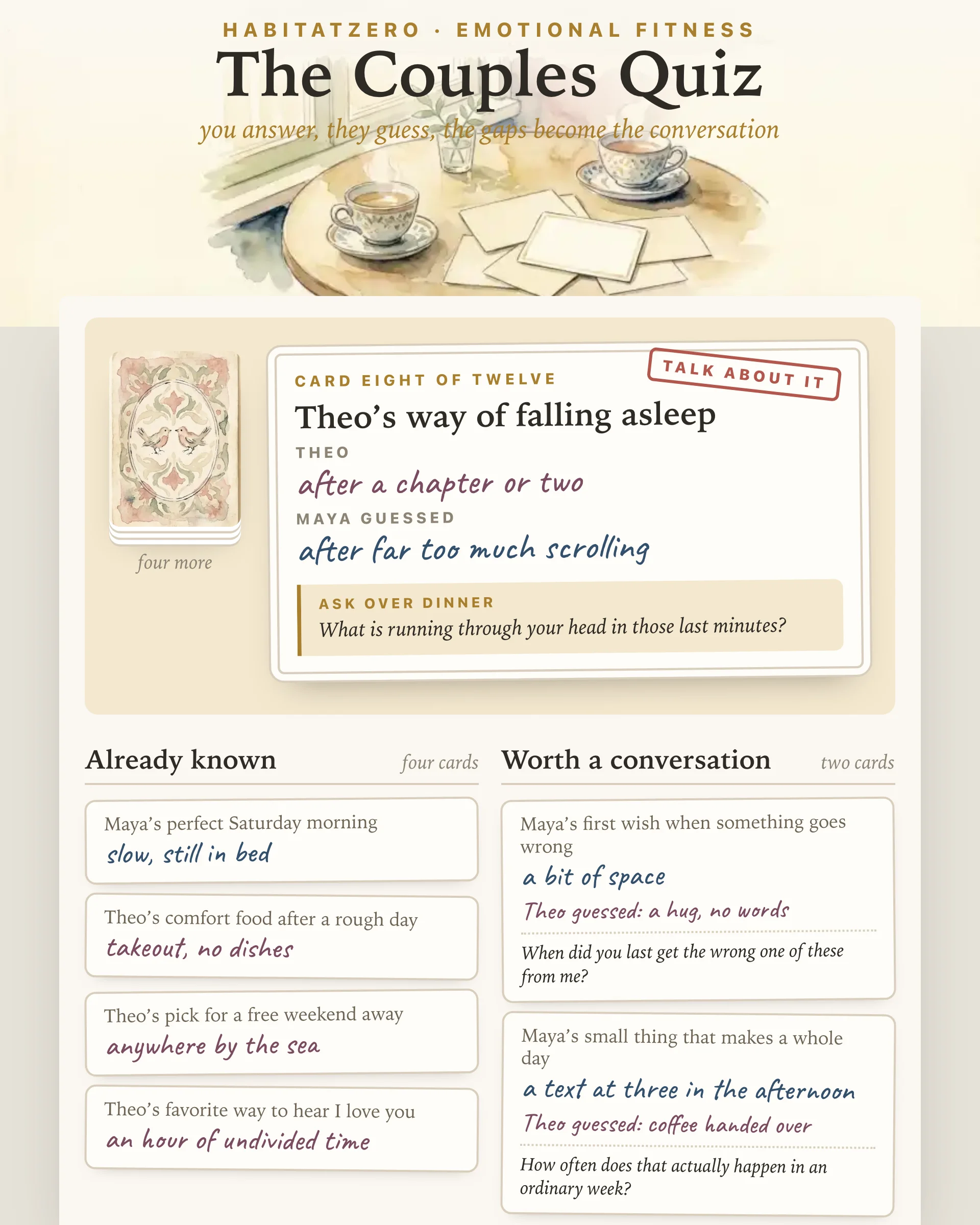
Somewhere between the first year and the tenth, most couples stop checking. Not from neglect but from confidence: you already know what they would order, what they do when a plan falls through, how they like to be told. A couples quiz in the how-well-do-you-know-me format exists to check anyway, and the surprises are the point. This page deals that old kitchen-table game as twelve cards on a single screen, with the scoreboard left off on purpose.
Two names go on the sheet first, one in blue ink, one in plum. Then the first card turns face up: Maya's perfect Saturday morning, four answers beneath it. Maya taps hers while Theo studies the ceiling, and the card flips onto its painted back. Theo turns it over, sees the same four answers, and taps the one he believes she chose. The card shows both, stamps itself matched or talk about it, and slides into one of two piles when you call for the next one. That next card is Theo's to answer and Maya's to guess, and the deck keeps alternating until it is empty.
A miss arrives with a question written for that specific card. If Maya's first wish when something goes wrong is a bit of space and Theo guessed a hug, the card asks when she last got the wrong one of those from him. That is the whole design in one move: a gap is not a mark against anyone, it is the next thing worth asking, and the sheet hands you the opening line so nobody has to improvise one.
You could simply read the twelve questions aloud to each other. Guessing first does something plain asking cannot: it exposes the picture you carry of your partner and lets them correct it on the spot. Researchers who follow marriages over time have found that this picture matters in a particular way. In two longitudinal studies of newlyweds, Lisa Neff and Benjamin Karney found that nearly everyone adored their new spouse in general terms, but spouses differed a great deal in how accurately they saw each other's specific qualities. For wives, that specific accuracy went with more supportive behavior and with marriages that were less likely to end in divorce; the same pattern did not appear for husbands. Their summary line was that love grounded in accuracy looks sturdier than love without it.
The talking that follows a miss has its own evidence. Arthur Aron and colleagues showed that pairs of strangers who worked through a set of gradually more personal questions for forty-five minutes felt closer afterward than pairs who made small talk for the same stretch. And a meta-analysis of self-disclosure studies by Nancy Collins and Lynn Carol Miller found the link runs in both directions: we like people who open up to us, and we open up to people we like.
What none of this shows is that a card game changes a relationship. Nobody has tested this deck. The newlywed findings are correlations, the closeness effect was measured minutes after the conversation, and a light quiz about comfort food is not therapy. What the evidence does support is the modest claim built into the page: knowing the specifics matters, saying them out loud helps, and a structure that makes both happen on a Tuesday evening is worth having.
The page keeps a tally in words, seven matched and five worth a conversation, and never a percentage. That is a deliberate refusal. A score turns the evening into a defense of your guesses, and a comparison of who knows whom better is exactly the kind of ranking that sours a game. The two piles say something more useful. The already-known pile is a small record of attention paid. The worth-a-conversation pile is a list of questions, each attached to the card that raised it, that you can work through over the washing up.
The twelve cards ask about ordinary preferences on purpose: the chore that never felt like one, the guilt-free splurge, the mood that shows up when you are running on empty. None of them asks how the relationship is going. That keeps the mood light, which is what makes the game fun to repeat, while the gaps quietly point at things one of you has never said.
Deal it on a slow evening with the phone between you, on a long drive when the passenger holds the screen, or as the first ten minutes of a date night that needs something to talk about. Play it again in six months; the answers move more than people expect, and a card that matched in spring can open a conversation in the fall.
If you want a weekly rhythm rather than an occasional game, the Couples Check-In gives two people three short rounds and a shared aim. If a card's question turns into a real disagreement, the Conflict Resolution Worksheet walks one conflict through four stations. And if a missed guess stings more than a card should, the Anxious Attachment Journal is for untangling that on your own before it reaches the table.
A set of questions two people answer about each other rather than about the relationship. On this page each card asks one partner for the true answer and the other for a guess, which is the how-well-do-you-know-me format couples have played at kitchen tables for decades.
There is a tally in words, six matched and five worth a conversation, but no percentage and no grade. A missed guess is not a mark against either of you; it is something one of you has not said out loud yet, and the card hands you the question to ask.
That is how this one is built. A single screen passes back and forth: the card flips to its painted back after the owner answers, so the guesser sees nothing until they turn it over. It works on a phone held between two people, a tablet on the table or a laptop turned around.
Everyday ones with four answers each: the perfect Saturday morning, comfort food after a rough day, the chore that never felt like one, the way you like to hear I love you, what you turn into when you are running on empty. Nothing on the cards asks about the relationship itself, so the mood stays light while the gaps quietly point at things worth knowing.
The public page only shows a worked example with a few cards already turned. Open the quiz inside HabitatZero, which costs nothing, to write your own names, deal the twelve cards and keep the two piles for next time.
By the team behind Fabulous, the science-based self-care app used by over 30 million people.