Leaves on a StreamEmotional Fitness · ~3 min
About this template · Updated July 2026
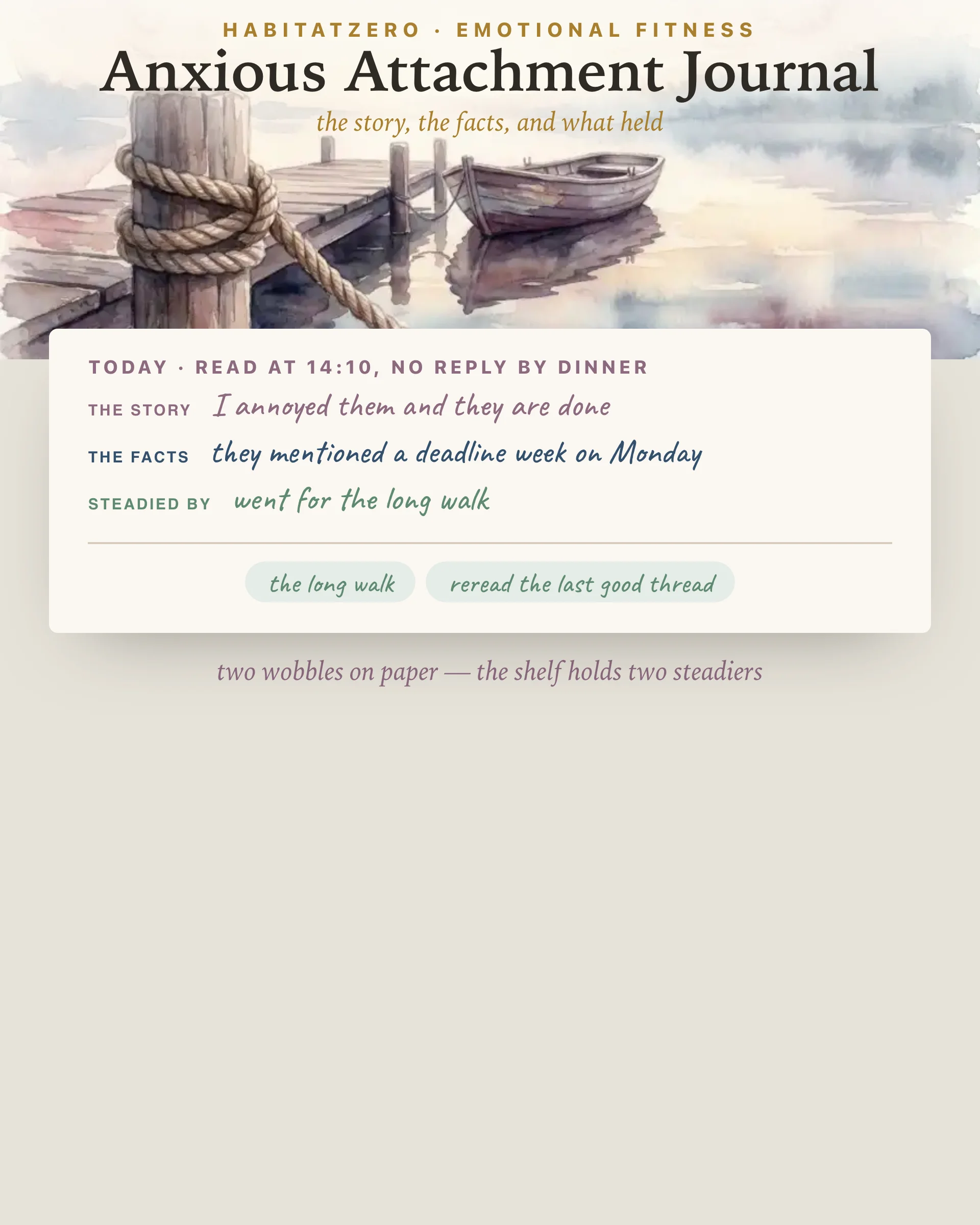
There is a particular kind of evening familiar to anyone whose closeness alarm runs sensitive: a message is read and not answered, and within the hour a whole story has written itself — they're pulling away, you did something, it's ending. The story feels like information. It is usually a draft. This journal is built for exactly that hour, and it asks for only four lines.
The moment goes first, small as it really was: read at 14:10, no reply by dinner. Naming the trigger at its actual size is quietly powerful — spirals inflate their causes, and the written version refuses to inflate.
Then the split, which is the heart of the page. The story — what you started telling yourself — goes down in one color. The facts — what a camera would have recorded — go down in another. They're done with me sits directly above they mentioned a deadline week on Monday, and the page holds both without arguing. It doesn't need to argue. Seeing the two lines apart, in your own handwriting, does most of the work: the feeling stays real, and the evidence stays its actual size.
The last line is what steadied you, even a little — the walk, calling instead of re-reading, tea and twenty minutes. It's fine to leave blank. But when it isn't blank, something useful happens.
Every unique steadier you record collects on a shelf at the top of your log. This is the journal's long game: wobbly moments are terrible at remembering what helps, and the shelf remembers for you. The research points the same direction — a meta-analysis of attachment security priming studies found that deliberately bringing to mind sources of felt security is reliably associated with steadier mood and outlook, and writing exercises built on self-kindness have shown measurable benefits in controlled trials. Your shelf is both of those, personalized: proven steadiers, in your own words, ready before the next wobble arrives.
Over weeks, the log develops a second use. Reread it and the pattern becomes visible — the same three triggers, the same story-shapes, the same steadiers doing the heavy lifting. Patterns you can see are patterns you can plan around.
It is a self-help practice for individual moments: catch, split, steady, keep. It is deliberately not therapy, not a diagnosis of anyone's "style," and not a promise that journaling rewires anything by itself. If the spirals are shaping whole weeks — or the same ending keeps happening — someone trained in relationships is the genuinely strong move, and this log rides along well as a record of what the weeks actually looked like.
For the body-first moments when words aren't reachable yet, 4-7-8 breathing and the 5-4-3-2-1 grounding exercise come before the pen. And for generalized worry that isn't about closeness, the anxiety journal's check-back ledger is the sibling tool.
The next wobble is coming; that's not pessimism, just weather. Four lines, two colors, one shelf.
The specific wobble moments, close to when they happen: the trigger, the story your mind drafted, and the plainest possible account of what occurred. This page keeps each entry to four short lines so it works mid-spiral, not just in calm retrospect.
Because in a wobble the two arrive fused together. Writing them as separate lines — in different ink — lets you hold both at once: the fear is real as a feeling, and the evidence is usually smaller than the story. Over many entries, the gap itself becomes familiar and less convincing.
Every entry can end with what actually helped, even a little. The journal collects the unique ones on a shelf above your log, so the next wobbly evening starts with your own tested list rather than a blank mind.
No, and it does not promise to. It is a self-help practice for individual moments — good company between the bigger moves. If the spirals shape whole weeks or every relationship, working with someone trained in relationships is the strong play, and this journal pairs happily with that.
By the team behind Fabulous, the science-based self-care app used by over 30 million people.