The Overwhelm Recovery ProtocolWellness & Routines · ~5 min
About this template · Updated September 2026
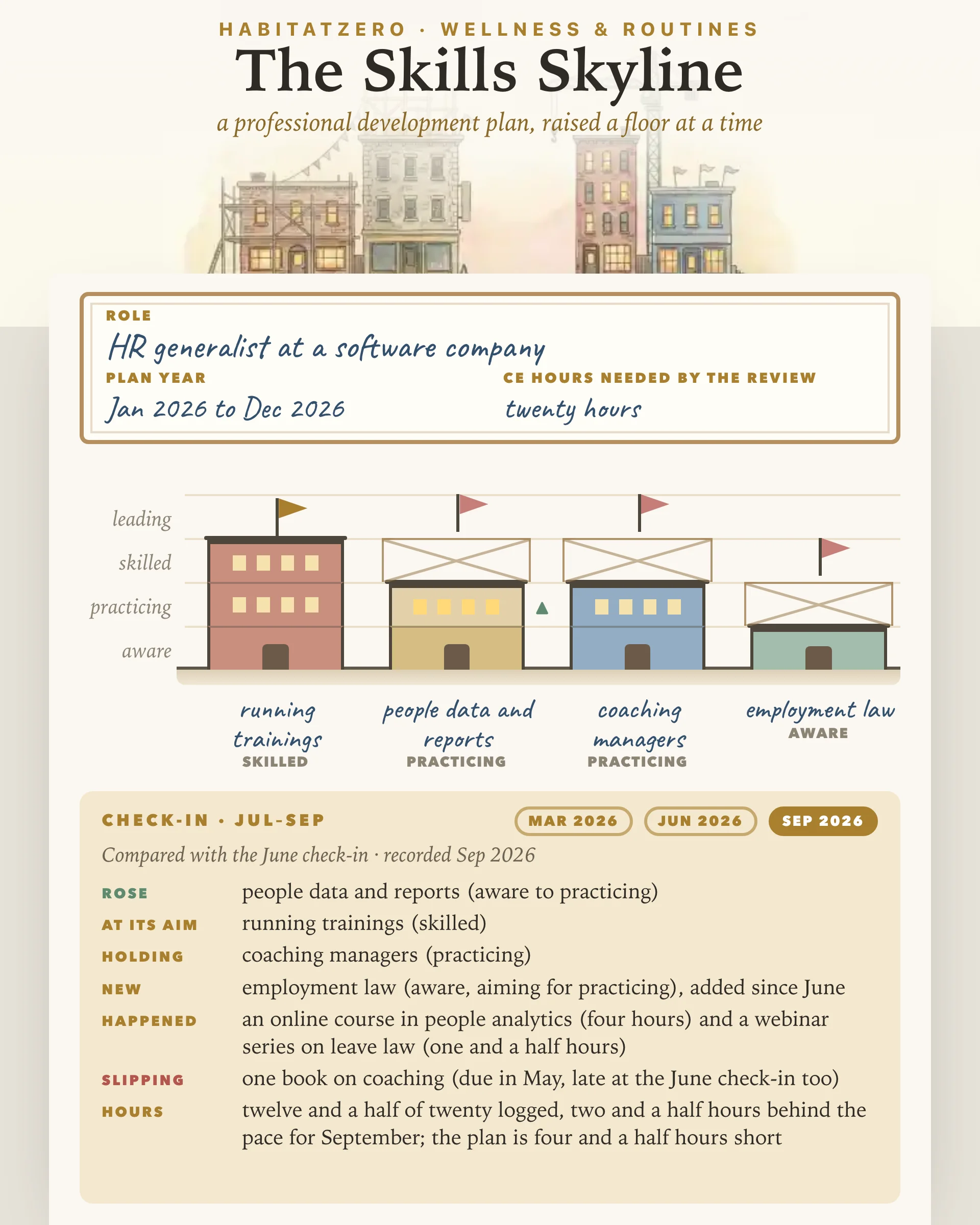
A professional development plan should answer one question at your next review: what got better? Most plans cannot, because they record what you attended rather than what changed. A certificate from March and a webinar from June prove you were busy. They say nothing about whether you can now run the budget meeting on your own.
This page draws the plan as a skyline so the answer is visible. Each competency you want to grow is a building, its floors are four levels from aware to leading, and scaffolding rises from where it stands today to where you are aiming. When your evidence says a competency has moved, you build the next floor.
Forms from HR departments and professional associations ask for the same parts:
Tap a suggested competency or name your own, and a building goes up. Set its level now and its aim: aware means you know what good looks like, practicing that you can do it with help, skilled that you do it well alone, and leading that you teach it to others. A flag marks the aim and turns gold once the building reaches it.
Each building takes up to four activities, each with a due month, the hours it counts for and the evidence it will leave. Mark an activity done when you finish, and its hours join the bar. Learning outside the plan goes in as one running total.
Enter the hours your license or school requires and the review month, and the bar gains a pace mark. Fall behind and the page says how many hours a month would close the gap, and if even your open activities cannot cover the total, how many hours the plan is short.
At the end of each quarter, raise any building your evidence supports, then record the check-in. The reading compares the plan with your previous check-in: which competencies rose a floor, which are holding, which activities happened and which are late. An activity that was already late last time gets called out again, since that pattern usually means the activity is wrong for the goal rather than short on willpower. Once the review month passes, the next plan year starts from your current levels.
Plans lean on courses because courses are easy to schedule. The Center for Creative Leadership's 70-20-10 rule, which grew out of its research on how executives learn from experience, holds that most growth comes from challenging assignments, a smaller share from relationships with bosses and mentors, and a thin slice from formal training. Read the split as a rough guide and nothing firmer, because a review of the studies behind it concluded that the evidence for the 70 percent figure is weak. Keep the useful part: give every competency one activity that makes you do the thing, not only read about it.
The levels here are self-ratings, and self-ratings drift. A systematic review of physicians found that in 13 of 20 comparisons, self-assessment showed little, no or even an inverse relationship with outside measures of competence, and several studies found the least skilled and the most confident were the least accurate. That is why every activity asks for evidence someone else could see, and why a floor is best raised after a conversation with your manager rather than on a good afternoon. To compare your own view with your colleagues', try The Johari Window.
Hours deserve the same humility. A meta-analysis of deliberate practice found it explained less than 1 percent of the differences in performance in professions, against roughly a quarter in games. Hours still matter when a license requires them, but a full hours bar is not a taller building. No study tested this page either; what it offers is the evidence and the dates, kept where you and your manager can both see them.
Switch the wording to educators and the page becomes a professional growth plan. Competencies turn into growth areas, activities include peer observations, coaching cycles and new classroom practices, and the hours become PD hours. In some states, Washington and Indiana among them, a completed growth plan can count toward renewing a teaching certificate, so check what yours accepts. The reflection most growth plans ask for fits naturally in a Reflective Journal.
Build the skyline at the start of your review year, or in the fall and January seasons when reviews come due. If a competency still reads like a wish, sharpen it first with the SMART Goals Worksheet. Then come back once a quarter: moving the floors and recording the check-in takes about ten minutes, and it turns the review from a memory test into a walk down your own street.
It is a written plan, usually covering one review year, for getting better at the job you already hold. It lists the competencies you want to build, where each one stands today and where you are aiming, the activities that will move them, the evidence each activity should leave, and the dates you will review progress, often with your manager.
The sample on this page belongs to an HR generalist working on four competencies. Running trainings reached its aim in the spring, people data rose a level after an analytics course, a book on coaching has been late at two check-ins, and the hours bar shows twelve and a half of the twenty CE hours logged, a little behind the pace for September.
It is the version of the plan used in schools, where educators set growth goals tied to teaching standards, plan the learning that supports them and gather evidence such as lesson plans or student work. In some states, including Indiana and Washington, a completed growth plan can count toward renewing a teaching license. Switch this page to educator wording and the labels change to growth areas, classroom practices, peer observations and PD hours.
A useful goal names a competency and a level rather than an activity. Move from practicing to skilled at presenting to leaders says what should change, while taking a presentation course only says what you will attend. Pair each goal with two or three activities and the evidence you expect, such as feedback in writing or work you can show.
The filled-in skyline here is a sample to explore. Personalize it in HabitatZero to raise your own buildings, log hours as you earn them and keep every quarterly check-in in one place, at no cost.
By the team behind Fabulous, the science-based self-care app used by over 30 million people.