Leaves on a StreamEmotional Fitness · ~3 min
About this template · Updated September 2026
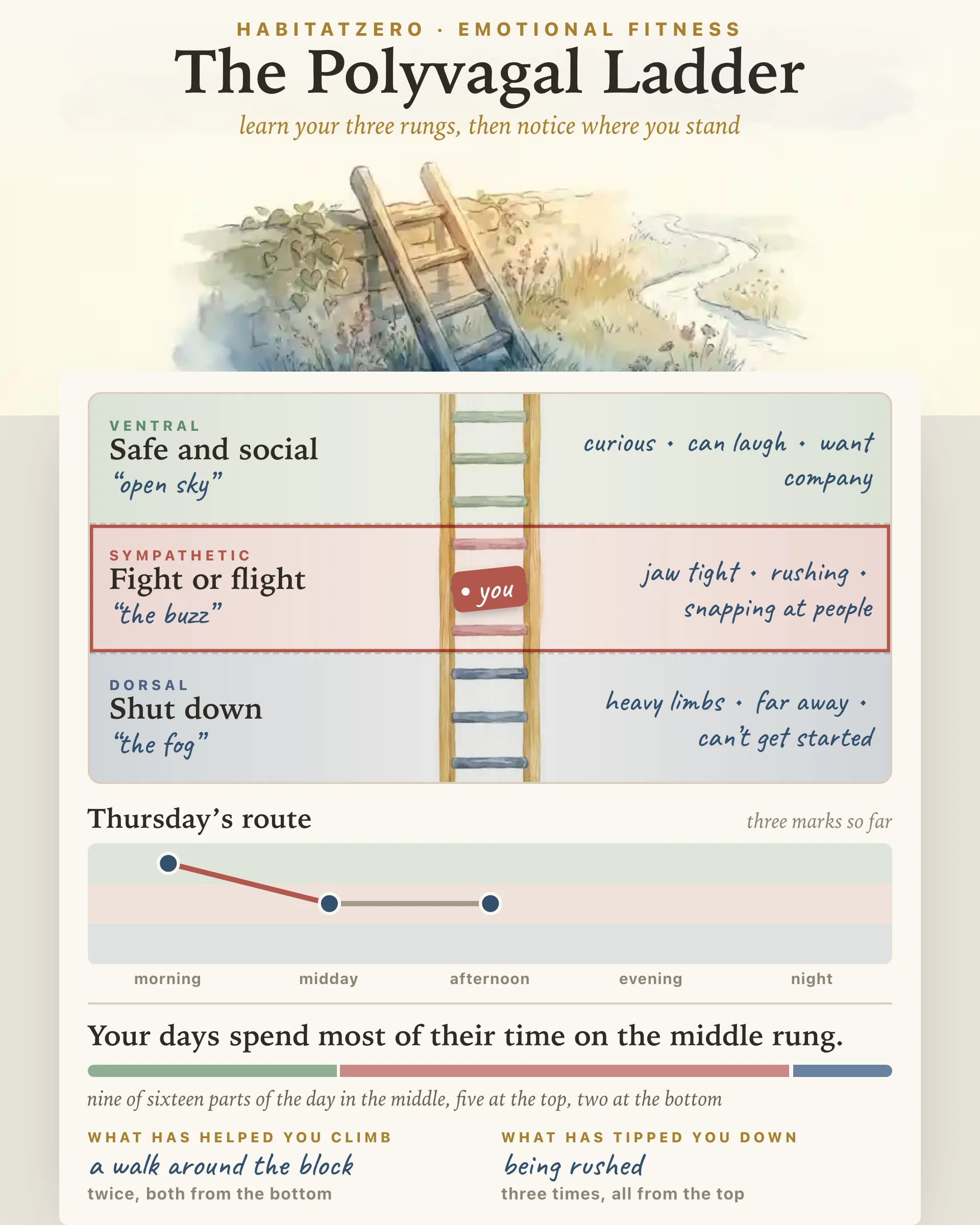
The polyvagal ladder comes from Deb Dana, a clinical social worker known for putting polyvagal theory into words that therapists and clients can use. The theory underneath it belongs to Stephen Porges, a research scientist at Indiana University, who proposed polyvagal theory in 1994 to link the evolution of the mammalian nervous system to social behavior. This page is our own practice sheet built on her picture. Neither she, Porges nor the Polyvagal Institute made it, checked it or vouches for it, and it has no ties to any of them.
Dana invites you to imagine your nervous system as a ladder with three rungs.
At the top is safe and social, the state the theory calls ventral vagal. Faces and voices register, you can see the bigger picture, and reaching out to people feels possible.
The middle rung is fight or flight, the sympathetic state. Something reads as danger, the world narrows, and you scan for trouble, anxious, angry or unable to keep still.
At the bottom is shut down, the dorsal vagal state, which Dana describes as the path of last resort when moving does not help. Energy drains away. People describe it as foggy, heavy, numb and far from everyone, and the story it tells leans toward hopelessness.
The ladder's central idea is about order. Under enough pressure you tend to slide down it, and you climb back the same way. Dana points out that from the bottom the top can look impossibly far off, and that getting there means passing through some of the middle rung's energy. So the first step up from the bottom is often something that brings a little energy back, such as standing up or walking, rather than a push for instant calm.
Build the map first, on a steady day: for each rung, tap or write up to four signs that you are there, in your body, your thoughts or what you do. Dana suggests mapping the middle rung first, then the bottom, and finishing at the top so the exercise ends somewhere settled; the page follows that order. She also encourages renaming the states if the clinical terms feel cold, so each rung has a line for a name of your own.
Two more lists sit beside the rungs. One holds what tips you down, the cues of danger that Dana calls triggers. The other holds what helps you climb, including glimmers, which she describes as small moments of regulation that bring a sense of well-being, like morning light on the table or a friend's voice.
Then you mark. A few times a day, tap the rung you are on. The mark lands on that day's route, and if you have moved since the last one, the page asks what did it and offers your own lists to tap, so nothing needs typing in the moment.
After a few days the marks answer back. The page counts how many parts of your day were spent on each rung, and tallies what has helped you climb, from which rung, and what has tipped you down. When you mark a lower rung, it hands back the helpers that have lifted you from that same rung before, so you are reading your own track record instead of guessing.
The biology is contested. In a 2023 paper, the researcher Paul Grossman argued that each of the theory's five basic premises is either untenable or highly implausible on the available evidence, including the claim that separate ventral and dorsal branches of the vagus each have their own effect on the heart. The Polyvagal Institute, which Porges co-founded, replies that its critics misread the theory, and the debate is still running.
This page takes no side. It uses the ladder as a plain-language way to notice where you are, not as a claim about which nerve is doing what. We know of no trial of a ladder map on its own, so treat it like a careful diary: its value is the pattern it shows in your own days.
Map the rungs when you have room to think. Mark whenever something shifts you, and at a few set times even on quiet days, since those marks also show where your time goes.
If you already use The Window of Tolerance, the territory will feel familiar; that page draws the same swings as a band with two edges, and one picture may simply fit you better. When you are on the middle rung, Somatic Exercises for Anxiety gives your body something plain to do for a minute. Near the bottom, 5-4-3-2-1 Grounding is a gentle way to bring your attention back to the room.
This is a self-awareness practice, not treatment. If most of your marks sit near the bottom, if you lose stretches of time, or if old memories are what pull you down, a trauma-informed therapist can help you work with the map safely, and a filled-in ladder gives that first session somewhere to start.
If you are in crisis or thinking about hurting yourself, call or text 988 (US) right now, or reach your local emergency number.
It is a picture the clinician Deb Dana drew from Stephen Porges's polyvagal theory: three nervous system states stacked like rungs. Safe and social sits at the top, fight or flight in the middle and shut down at the bottom. The idea is that people slide down it under threat and climb back up one rung at a time.
In Deb Dana's work, triggers are cues of danger, from a sharp tone to a crowded room, that pull you down the ladder. Glimmers, as she uses the word, are brief moments of regulation, like sun on your face or a pet leaning against you, that help you climb. This ladder keeps a list of each and counts which ones show up when you move.
On the ladder, the route up from the bottom passes through the middle, so the first step tends to be a little energy rather than instant calm: standing up, a short walk, opening a window, a voice you trust. If you spend long stretches down there, or it comes with hopelessness, a trauma-informed therapist can help.
No, and its biology is openly disputed. Critics such as the researcher Paul Grossman argue that its central claims about the vagus nerve do not fit the evidence, while Porges and the Polyvagal Institute reply that the critics misread the theory. This page treats the ladder as a plain-language way to notice your own states, not as a claim about nerves.
Reading how the ladder works and looking through a filled-in example costs nothing and needs no account. Mapping your own rungs, keeping each day's route and watching the climb tally grow happen in a personal copy, free as well, which opens when you tap Personalize this template.
By the team behind Fabulous, the science-based self-care app used by over 30 million people.