
The Overwhelm Recovery ProtocolWellness & Routines · ~5 min
About this template · Updated November 2026
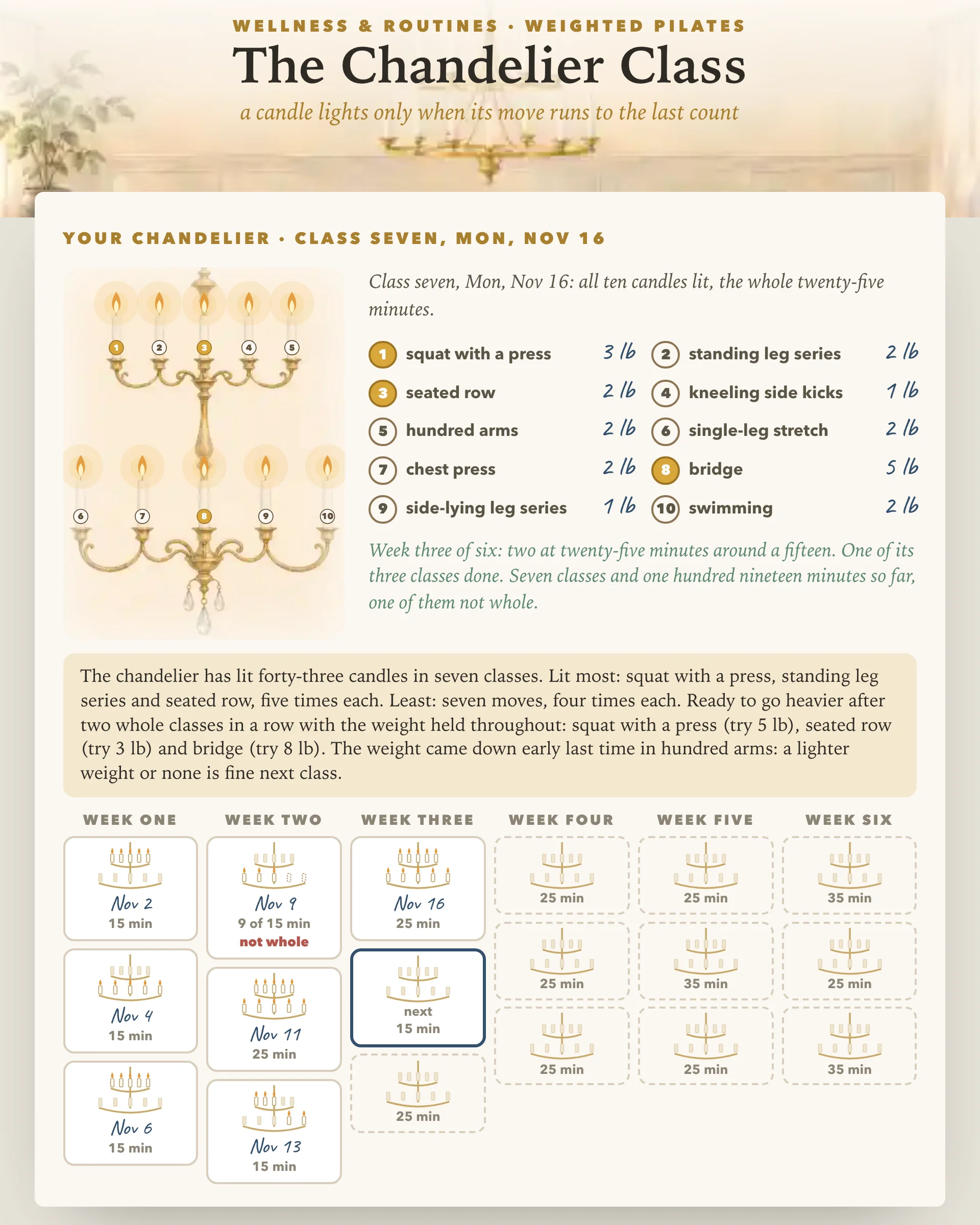
The moves on this page come from the mat work Joseph Pilates developed in the early twentieth century, which he called Contrology; Penelope Latey's The Pilates method: history and philosophy tells how his method traveled from his New York studio to the teachers after him. The Chandelier Class is a separate thing: an independent class builder that no Pilates studio, teacher training school or certifying body wrote, approved or has any tie to.
Pilates with weights keeps the slow, controlled moves and adds a small load: a light dumbbell in each hand, one resting on your hips, or a weight strapped around each ankle. The breathing and the long spine stay; your arms and legs simply carry a little more, rep after rep.
The page is a brass chandelier with two tiers of five candles, one for each move, in class order:
Fifteen minutes runs five moves, the five lit least so far or five you pick. Twenty-five runs all ten, and thirty-five runs all ten with every rep slower. Each two-minute move gives you twelve seconds to get set, then two sets of twelve slow reps with a rest or a side switch between.
A clock keeps real time while it paces each rep and names its half: sit back, then stand and press. A phone that locks partway through still counts true time. A candle lights only when its move runs to its final count; skip it or stop partway and the candle stays dark. A class ended early keeps its whole minutes and nothing more.
Each move keeps its own weight, from none up to the top of light: 5 lb for a pair, 8 lb on the hips, 3 lb at the ankles.
Twelve reps in both sets, the weight held the whole time, is the top of the range. When form slips, tap set the weight down and finish without it. The candle still lights, but that class won't count toward going heavier.
A move earns the next weight after two whole classes in a row at the same weight, never set down. Its number on the chandelier turns gold. Classes with no weight never count, and neither does a class cut short. If the weight came down before the eighth rep last time, the page suggests going lighter instead.
Pilates on its own asks less of your muscles than lifting weights does, and the trials so far fit that. A 2024 review from a Brazilian university pooled twenty-four randomized trials with 1,190 adults over sixty and found no clear gain in muscle strength from Pilates over control groups, and results about level with other exercise. The authors rated much of that evidence low quality and called for better trials.
Strength research points the other way. A 2017 meta-analysis of twenty-one training studies, in which every set went until the muscles could do no more, found that heavier loads built more maximal strength than light ones, while muscle size grew about the same across loads. Those studies pushed every set to failure, which a 2 lb Pilates set rarely does, so they can't tell you how much a light-weight class builds.
That leaves an honest middle. Adding load moves Pilates closer to strength training, and the go-heavier rule keeps it climbing slowly. Trials of Pilates done with dumbbells or ankle weights are hard to find, so nobody can yet say how much the weights add, and this page makes no toning or sculpting promises.
A 2022 UK consensus on exercise for osteoporosis, from clinicians and researchers across physical therapy, medicine and exercise science, recommends muscle-strengthening work two or three days a week, ideally building toward a load you can lift eight to twelve times. It also advises changing or avoiding exercises that curve the back too far forward, especially with an added load, and suggests alternatives to the Pilates roll-down and curl-up. So the head stays down here in the hundred and the single-leg stretch, and no move curls the spine while you hold a weight.
Talk to a doctor or physical therapist before your first class if you have osteoporosis, a recent injury or surgery, back, shoulder, hip or knee pain, or a heart or blood pressure condition. Stop any move that hurts, and never hold your breath.
The Mat Pilates Class Deck deals the classic floor sequence with no equipment. The Pilates Sampler adds classic moves week by week. The Twelve-Wicket Pilates Lawn keeps you on your feet. This page is the one with weights, logged move by move.
Three days a week, a rest day between, for six weeks: fifteen minutes to start, thirty-five by the end. Own one pair of dumbbells? Use it wherever it fits and choose none elsewhere.
Light ones. Most people begin with 1 to 3 lb in each hand and 1 or 2 lb at each ankle. Choose a weight you can move slowly through two sets of twelve without your form going, and step up only once that feels steady two classes running.
It sits somewhere between them. Load pushes Pilates a little toward strength work, but a 2 lb dumbbell seldom makes twelve reps hard, and studies find heavier loads build more maximal strength than light ones. If getting stronger is your main aim, add a strength routine as well.
Often yes, after a talk with your doctor or physical therapist. A UK expert consensus on exercise for osteoporosis advises against rounding the spine forward under a load, so on this page the head stays down and the back stays long, with no curl-ups while holding a weight.
Two or three days a week, with a rest day between, suits most people. The six-week plan here follows three classes a week, growing from fifteen minutes to thirty-five.
No. The moves draw on the mat method Joseph Pilates developed, but this class builder is our own, and no Pilates studio, teacher training school or certifying body wrote or checked it.
By the team behind Fabulous, the science-based self-care app used by over 30 million people.


