
The Overwhelm Recovery ProtocolWellness & Routines · ~5 min
About this template · Updated November 2026
Credit first: Pilates is the method Joseph Hubertus Pilates built in the early twentieth century and called Contrology. While interned in England during the First World War he began hooking springs to hospital bed frames, the seed of the spring equipment Pilates studios use today, as Jonathan Hoffman and C. Philip Gabel recount in their history of Western mind and body exercise. The cable car is our own worksheet. Nobody who carries his name, runs a Pilates studio or certifies teachers made it, checked it or backs it.
A Pilates bar is a light, padded stick with a resistance band fixed near each end. You stand on the bands, kneel on them or hook them around your arches, and the bands push back as you press, row or curl. It is not a ballet barre to hold on to, and nothing here asks you to lean your weight on it.
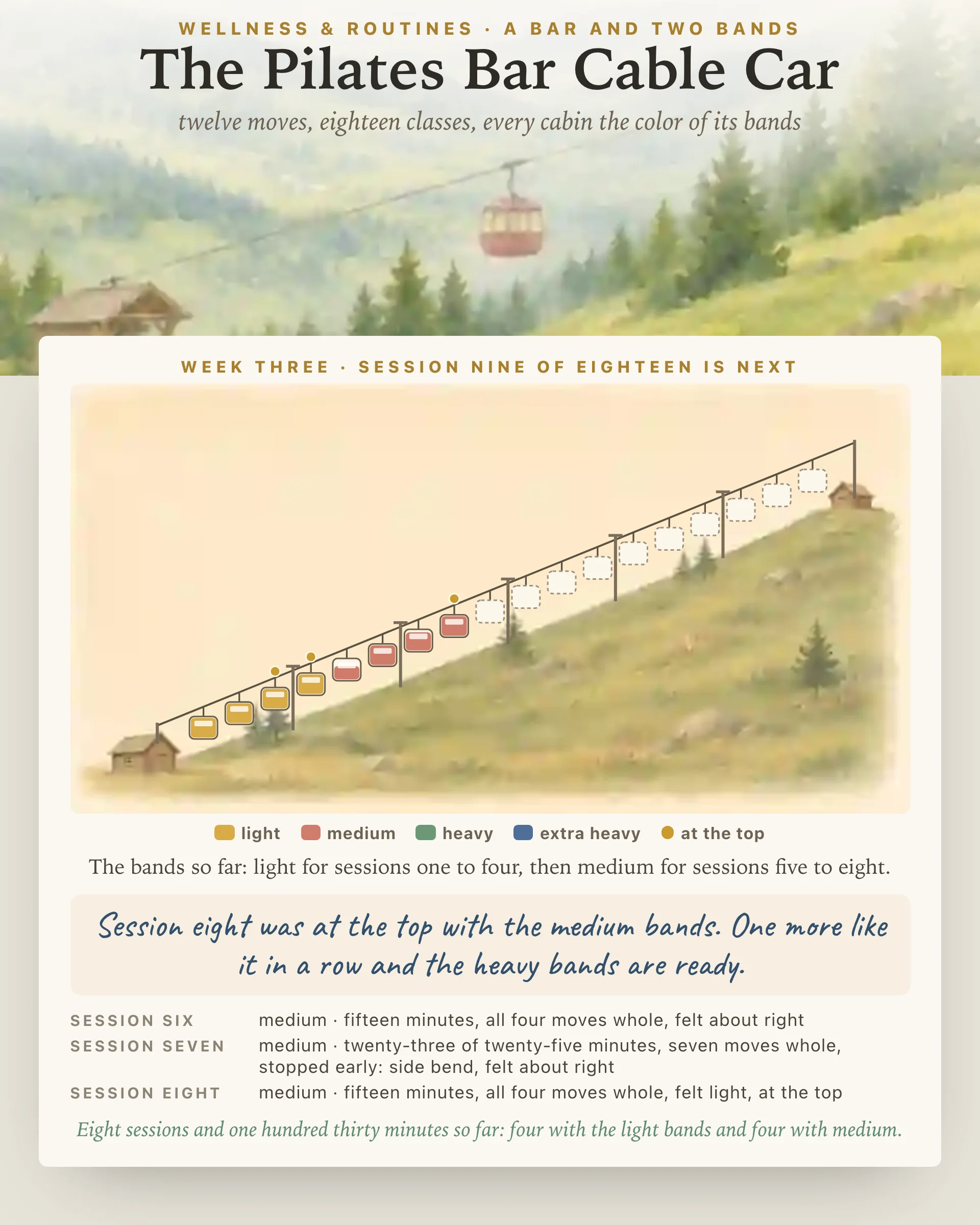
The page is a mountain line of eighteen empty cabins, one per class. You choose today's band strength (light, medium, heavy or extra heavy) and the class length. Fifteen minutes is a warm-up, four moves and a cool-down, two and a half minutes each. Twenty-five holds eight moves, thirty-five all twelve.
The twelve moves come in four groups of three: legs, back and hips, arms and chest, and middle and sides. The page picks an even mix, least-finished moves first, or you tap your own. Every move has an easier version and a band check, such as making sure only the front foot holds the bands in the lunge.
Press begin and the timer takes over. Each move is two and a half minutes: fifteen seconds to get set and check the bands, a minute of slow reps, fifteen seconds to rest or switch sides, and a second minute. It keeps true time even when your phone locks. A move counts as whole only once both minutes have run, and a class you stop early keeps only its whole minutes. When it ends, a cabin goes up the line in the color of your bands, filled partway if you cut the class short.
After each class you say how the bands felt: light enough to do more, about right, or too heavy. Two classes in a row that ran whole, used every move as written and felt light mark the next band as ready, and one tap sets it for next time. A class that felt too heavy points you the other way, even if you stopped early. Over six weeks the cabins show your climb as a change of color.
Three classes a week, a rest day between. Week one is three fifteen-minute classes on light bands. A twenty-five-minute class joins in week two, week four is all twenty-five, and the full thirty-five-minute class arrives in week five. A missed day waits: the next class you do is the next cabin.
We found no trial of the Pilates bar itself in the medical literature. What a bar adds is elastic resistance, and that has been studied. A systematic review of eight trials found that training with elastic bands or tubes built about as much strength in the arms and legs as weight machines and dumbbells did. In a ten-week trial with forty-five sedentary middle-aged women, two sessions a week with elastic bands improved knee push-ups and a sixty-second squat test much as weight machines did. That was a small, short study of healthy women early in their training, and its bands were not mounted on a bar. None of it says a bar class will reshape your arms or thighs.
Bands wear out. A retina practice in San Francisco described eleven patients whose eyes were hurt when an exercise band snapped back between 2013 and 2020. Three of the injured eyes needed surgery, and the authors urged checking equipment for wear. A case series cannot say how common this is, but the guarding habits are simple. Run the bands through your fingers for nicks before every class. Keep each band under the middle of your arch, never near the toes. Never let go of the bar while the bands are stretched.
Talk with a doctor or physical therapist before you begin if you have had a fall, dizzy spells, a joint replacement, osteoporosis, a heart or blood pressure condition, or pain that keeps returning. With weak bones, take the roll-back's easier version, which leans back with a long spine instead of curling.
The Pilates Ring Squeezebox paces squeezes of a soft ring with no bands at all. The Resistance Band Rack counts sets and reps with loose bands and moves each exercise to a stronger band on its own. The Music Box Barre is a ballet-style class at a counter. Here the bar ties both bands together, so the whole class shares one band strength and steps up as a single line.
Open it on a class day with your bar, a mat and a clear wall nearby, and let the cabins keep count while you work.
A class built around a light, padded bar with a resistance band fixed near each end. You stand on the bands, kneel on them or loop them around your arches, and they resist as you press, row or curl the bar.
It can be, if you start light. Take the lightest pair of bands, the fifteen-minute class and the easier versions, and move up a band only after whole classes that leave you feeling you could do more.
No trial has tested the bar itself. Its resistance comes from elastic bands, and a review of eight trials found band training built strength about as well as weights and machines. Nothing shows it reshapes one body part.
Check both bands for nicks before each use, keep each band under the arch of the foot rather than the toes, and never let go of the bar mid-pull. A band that slips off or snaps back can hit your face or eyes.
Three days a week with a rest day between suits most people. This plan runs six weeks, from fifteen-minute classes up to thirty-five, and notes the band strength of every class.
No. It is an independent worksheet of moves taught in Pilates-style bar classes, and no Pilates studio, teacher-training school or keeper of Joseph Pilates' name wrote or approved it.
By the team behind Fabulous, the science-based self-care app used by over 30 million people.


