
The Overwhelm Recovery ProtocolWellness & Routines · ~5 min
About this template · Updated November 2026
Credit first. Pilates is the work of Joseph Hubertus Pilates, a German-born trainer who shaped his method, which he called Contrology, during the First World War and later taught it from a studio in Manhattan. Two independent movement researchers trace that story in a 2015 history of mind and body exercise methods. The chain on this page is an independent routine built from familiar mat moves, and no Pilates studio or teacher-training group made it, reviewed it or endorses it.
Pilates ball exercises use a soft, bendy ball about 9 to 10 inches across, often sold as a Pilates ball, a mini exercise ball or a barre ball. Blown up about two thirds of the way, it gives under your weight instead of rolling off. That softness lets one ball do four different jobs. Under your low back or your head, it holds you up. Between your knees or ankles, it gives your inner thighs something to press. Under one hand in a side plank, it wobbles a little, so your shoulder has to steady you. Against a wall or under your hands, it rolls, guiding the path of a squat or a chest lift.
Pick ten to twenty minutes, in steps of two. Each move takes two minutes, so ten minutes holds five moves and twenty holds ten. Those two minutes are fifteen seconds to get set and a minute and three quarters of slow reps. A move done one side at a time gives each side forty-five seconds, with fifteen seconds in between to switch.
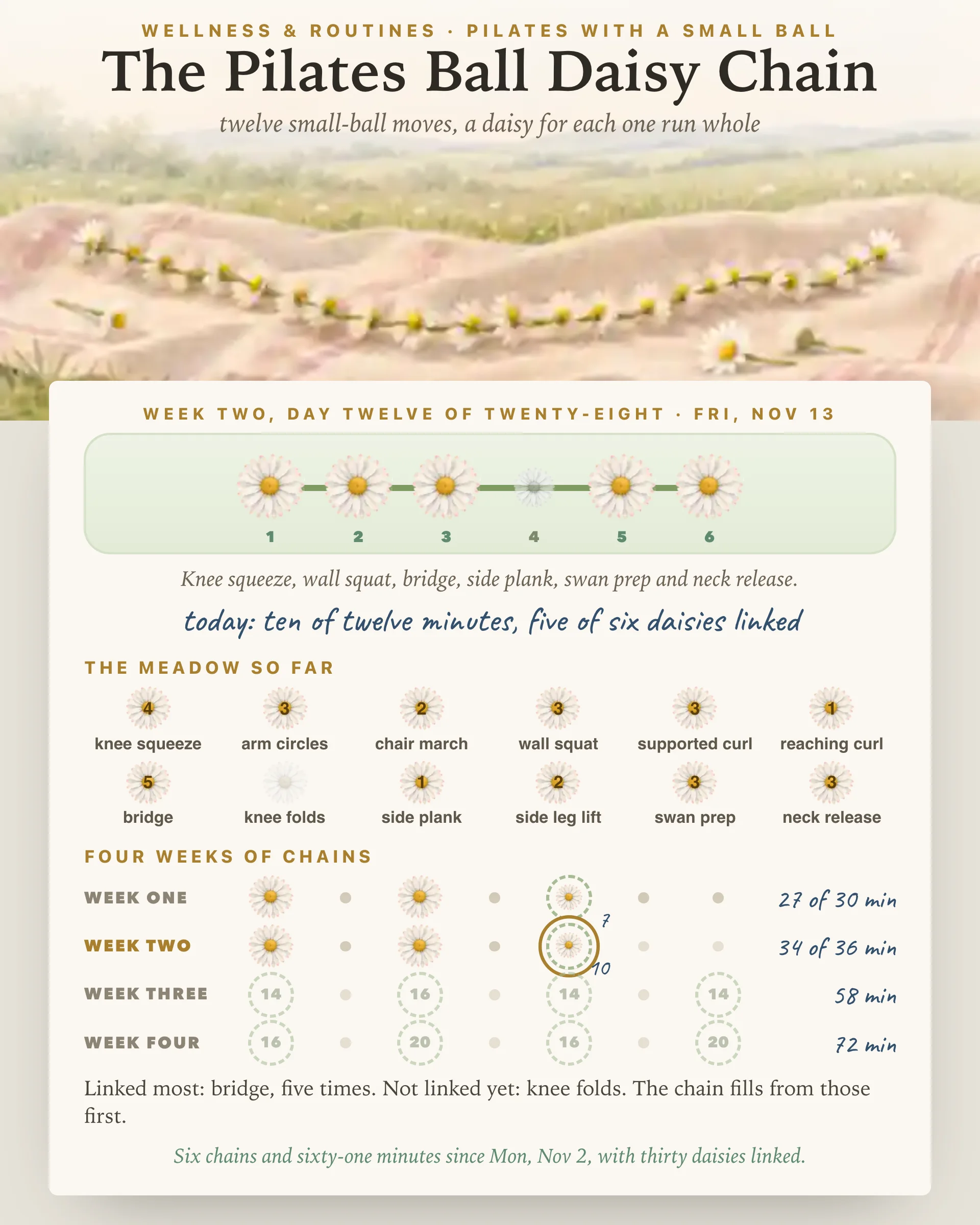
The page fills today's chain for you, starting with the moves you have linked least, and you can tap any move in or out. Each move also has an easier version, such as lifting only your heels in the chair march. Press begin and the timer follows the real clock, so a phone that locks partway through a move still keeps true time.
A daisy joins the chain only when its move has run its whole two minutes. Skip a move and its daisy stays a pale bud, and the seconds you skipped never count. Stop early and you keep the whole minutes you did, rounded down. On the four-week log, each planned day opens into a daisy once its minutes are in.
Weeks one and two ask for three chains a week, ten minutes long and then twelve. Week three adds a fourth day, and week four reaches twenty minutes twice. Rest days sit between sessions.
The Beginner's Pilates Mat teaches the classic mat order with no equipment, one week at a time. The Pilates Ring keeps older adults mostly in a chair or standing behind one, with every move at three levels. This page is about the ball itself: you build each session from twelve moves, and the log shows which ones you keep passing over. If what you own is a large ball you can sit on rather than a small soft one, The Ten-Pin Ball Workout is built around that.
A small lab study from South Korea recorded muscle activity in twenty-eight men in their twenties doing a modified Pilates hundred with no prop, a soft mini ball or a Pilates ring. Their belly muscles worked harder with the ball than with nothing, and harder again with the ring. That was one session of one move in young men, and it measured muscle activity, not strength gained over weeks.
For people with fragile bones, a team writing for Canada's 2021 osteoporosis guideline looked for Pilates trials and found only five studies with 143 participants, nearly all of them women over fifty. Low-certainty evidence pointed to better physical function and quality of life. The effect on falls and bone density was unclear, and none of the studies reported on fractures or harms. No trial has tested this chain, and nothing here promises a flatter stomach, a straighter back or fewer falls.
A 2022 UK consensus on exercise for osteoporosis, written by a panel of physiotherapists, rheumatologists, researchers and a specialist nurse, advises against deep forward bending and suggests alternatives to Pilates moves such as the roll-down and the curl-up. It also recommends exercise that strengthens the back. So when you turn on the bone setting, the supported curl and the curl with a reach hand their places and their two minutes to supported heel slides and supported arm reaches. Lift the bridge in one piece, and keep the neck turns small.
Talk with a doctor or physical therapist before your first chain if you have osteoporosis or low bone density, a past fracture or fall, a joint replacement, dizziness, a heart or blood pressure condition, back or neck pain, or if you are pregnant. Stop any move that hurts, and keep a sturdy chair beside you for the wall squat.
Keep the ball beside your mat and open the chain on the days the plan marks. When the four weeks are done, start a fresh set, and the moves you linked least will lead the way.
A small, soft ball about 9 to 10 inches across, often sold as a Pilates ball, mini exercise ball or barre ball. Blow it up only about two thirds of the way so it squashes a little under your hand. The large ball you sit on is a different tool, and these moves are not built for it.
It holds you up when it sits under your low back or head, gives your inner thighs something to press when it sits between your knees, and adds a little wobble under one hand. In one lab study of young men, a soft mini ball made the belly muscles work harder during a Pilates move than no prop at all.
Many of them, after a word with your doctor or physical therapist. A 2022 UK consensus advises against deep forward bending and suggests alternatives to curl-ups in Pilates, so the bone setting here swaps both curling moves for stand-ins that keep the spine long, in the same place and for the same two minutes.
The four-week plan starts with three ten-minute sessions a week, adds a fourth day in week three, and reaches twenty minutes twice in week four. Rest days fall between the sessions, and a missed day is fine to leave behind.
No. The daisy chain is an independent worksheet built from moves that Pilates classes often use with a small ball, and no Pilates studio, training school or body that certifies teachers wrote or approved it.
By the team behind Fabulous, the science-based self-care app used by over 30 million people.


