Leaves on a StreamEmotional Fitness · ~3 min
About this template · Updated September 2026
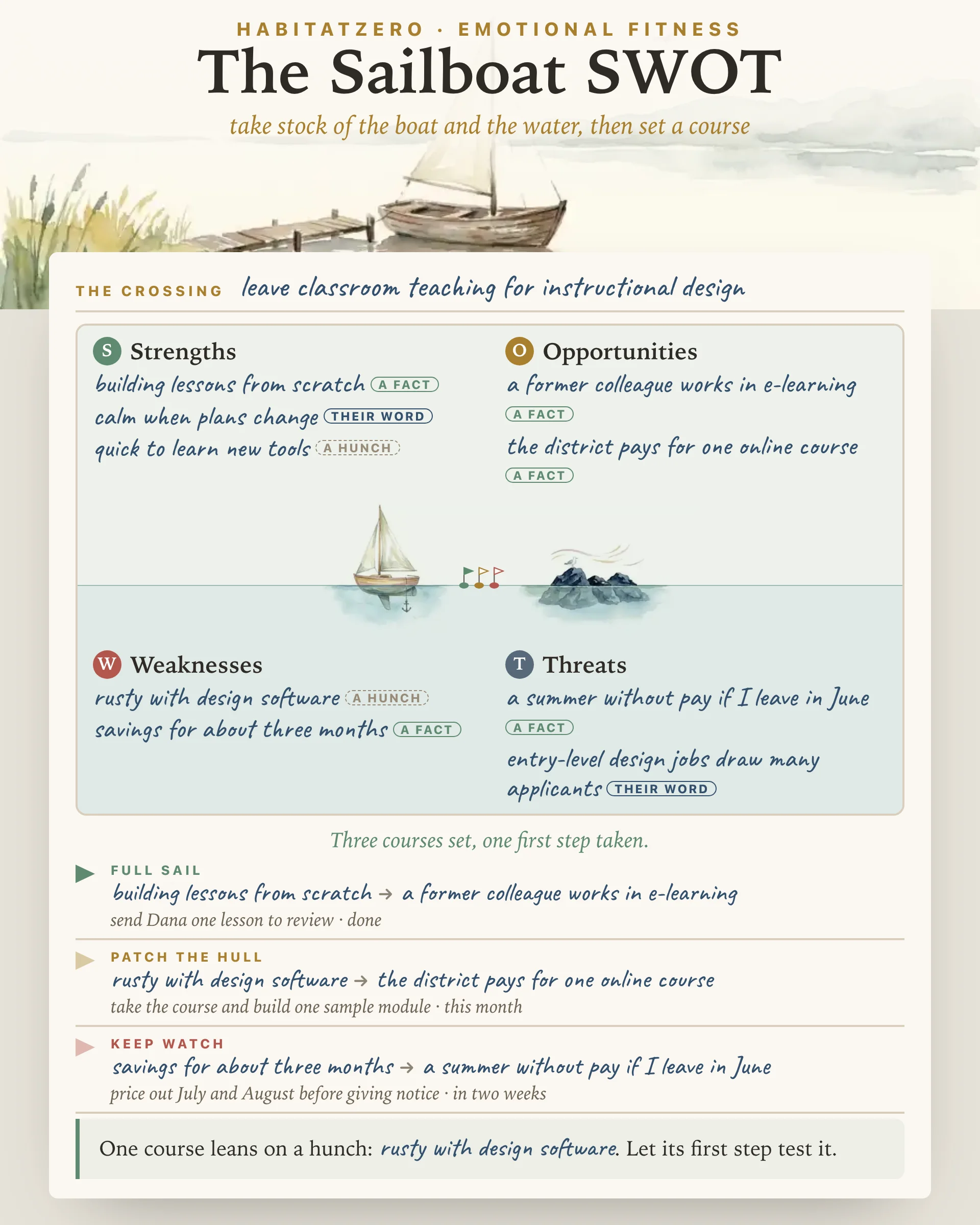
SWOT grew out of corporate planning in the 1960s, and who invented it is still argued over. Some accounts credit a Harvard business policy textbook from 1965. A 2023 archival study by Richard Puyt, Finn Birger Lie and Celeste Wilderom traces it instead to Robert F. Stewart's long-range planning group at the Stanford Research Institute, where managers wrote down the key issues facing their units and graded each one, with evidence, as satisfactory, an opportunity, a fault or a threat. That scheme, SOFT, was later relabeled SWOT. This sailboat is an independent version of the method for one person and one decision, with no tie to either institution.
A personal SWOT has a weakness of its own: you are grading yourself. In a long review of the research, David Dunning, Chip Heath and Jerry Suls found that people's views of their own skill track their actual performance only modestly, and that other people sometimes predict a person's results better than that person does.
So the sheet asks what shows each line is true. Tap the tag beside it. A fact is something you can point to, like a result, a number or a date. Their word is feedback from someone who has watched you work. A hunch is a sense you have not tested yet. Every new line starts as a hunch until you say otherwise, and there is room beside the tag for the few words that show it.
Hunches are not worthless. A hunch about an opening is often where a good plan starts. The tag only keeps you honest about which lines are carrying the weight.
The boat is you. Strengths sit in the sails, the things that move you forward. Weaknesses sit below the waterline, where drag hides. The water is everything outside you: opportunities are the wind, openings you could use, and threats are the rocks, the things that could run the plan aground. That split, inside against outside and helpful against harmful, is the classic SWOT grid turned on its side so the two helpful boxes share the sky.
Each box holds five lines at most. Tap a suggestion or write your own. The sheet turns away a sixth line, and a line that already sits in another box, and tells you why.
A SWOT that stops at four lists is where the method usually stalls. In a much-cited critique, Terry Hill and Roy Westbrook argued that SWOT was due for a product recall: the lists were often drawn up in haste, and nobody used them in the later stages of the strategy. A way forward had already been published by Heinz Weihrich, whose TOWS matrix crosses each inside factor with each outside one to produce four kinds of move.
The chart below the boat does that crossing. Pick one line from the boat and one from the water, and the sheet names the move:
Every course needs a first step small enough to start and a time: this week, in two weeks or this month. Four courses is the limit, because four is about as many as one person can steer at once. Each course you set raises a marker on the water between the boat and the rocks, and its flag fills in when the first step is done.
Underneath, the sheet reads your courses back to you: which ones lean on a hunch, so the first step can double as a test; which strengths are not at work in any course yet; and which rocks have nothing steering around them.
SWOT is a thinking scaffold, not a validated test, and nothing on this page scores you. The research above supports two narrower points. Self-ratings drift from reality, so proof from outside your own head helps. And lists only matter once they turn into action, so the pairing is the part worth your time. Treat each course as an experiment. When a first step is done, come back and check whether the water has changed.
Use it before a decision you keep circling: a job offer, a return to school, a move to a new city, a request for a promotion. If you are not yet sure which part of life needs the change, The Wheel of Life gives the wide view first. If this choice sits inside a bigger plan, The Life Map holds the five-year trail the crossing belongs to. A high school student deciding what to explore can start with The Signpost, then bring what it turns up here as opportunities.
It is the SWOT method from business planning turned on a single person. Strengths and weaknesses describe you, while opportunities and threats describe what is happening around you. It earns its keep when a real choice is on the table, such as a new job, a degree or a move.
Name the decision first, then write a few honest lines in each box. For every line, ask what shows it is true: a result you can point to, feedback from someone who has watched you work, or only a hunch. Finish by pairing lines across the boxes into small actions with a date.
A teacher weighing a move into instructional design might list building lessons from scratch as a strength, having no portfolio as a weakness, a district-paid online course as an opportunity and crowded entry-level postings as a threat. A student choosing a major could pair strong lab work with a paid summer research program. In the teacher's case, pairing the missing portfolio with the paid course turns two lines into one first move.
Heinz Weihrich described it in 1982 as a way to turn a SWOT into strategy. Each inside factor is crossed with each outside one, giving four kinds of move: strengths with opportunities, strengths with threats, weaknesses with opportunities and weaknesses with threats. The chart under the sailboat does that crossing whenever you pair two lines.
No. The sample boat on this page shows every part working, from proof tags to the markers on the water. To chart your own decision and return to its courses later, personalize the template in HabitatZero at no cost.
By the team behind Fabulous, the science-based self-care app used by over 30 million people.