Reading JournalStudy & Learning · ~4 min
About this template · Updated September 2026
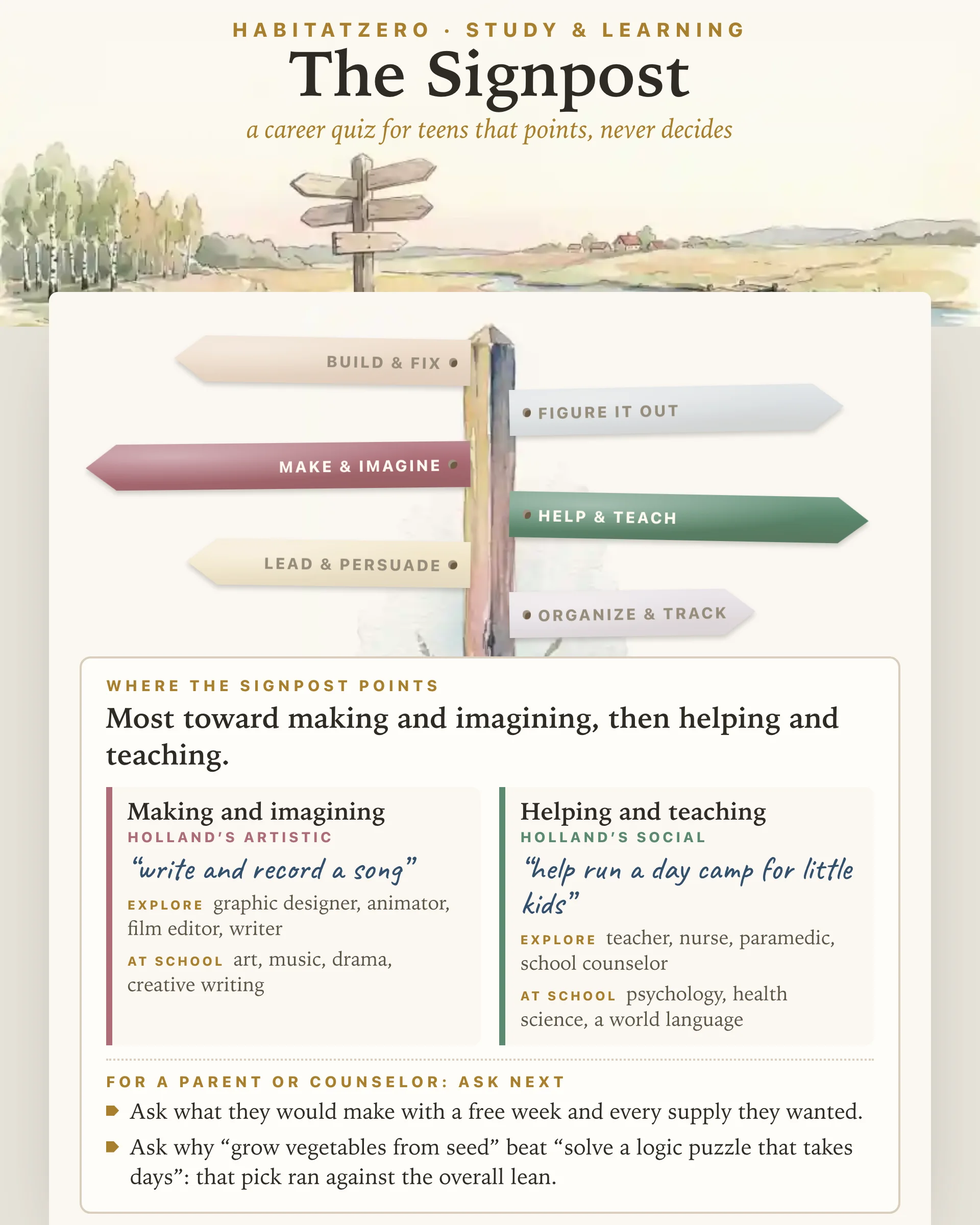
The six interest areas on this page come from John L. Holland, the psychologist who published a theory of vocational choice in 1959 and refined it over the following decades into the six types counselors still teach: realistic, investigative, artistic, social, enterprising and conventional, known together as RIASEC. The Signpost is an independent HabitatZero worksheet built on that public framework. Nobody connected to Holland's work or to the Department of Labor made it, reviewed it or endorses it.
Ask a teenager what they want to be and you usually get a shrug, or the name of the one job they have seen up close. A career quiz gets around that by skipping the destination and asking about Saturday afternoons instead. Would they rather wire the lights for the school play or act in it? Fix a bike or babysit? Small preferences like these add up to something more useful than a job title: a direction.
That is the whole job of this page. It points. It never tells your teen who to be.
Hand the page over. Each of the eighteen forks sets two activities side by side, and your teen taps the one that sounds better. If both appeal, both sound good gives each side half a pick; if neither does, neither, really is an honest answer and the next fork appears.
Every pick lengthens one arm of the painted signpost, one arm per interest area: building and fixing, figuring things out, making and imagining, helping and teaching, leading and persuading, and organizing and keeping track. The forks are balanced so that no area gets a head start. Every pair of areas meets at least once, each area turns up in six forks, and each sits on the left as often as on the right.
When the last fork is answered, the longest two or three arms light up. Each one opens into a card holding the picks that fed it, quoted back in your teen's own choices, plus careers to explore and school subjects to try. The careers are not guesses. Each carries an O*NET interest code that starts with its area, which is how a commercial pilot ends up under organizing and keeping track, and a head chef under leading and persuading.
Below the cards, a small hexagon shows where the top two areas sit in Holland's model. He arranged the six in a ring with the most alike side by side, so neighbors such as making and helping share a great deal, while opposite corners, such as building and helping, are the pairing he saw as least alike. An unusual pairing is not a warning sign. It is often the most interesting thing to ask about.
The reading closes with three questions meant for you rather than your teen: one for each of the top two areas, and one worked out from the answers themselves. That last one finds the pick that ran hardest against the overall lean, such as a teen who leans toward making and helping yet chose growing vegetables over a logic puzzle, and asks what pulled them there. Surprises like that are where the real conversation starts.
Interests deserve to be taken seriously. A meta-analysis spanning more than sixty years of research found that interests are related to performance and persistence at work and in school, and that the fit between a person and their setting predicted performance better than interest scores alone.
A teenager's interests are still moving, though. A review of long-term studies found that the stability of interests barely changes across most of adolescence, then climbs sharply during the college years, from about eighteen to twenty-two. A signpost painted at fifteen is a snapshot, so paint another one next year and set the two side by side.
This page is also not a test. The eighteen forks were written for it and have never been validated, and nothing here measures ability, grades or what your teen would be good at. For a validated next step, the free O*NET Interest Profiler from the US Department of Labor scores the same six areas across thirty questions and links its results to more than nine hundred occupations.
Before course selection, so electives get picked with a direction in mind. Before a meeting with the school counselor, so the conversation starts from something concrete. At the start of summer, when there is finally time to try one thing from a card.
Then shrink the direction until it fits a term. The Semester Goal Worksheet sizes a goal to a single semester, and the SMART Goals Worksheet gives a loose plan, like spending a day shadowing an electrician, a number and a date.
A signpost never walks the road for anyone. It only makes the next step easier to see.
Yes. The O*NET Interest Profiler, sponsored by the US Department of Labor, is free online, asks thirty short questions and links its results to more than nine hundred occupations. It scores the same six Holland interest areas this page uses. The Signpost is lighter on purpose: eighteen quick forks meant to start a conversation, which makes it a good warm-up before the profiler.
Treat any short quiz as a snapshot. These forks were written for this page, have not been validated, and say nothing about ability. Interests also keep moving during the teen years: a large review of long-term studies found that their stability barely changes across most of adolescence, then rises sharply between about eighteen and twenty-two. Retake it next year and compare the two.
They come from the psychologist John Holland: realistic, investigative, artistic, social, enterprising and conventional, often shortened to RIASEC. This page calls them building and fixing, figuring things out, making and imagining, helping and teaching, leading and persuading, and organizing and keeping track, and paints each one as an arm of the signpost.
Start with the questions under the reading rather than the list of careers. They ask about real moments, like something the teen built or a time they talked people into a plan, and one of them points at a pick that ran against the overall lean. Then choose one small experiment for the term: a class, a club, a volunteer shift or a day shadowing someone at work.
It costs nothing. This page shows a finished signpost so you can see how the arms and the reading behave. For a teen to answer the forks, keep the reading and revisit a pick later, open it in HabitatZero, which is free as well.
By the team behind Fabulous, the science-based self-care app used by over 30 million people.