Leaves on a StreamEmotional Fitness · ~3 min
About this template · Updated September 2026
The twenty-four strengths in this page's type case come from the VIA Classification of Character Strengths, the work of psychologists Christopher Peterson and Martin Seligman, published in 2004 as Character Strengths and Virtues: A Handbook and Classification. The VIA Institute on Character, which supported that project, keeps the full list of 24 character strengths and a free survey on its site. This worksheet is an independent reflection tool made by Fabulous: the VIA Institute did not build it, has not reviewed it and has no connection to it, and none of the VIA Survey's questions appear here.
Most strengths lists are adjectives. Organized, patient, creative: the words come easily, and that is the trouble. You can write "brave" without ever having been brave, and a list made that way records what you admire, not what you do.
A moment changes that. "Kindness" is a claim. "Drove my neighbor to her eye appointments all March" is evidence. It happened, it had a when and a where, and nobody can argue you out of it, including you on a bad day. It is also exactly what a job interviewer is fishing for with "tell me about a time".
This page treats each strength as a piece of wood type. Set it in your stick and it holds its place. Give it a moment and it prints in ink. Leave it without one and it prints blind, the way letterpress printers press paper with no ink on the type: the shape is there, but you have to tilt the page to see it.
The case. Twenty-four strengths sit in six drawers, one for each VIA virtue: wisdom, courage, humanity, justice, temperance and transcendence. Tap any block to read what that strength looks like on an ordinary day. A few names mean something other than you might guess. Prudence is planning ahead, not timidity, and judgment is weighing the side you disagree with, not judging people.
The stick. Set up to five into the composing stick and rank them, truest on top. Five is enough to be honest and few enough to remember. The stick refuses a sixth and tells you why.
The moments. Under each strength, write one moment in a few words: when, where, what you did. Two words are enough for the line to print in ink, though more detail will serve you better when you read it back in a month.
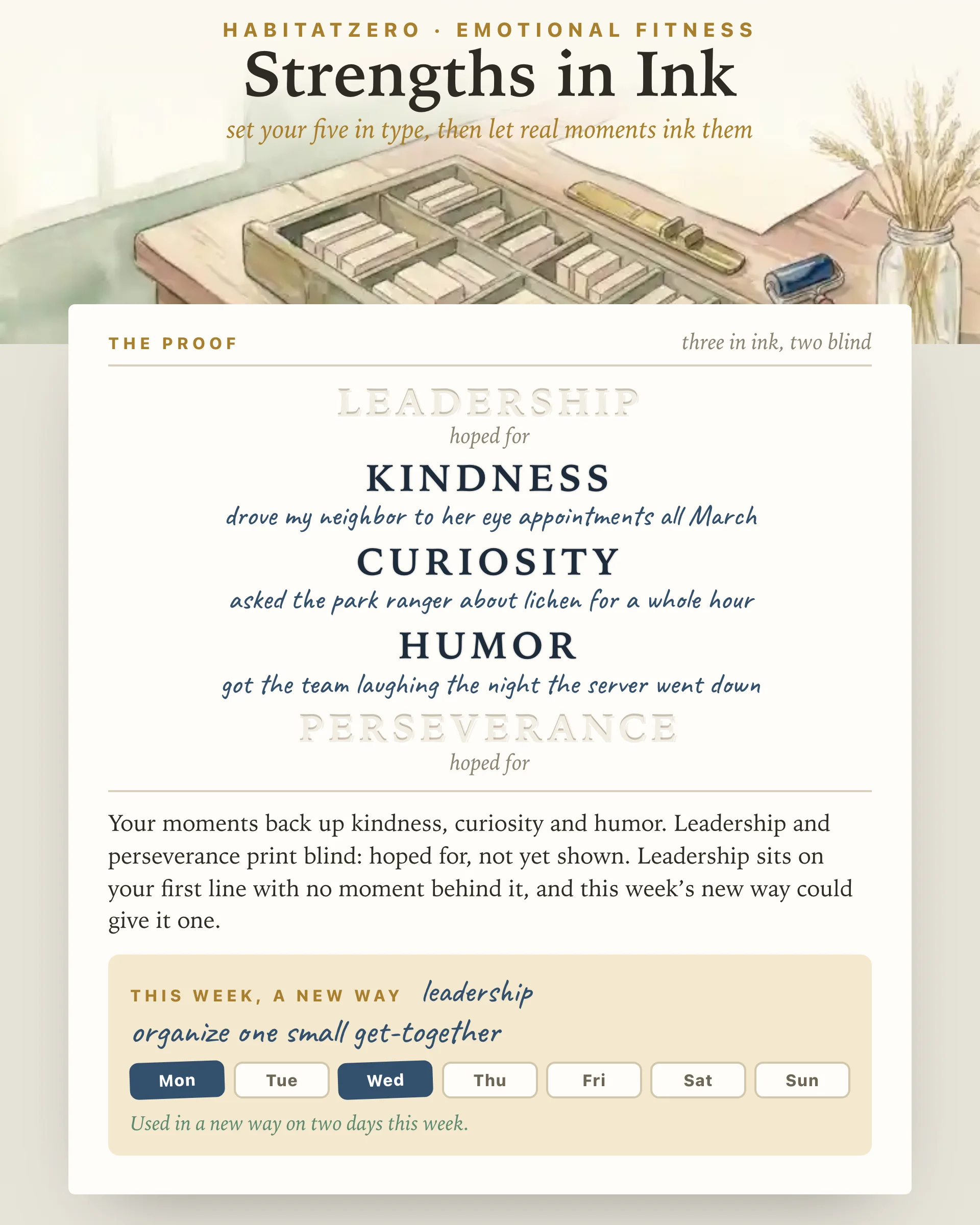
The proof. The proof pulls your five in rank order and reads them back: which ones your moments back up, which print blind as hopes, and whether your first line has anything behind it yet. It is easy to rank the strength you want above the ones you already use, and the proof shows that without a lecture.
This week. Pick one of your five and use it somewhere new, from a short list of ideas or a line of your own, then mark the days you manage it.
The new-way exercise comes from a 2005 online trial by Seligman, Steen, Park and Peterson that compared five short exercises with a placebo. Using one of your top strengths in a new way over one week was among the exercises whose gains in happiness, and drops in depressive symptoms, lasted well beyond the week itself.
Later work adds useful caution. A replication by Mongrain and Anselmo-Matthews found that the exercises raised happiness, but so did a positive placebo designed only to get people thinking about good things about themselves, and the exercises did no better than the control on depression. Part of the benefit, in other words, may come from spending time with true and good information about yourself, which is what writing the moments does.
A trial of 375 adults by Proyer and colleagues compared using your five highest strengths in new ways with using your five lowest. Against a placebo exercise, both raised happiness for up to three months, and people rated them equally rewarding. So if the proof shows a blind line, choosing that strength for the week is a sound move rather than a lesser one: it is how a hope gets its first moment.
None of this makes a strengths list a treatment or a test. It cannot tell you who you are, and it is no substitute for care if your mood has been low for weeks; a doctor or therapist is the right next call there.
Reach for it before a job interview or a performance review, when you want strengths you can back with a story. It fits the start of a new role or a new school year, and the end of a hard stretch that has you forgetting what you are good at. It also works well with a friend beside you, since other people often name moments you would never think to count.
Strengths sit naturally beside values. If you know what you are good at but not what it is for, the Core Values Worksheet is the next page to open. To compare how you see yourself with how others see you, try The Johari Window, and to connect your strengths with work that matters to you, The Ikigai Circles.
It is a short list of the qualities you bring to most situations, such as curiosity, kindness or perseverance. The version worth keeping pairs each one with a real moment, so the list rests on what you have done rather than on words that sound good.
The VIA Classification sorts them under six virtues. Wisdom holds creativity, curiosity, judgment, love of learning and perspective. Courage holds bravery, honesty, perseverance and zest. Humanity holds love, kindness and social intelligence. Justice holds teamwork, fairness and leadership. Temperance holds forgiveness, humility, prudence and self-regulation. Transcendence holds appreciation of beauty and excellence, gratitude, hope, humor and spirituality.
Start from memory instead of adjectives. Recall a week when you felt most like yourself and ask which strength was doing the work. The VIA Institute offers a free survey that ranks all twenty-four; this page lets you test your top picks against moments you can actually name.
For a job interview, two or three strengths, each with a short example ready, and one honest weakness with what you are doing about it. In the VIA view, the strengths at the bottom of your profile are lesser strengths rather than flaws, which makes them a calmer place to look for growth.
Reading the filled example here needs no account. To set your own five, write the moments and keep this week's marks between visits, personalize it in HabitatZero at no cost.
By the team behind Fabulous, the science-based self-care app used by over 30 million people.