Leaves on a StreamEmotional Fitness · ~3 min
About this template · Updated September 2026
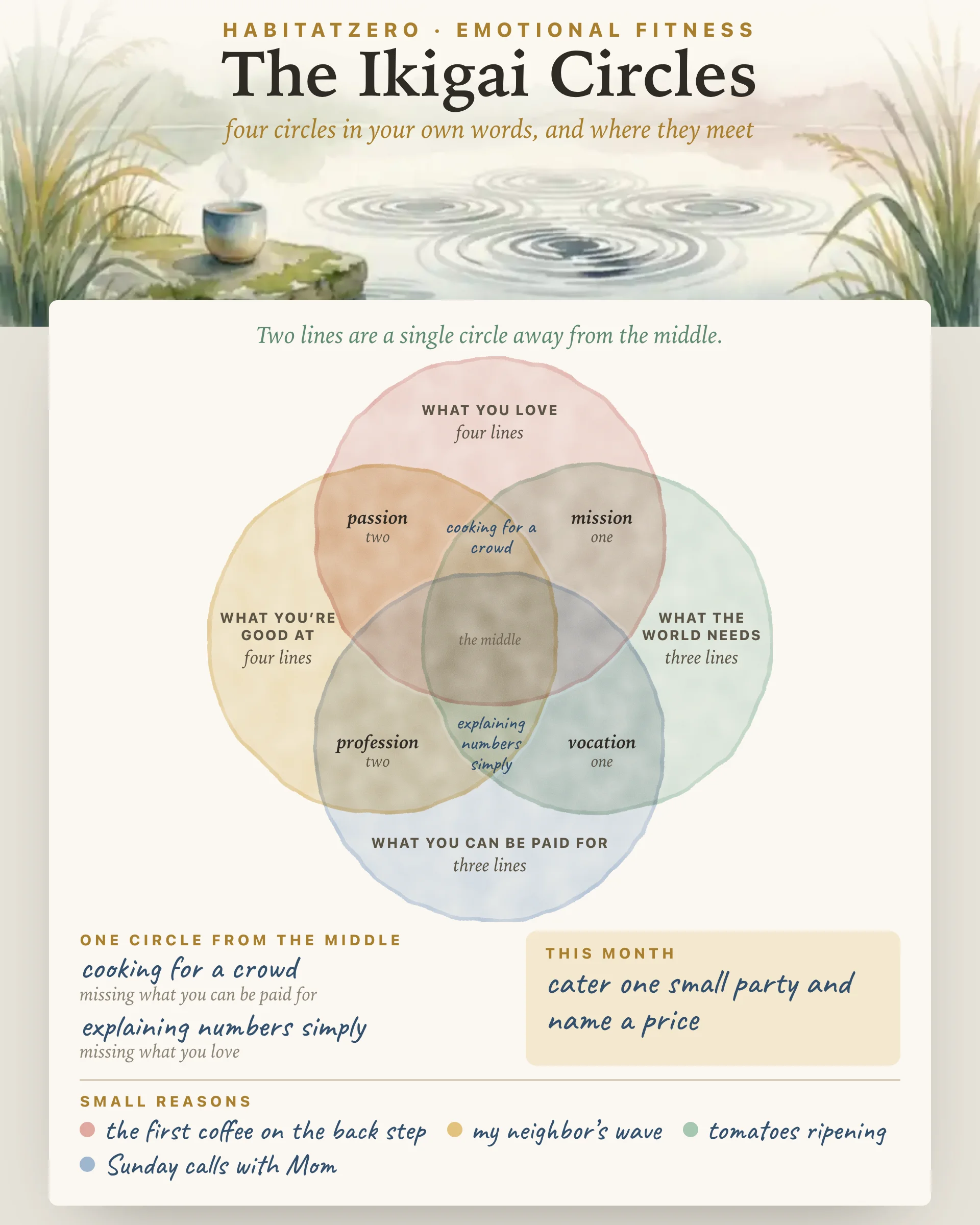
Credit first. The four-circle ikigai diagram joins two older ideas: a Venn diagram of purpose drawn by Andrés Zuzunaga, and the Japanese word ikigai, which Marc Winn wrote into its center in a short blog post in 2014. Winn tells that story himself and asks anyone who uses the picture to link to his page about where the diagram came from. This worksheet was built independently and has no connection to Winn or Zuzunaga; neither of them has reviewed or endorsed it.
Ikigai is usually translated as a reason for living, or whatever makes life feel worth living. Psychiatrist Mieko Kamiya's 1966 book on the subject is still treated as the classic, and she set ikigai apart from happiness in one way: it is what lets you look forward even while the present is hard. That summary comes from Yukari Mitsuhashi's explainer for the BBC, which also reports a 2010 survey of two thousand Japanese men and women in which only about three in ten named work as their ikigai.
So in its home language the word often lives at a small, domestic scale, in the everyday joys that add up to a fuller life rather than in a job title. Winn makes the same point about his own picture. He calls the four circles "a Western purpose diagram wearing a Japanese name," useful and even beautiful, but not the whole of ikigai.
Because they look at your life from four sides at once. Ask what you love, what you are good at, what the people and places around you need, and what someone would pay you for, then check where the answers overlap. That surfaces things a single list hides. Maybe the skill that pays best leaves you flat. Maybe the thing you love most is badly needed and never paid. Neither of those is a verdict. Both are worth seeing clearly.
Open a circle, tap an idea or write a line of your own, then move on to the next. Each circle holds six lines, so whatever goes in has to earn its place. Beside every line sit four colored dots, one for each circle. Tap a dot to say the line belongs there too, and the painted map at the top answers. Each circle's wash deepens as it fills. The four named overlaps that usually come with the diagram (passion, mission, vocation and profession) darken when they hold something. A line that reaches three circles appears in handwriting just beside the middle, on the side away from the circle it lacks, and a line in all four sits in the middle itself.
Below the map, a short reading lists what each overlap holds, names any circle that is still empty, and points to the line nearest the middle. From there you choose one small experiment aimed at the missing circle: ask one person what they would pay for it, take a single lesson, offer an afternoon of it for free. Mark it tried when you have, and write down what you noticed. If it changes your mind, move the dots.
The last section is a short list of small reasons, up to seven everyday things that make a morning worth getting up for. They share the page with the circles on purpose. A life can be full of ikigai in the older sense while the four circles barely touch.
The study quoted most often followed more than 43,000 adults in the Ohsaki cohort in Japan for seven years. Each person answered one plain question: do you have ikigai in your life? People who did not report having it had about one and a half times the risk of dying during the follow-up once other factors were accounted for, mostly from cardiovascular disease and external causes rather than cancer.
Two cautions belong next to that finding. It is an association from an observational study, not proof that ikigai protects anyone. And the question asked about the everyday sense of the word, not about four overlapping circles. The finding says nothing about whether filling in a diagram like this one changes your health. What the worksheet can do is smaller and still worth doing: put your own words where you can see them side by side, then test one of them in real life.
Reach for it at a crossroads: a job change, the end of school, the run-up to retirement, or a season when work feels hollow and you cannot say why. It helps to know what matters to you before you start, and if that part is fuzzy, the Core Values Worksheet is a good first stop. When an experiment works out and you want to turn it into a direction, The Life Map lays out milestones one, three and five years ahead.
Keep the exercise gentle. If the circles leave you feeling that nothing lines up, read your list of small reasons before you judge the week. By the older meaning of the word, that list may already hold the answer.
It is a page that walks you through the popular four-circle ikigai diagram: what you love, what you are good at, what the world needs and what you can be paid for. You write your own lines in each circle and then look at where they overlap. This one adds a place for the small everyday things that make life feel worth living, which is closer to how the word is used in Japan.
The word is Japanese and old, and it means something close to a reason for living. The four circles are much newer. In 2014 Marc Winn wrote ikigai into the middle of a Venn diagram of purpose drawn by Andrés Zuzunaga, and the picture spread from his blog. Treat it as a helpful Western tool with a borrowed Japanese name rather than a traditional Japanese chart.
No quiz can hand you a reason for living. A study that followed more than 43,000 Japanese adults simply asked each one whether they had ikigai in their lives, which measures how life feels to them, not what their purpose is. This worksheet is a mirror rather than a test: it shows your own words back to you and leaves the conclusions with you.
In the four-circle sense, an example is one line that fits several circles at once, such as a bookkeeper who loves cooking for a crowd and gets asked to run the neighborhood potluck. In the everyday sense, examples are smaller and closer to home: coffee on the back step at sunrise, tomatoes ripening in the yard, a weekly call with family.
The filled example on this page is there to explore. Writing your own lines and keeping them happens when you personalize the worksheet in HabitatZero, at no cost.
By the team behind Fabulous, the science-based self-care app used by over 30 million people.