Leaves on a StreamEmotional Fitness · ~3 min
About this template · Updated September 2026
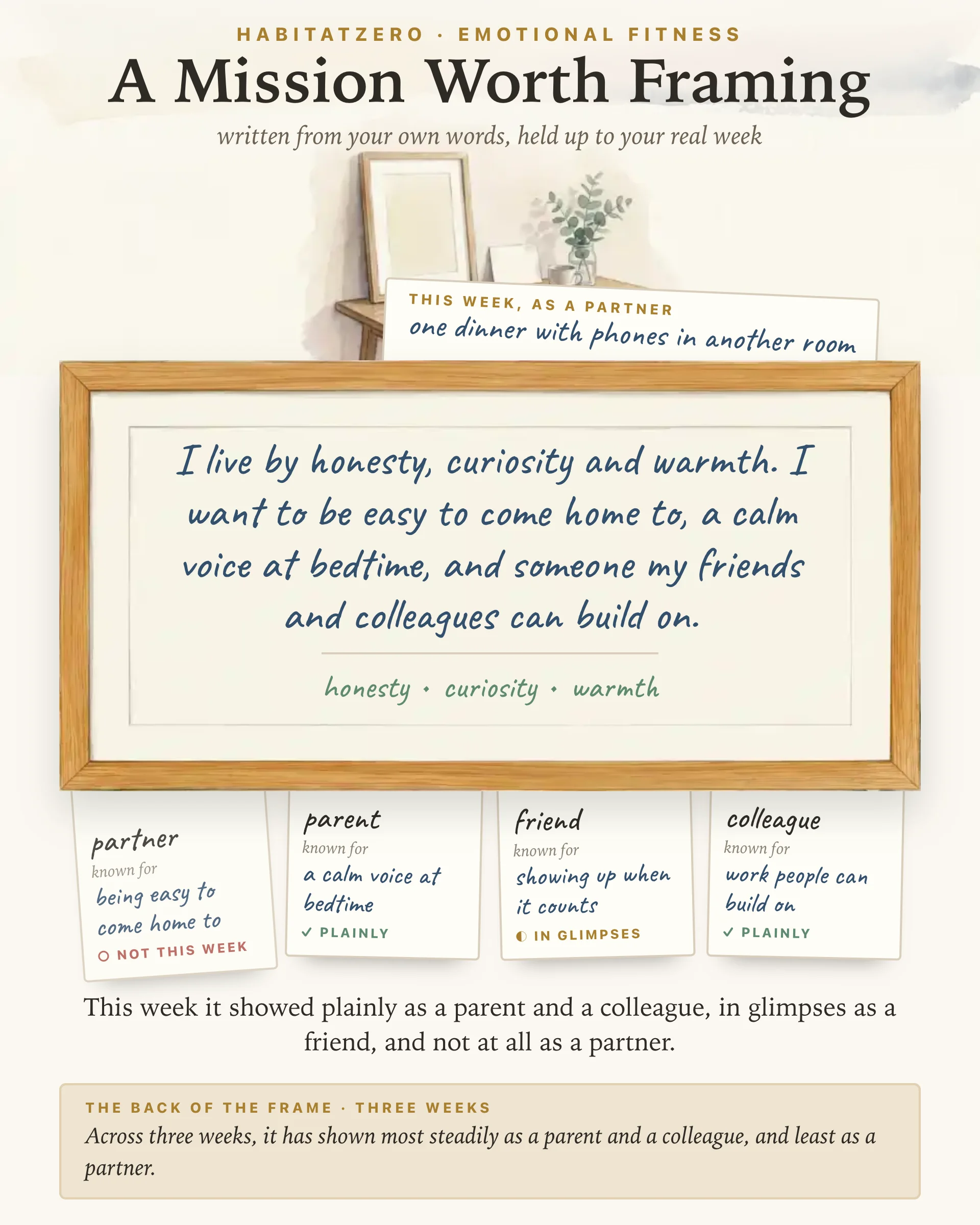
The personal mission statement, as most people meet it, comes from Stephen R. Covey's The 7 Habits of Highly Effective People, first published in 1989. His second habit, Begin With the End in Mind, asks you to decide who you want to be before a crowded calendar decides for you, and FranklinCovey's own page on that habit likens writing a mission statement to drafting a personal constitution. His third habit adds a weekly look at your roles and goals. This page builds on both ideas in its own way. It is an independent worksheet: FranklinCovey has not reviewed or endorsed it, and the two have no affiliation.
Most first drafts come out as a string of admirable adjectives: honest, kind, driven. They are true enough, and they could belong to anyone. Covey's way past that is a thought experiment: picture your own funeral with four speakers, one from your family, one friend, one from your work and one from your community, and ask what you would want each of them to say.
This page keeps the question and leaves the funeral out. You tuck a card into the frame for each person you show up for, up to five, and finish one line on each: known for. The answers come back far more specific than any adjective. Being easy to come home to. A calm voice at bedtime. Work people can build on. Those phrases are the raw material of your statement, already in your voice.
Under the people sit up to three values, since one sentence can carry three and still be remembered.
Then comes the desk. Write one or two sentences, tapping in your own words where they fit; the ones already used fade. If the blank page stops you, the rough-draft button strings your values and known-for lines into a first attempt that is meant to sound a little clumsy, so you have something to push against. Redraft until it sounds like you, then frame it. Earlier drafts stay below the frame, crossed out, so you can watch the statement find its words.
The part a printed template cannot do comes at the end of a week. Hold the statement up to the days you actually had and mark each card: plainly, in glimpses, or not this week. The page reads the week back in one sentence, lets the quietest card slip in the frame, and offers small changes for that person, with room to write your own. The one you choose is tucked into the corner of the frame. Write the week on the back and the cards reset for the next one; once two weeks are there, the back shows which people the statement reaches most steadily and which it tends to miss.
Each of these could only have come out of one particular life. Borrow a shape if it helps, but keep the words your own.
No trial has tested personal mission statements as such, so be wary of anyone promising measured results. The evidence is about the ingredients.
Writing about the person you hope to become seems to do some good. In a study of eighty-one undergraduates, those who wrote about their best possible future self for twenty minutes on four days running reported higher well-being three weeks later, and found it far less upsetting than writing about a trauma.
Your own words matter too. Goals that fit a person's developing interests and core values draw more sustained effort and bring more well-being when they are reached, which argues for building the statement from your phrases rather than a borrowed slogan.
And writing the week down is not busywork. A meta-analysis of well over a hundred experiments, with close to twenty thousand participants, found that prompting people to monitor their progress helped them reach their goals, more so when the progress was physically recorded.
This is a reflective exercise, not therapy, and a week that falls short of the frame is information about the week, not a verdict on you.
Write the statement on a slow morning or at a turning point: a new job, a move, a birthday with a zero in it. Hold it up every Sunday evening while the days are fresh. If you are unsure which values belong underneath, the Core Values Worksheet makes the harder cut first. For a value-by-value look at where one week went, The Integrity Gap sets what you say matters beside what the week showed. Once the statement feels settled, The Life Map turns it into milestones at one, three and five years.
It is one or two sentences, in your own words, about who you mean to be and what your days should add up to. Stephen R. Covey made the idea popular in The 7 Habits of Highly Effective People, and FranklinCovey describes it as something like a personal constitution you can check choices against.
Begin with the people rather than with virtues. Name the handful of people you show up for, write what you would want each of them to know you for, and pick two or three values to sit underneath. Then draft a sentence or two from those exact phrases. If the blank page stalls you, the rough-draft button strings your own lines together as a starting point, and redrafting does the rest.
Three in different voices. I live by honesty, curiosity and warmth, and I want to be easy to come home to. I teach patiently, fix what I break and leave each team a little kinder than I found it. My life is for making room: at my table, in my calendar and in how I listen. Borrow the shape if it helps, but keep your own words, because a statement only steers you when it sounds like you.
Short enough to say from memory on a busy morning. This template holds two sentences at most and about forty words, since a statement you can recite gets used, while a full page of principles tends to end up in a folder.
You can explore the filled-in example here without signing up. To build your own frame and keep the drafts and the weeks written on its back, personalize it in HabitatZero, which costs nothing.
By the team behind Fabulous, the science-based self-care app used by over 30 million people.