Leaves on a StreamEmotional Fitness · ~3 min
About this template · Updated September 2026
A personal manifesto is a single page of short declarations about how you mean to live. Not a résumé of your virtues, just plain sentences you could read aloud to a friend without flinching. Most people who try to write one stall on the first line, because "what do I believe?" is too big a question to answer cold.
This page makes the question smaller. You name a few values first, then set one short line at a time on top of them, the way a printer once set a broadside by hand: a line, then another, then a look at the whole sheet before anything is signed.
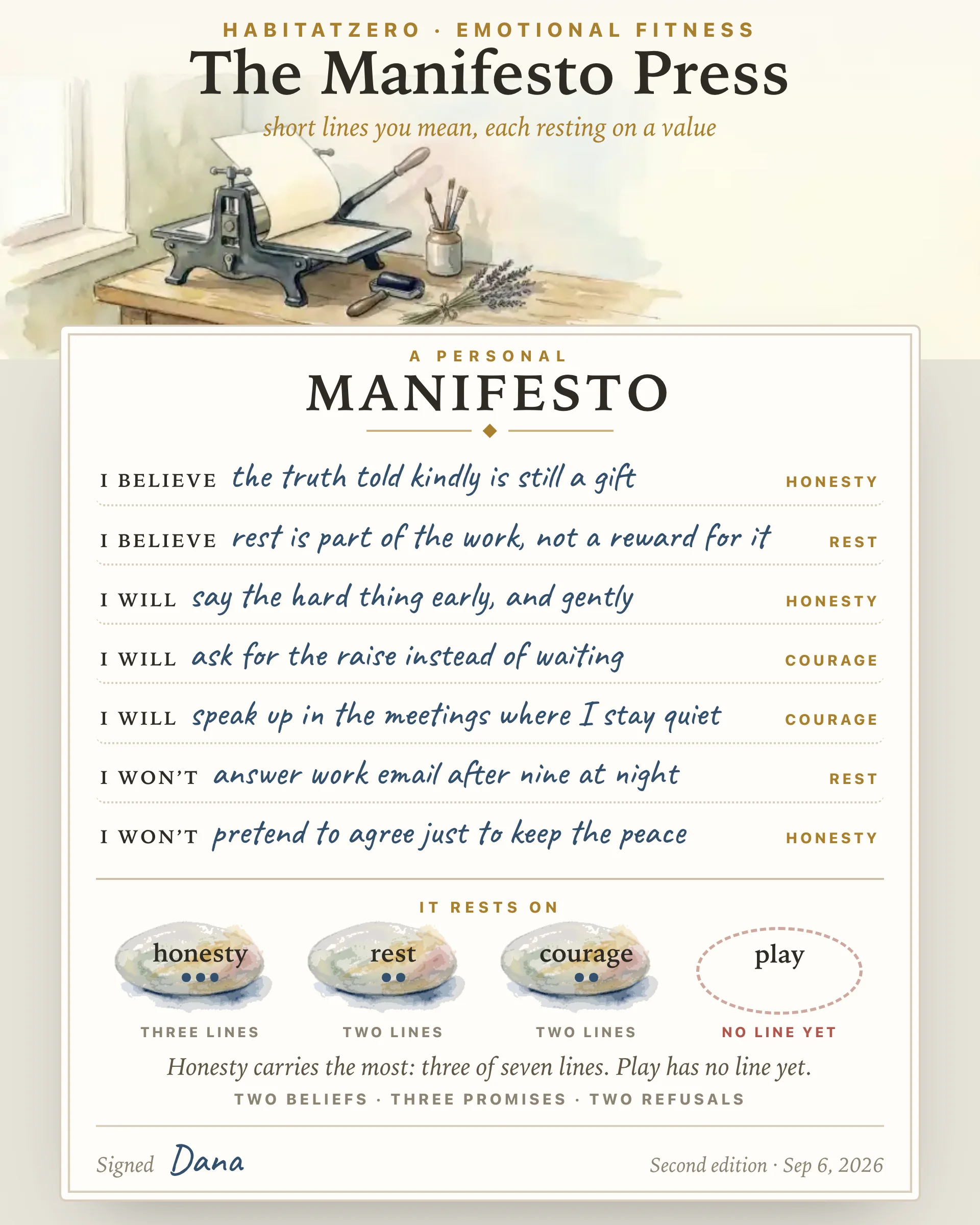
Every line opens with one of three stems, printed for you, and you write the rest.
The mix matters more than it looks. Beliefs alone read like a poster in a waiting room, and promises alone read like a to-do list. Refusals give a manifesto its spine, because they name what you will give up to keep the rest, and they are the lines most drafts leave out.
Begin where the sheet says it rests on: tap up to five values or type your own, even one only you would name, like being the steady one. Each becomes a stone in the foundation.
Then use the tray below the sheet. Pick how the line opens and which value it rests on, then write the rest yourself or start from a suggested line for that value and make it yours. If nothing comes, the tray asks a question drawn from experience, such as what your hardest year taught you that you want to keep.
Tap any line to move it, send it back to the tray to rework its words, opening or value, or take it off the sheet with two taps. The sheet holds twelve lines at most. Wanting a thirteenth means letting one go, which is the point: a manifesto you can't read in one breath stops being read at all.
As lines go on, the foundation fills. Each stone shows how many lines stand on its value, and a sentence underneath says which value carries the most and which still has nothing on it. A value with no line keeps only a dashed outline where its stone should be.
That outline is the most useful thing on the page. It usually means the value matters to you in theory but hasn't reached your actual week, or that it isn't really yours and can go. Either answer is worth knowing. A tally counts your beliefs, promises and refusals too, so a sheet that is all conviction and no commitment shows itself at a glance.
No study has tested personal manifestos, so it is worth being plain about what this page borrows. The closest work is on self-affirmation, where people spend a few minutes writing about a value that matters to them. Geoffrey Cohen and David Sherman's review describes those short exercises improving outcomes in education, health and relationships, sometimes for months. A meta-analysis of 144 experiments with health messages found the effects on accepting advice, on intentions and on behavior were real but small. Those were brief exercises done at a chosen moment, and none of them asked anyone to hang a page on the wall.
The refusals have a thinner thread behind them. In a set of four studies, people who framed a refusal as a choice, I don't, rather than a rule, I can't, were better at resisting temptation. An I won't line is written in that spirit. Treat both findings as good reasons to try the exercise, not as promises about what a sheet of paper can do.
Specific beats grand. I will call my brother on Sundays survives a busy month; I will value family doesn't. Use your own words, since a line you could have found on a mug is one you will skim past. Read the sheet aloud once, and rework any line that makes you wince.
When every line reads true, sign it, and the date goes on as the first edition. Change a line or a value later and the signature comes off until you sign again, which makes it the second edition.
Set it at a turning point: a new job, the end of a hard season, the week before a decision you keep circling. Reread it when the season changes, and rework whatever no longer sounds like you.
If you aren't sure yet which values belong under the sheet, sort them out first with the Core Values Worksheet or The Values Card Sort. If what you want is one sentence of purpose rather than a page of lines, A Mission Worth Framing is built for that.
It is a one-page declaration of how you mean to live, written as short plain statements in your own voice. Most mix what you believe with what you will do and what you refuse to do, and the whole thing can be read aloud in about a minute.
Begin with a few values rather than with slogans. For each value, write one line you could act on this month, and make sure some lines are refusals, since those tend to say the most. Then read the page aloud and cut every line that sounds borrowed.
Lines people tend to keep look like these: I believe rest is part of the work, not a reward for it. I will say the hard thing early, and gently. I won't answer work email after nine at night. Good ones are specific enough that a friend could guess whose sheet it is.
Close, but not quite. Credo is Latin for I believe, so a credo lists convictions. A manifesto usually adds promises and refusals to those convictions, which is why this sheet keeps all three kinds of line side by side.
The sample sheet on this page is free to look through with no account. Setting your own lines, signing editions and coming back to rework them happens in HabitatZero, which costs nothing to use.
By the team behind Fabulous, the science-based self-care app used by over 30 million people.